
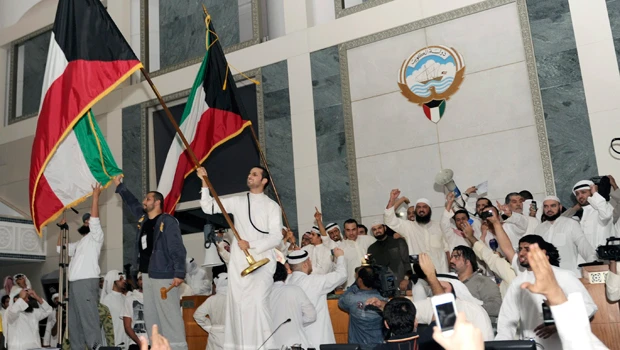
- KUWAIT CITY: Kuwait’s ruler ordered authorities Thursday to tighten security measures in the Gulf nation and conduct possible arrests after parliament was stormed by an anti-government mob angered by high-level corruption allegations.
The steps by the emir, Sheik Sabah Al Ahmed Al Sabah, underscore the deepening political tensions in the longtime Western ally, which could host thousands more American forces under a Pentagon-drafted plan to boost troop strength in the Gulf after the US withdraws from Iraq.
The rifts in oil-rich Kuwait began years before the Arab Spring protests, but opposition factions could be further emboldened by the push for reforms around the region. Critics of Kuwait’s ruling family claim it turns a blind eye to allegations of widespread corruption and uses security forces to crush dissenting voices.
Dozens of protesters surged over police barricades Wednesday and briefly entered the parliament chamber amid attempts by opposition lawmakers to bring the prime minister for questioning over claims that government officials transferred state funds to accounts outside the country. Kuwait’s key affairs are run by the ruling family, but it has one of the region’s most politically active parliaments.
Government spokesman Ali Fahad Al-Rashid, speaking after an emergency government meeting, quoted the emir as denouncing the parliament protest as threatening the country’s “security and stability” and calling for “stricter measures to confront this chaotic behavior.”
Al-Rashid said the Interior Ministry and other security forces were ordered to take “all necessary measures to combat any actions that might beset the country’s security.” The steps could include legal action against the protesters who entered parliament and possible crackdowns on opposition media for “any instigation,” according to the official Kuwait News Agency.
The Interior Ministry said five members of the security services were injured during the scuffles in parliament. The ministry did not elaborate, and there was no word on whether protesters were injured or detained.
Opposition parliament members have sought to question Prime Minister Sheik Nasser Al Mohammad Al Sabah over the money transfer allegations. Last month, Kuwait’s foreign minister resigned as the scandal grew.
On Wednesday, pro-government lawmakers managed to vote down a request for the questioning, but opposition groups filed another motion to force another debate later this month.
Kuwait also has been hit by a wave of strikes that grounded the state airline and threatened to disrupt oil shipments.
The tiny Gulf nation has not been hit by major pro-reform demonstrations inspired by Arab uprisings, but Kuwait stands out in the region because of its hardball political atmosphere. Kuwait’s parliament has the most powers of any elected body in the Gulf, and opposition lawmakers openly criticize the ruling family.
In January, the emir ordered 1,000 dinar ($3,559) grants and free food coupons for every Kuwaiti.
Kuwaitis are used to a cradle-to-grave social security system that has increasingly become a burden on the government.