
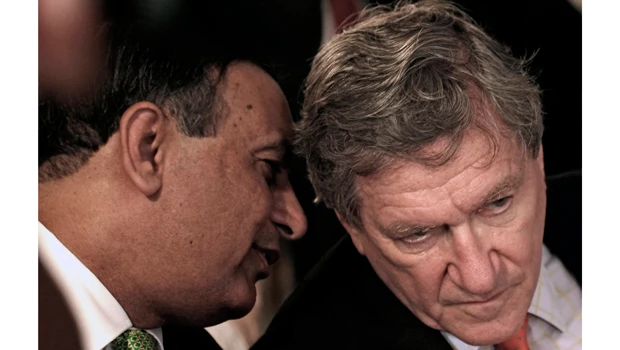
- ISLAMABAD: Pakistan’s Ambassador to US Hussain Haqqani tendered his resignation early Thursday morning.
Haqqani was summoned by President Asif Ali Zardari to Islamabad over allegations an unnamed Pakistani diplomat passed on a message from the president to the US asking for help after the killing of Osama Bin Laden in Pakistan. Army Chief Gen. Pervez Kayani told Zardari at a meeting Tuesday that army was not in favor of Haqqani holding such an important position after credible evidence that Haqqani was involved in “anti-army activities.”
Haqqani has also been accused of issuing countless visas to Blackwater personnel and to Raymond Davis, who was involved in the killing of two youths in Lahore.
The president, after receiving serious complaints against Haqqani had summoned him to Islamabad, but instead of returning, Haqqani sent his resignation to President Zardari.
The Pakistani government said Thursday it had not decided whether to accept the ambassador’s resignation.
The government has summoned Haqqani to Islamabad to question him about any role he may have played in the growing controversy, which was first disclosed in an Oct. 10 column in the Financial Times, said Farhatullah Babar, president’s spokesman.
Mansoor Ijaz, a US citizen of Pakistani origin, said in the column that a senior Pakistani diplomat asked him on May 9 — a week after US commandos killed Bin Laden in a Pakistani garrison town — to pass a message from President Asif Ali Zardari to the US asking for help. Ijaz did not name the diplomat.
Zardari was reportedly worried that the US raid had so humiliated his government, which did not know about it beforehand, that the military may stage a coup — something that has happened repeatedly in Pakistan's history, said Ijaz.
The memo sent to Adm. Mike Mullen, the top US military officer at the time, reportedly offered to curb support to militants from Pakistan's military intelligence service, the ISI, in exchange for American assistance, Ijaz said.
The Pakistani Foreign Ministry has called the Financial Times column "a total fabrication."
But Mullen's spokesman, Capt. John Kirby, confirmed to Foreign Policy's website Wednesday that Mullen did receive the memo from Ijaz, but he did not find it credible and ignored it.
Haqqani said Thursday that he did not write or deliver the memo, but offered his resignation to end the controversy.
"I do not want this non-issue of an insignificant memo written by a private individual and not considered credible by its lone recipient to undermine democracy," Haqqani told The Associated Press.
Haqqani is expected to travel to Islamabad in the next few days so that the government can determine who should be blamed for the incident, Babar said.

