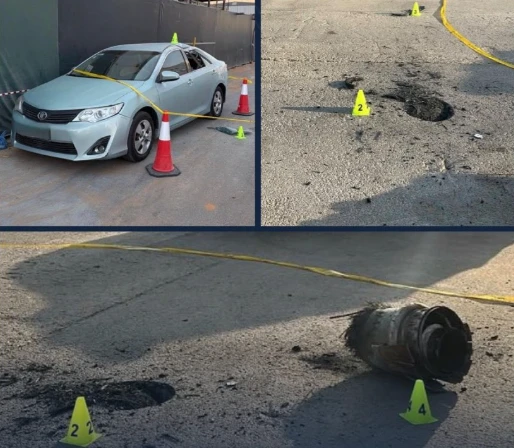
- Today, I have read a report about the one who shot at a Saher vehicle, burned it and shot dead the employee who was on duty at the time.
- It was really a vicious criminal act.
The resolution adopted by Saher is quite reasonable and it is a successful step that won the absolute support from the Ministry of Interior whether some people like it or not. The resolution undertaken by Saher has enabled the organization to resist critics and some social negative views.
Since the system of Saher came into existence, it was believed that the system was beset with difficulties. The first is indecisiveness and the second is reliance on others for feedbacks. I have emotionally been moved by the deadly scene that encouraged me to write this article, which I want to begin by expressing thanks and appreciation to the traffic police for application of this system, which has led to a remarkable decline of traffic accidents and accordingly a decline of deaths and injuries. Such achievements could be considered a brilliant success and a noble objective that should be appreciated. On the other hand, one could say that even the implementation has partially succeeded so far. The system in itself is considered a major step in the traffic and safety history of the Kingdom of Saudi Arabia and by far a distinguished one that reflects a positive achievement and encourages the community to respond and react.
There is a serious question that came to my mind while preparing to write this article, which is whether the ultimate target could justify the means when the system was introduced. Trying to find an answer to this question, the following points were taken into consideration:
1.The system was implemented nationwide directly during the first year and no experimental regions were selected randomly. So the outcome of the first year should be reviewed rationally to see what has gone wrong, why so many negative aspects resulted from the implementation, why criticism and resentments among the drivers have gone too far and some even resorted to murder, why the concerned bodies did not take the initiative to deal with the problems arising out of it rather than waiting for others to do so?
2.To apply any program worldwide, it is necessary to identify the ultimate target of such initiatives, procedural and practical steps of implementation and designing methods for the continuation of such projects. The question now is what is the objective behind the implementation of Saher? Let us believe that the objective is the limitation of traffic accidents and eventually deaths as many people think, but then another question comes to my mind: What kind of procedure is needed to realize such achievements bearing in mind that fees are the only punishment introduced so far.
3. The confinement to just this penalty has in fact sent a negative message to the public, that this system is introduced by money collectors only and that it is not aimed at traffic safety. It was not clear whether those who designed the project have consulted specialists in psychology, Shariah, etc.
4. There are three steps necessary for fixing people's behavior — education, training and application. The implementation procedure also involves a number of basic elements including punishment, awards, motivation and awareness drives.
Regarding the case of Saher, it has been noticed that all starting phases were in fact relegated to the last phase, which is the implementation. There was no public awareness drive organized. The second phase concerning training was also skipped and the community was subjected to uneasy experiences without trying and evaluating the new system.
Meanwhile, and unfortunately, the implementation mechanism of the system in terms of quality and quantity has proved the theory of money collection by hunting for erring drivers to fall into the trap of punishment. The question arising at this point is whether the collection of large sums of money is the main objective rather than spreading safety traffic culture and community awareness. Such awareness usually comes gradually but the situation of Saher now looks like a war situation. The system's personnel are hiding here and there, changing locations just to swoop down on violators.
Point five: Does the designated penalty really match the crime committed? Was the citizen aware of or prepared in advance of such punishments, which should not be imposed before being understood. Did the Saher launch an awareness campaign at schools, mosques, universities, marketplaces, streets and other gathering places or through the media before the implementation of the system? We need an educated and civilized community that knows and understands regulations first before being driven forcefully to punishment and paying money that might cost one-fourth of one's salary.
The following notes were numbered for reason of constructive criticism only and they contain some proposals that I believe would help in reinforcing the system for more success and acceptance:
1. As a matter of fact, and from scientific and practical stand points, any new system needs an experimental implementation plan that could be studied and assessed carefully, pinpointing negativity and making proposals for addressing negative aspects before going ahead with plans for full application of that system.
2. Introducing diversified methods to fix the negative behavior of vehicle drivers would really enhance the effectiveness of the system and before imposing penalty, there could by motivation and rewarding techniques like exempting a violator who does not repeat the same violation for a period of one month or many months. A competition between regions could be started for being the best in terms of least traffic violations and accidents. Saher personnel should not be encouraged to look for violators, penalty fees should be abolished right away and those who pay on time should be encouraged by paying only half of the original sum.
3. The posted speed on various streets and highways need to be checked and reconsidered by technical means to match with the prevailing traffic safety regulations, giving some flexibility to the drivers. Punishment means and violation fees should also be reconsidered. Imposing penalties only are not acceptable, as not all people have enough money to pay, so alternative means of punishment should be found.
4. Design of roads should be reconsidered and a lasting solution found for underage drivers. Vehicle inspection and maintenance should be an ongoing procedure and not only at the sales point, because safety and maintenance aspects are critical for the implementation of the system.
5. Methods of education and traffic safety culture should involve well-defined information and communication methods for spreading awareness and measuring progress.
6. Like others, I have noticed the increasing importance of education programs for families in a bid to inculcate traffic culture.
"The positive education that groups the above mentioned aspects and other programs are aimed at creating a positive individual. Teaching of such material could start at the middle school level along with other educational, training, information programs besides providing a competitive climate among students, families and drivers and reward them with prizes. Positive cooperation and coordination between Traffic Police and the Ministry of Education should be developed.
7. Fields of punishment should be diversified and not only restricted to money. A system of violation points should be introduced and linked with the driving license record. When the number of points reaches 12, the license could be revoked and when such revocation is repeated, then a fine should be imposed and the driver sent for a driving rehabilitating program or for doing some voluntary work. The license may be suspended and insurance coverage made higher to prevent further violations. I propose also making violation circles like green, yellow and red circles as a deterrent means.
8. Resistance and defiance of some drivers to the system should be studied carefully even if such people understand the positive aspects achieved by the system. Such opponents do not believe that the objective justifies the means. Protests and resentments start with talking and writing, and eventually develop into aggressive acts and criminal behavior. Saher authorities need to know why only their personnel and properties are being subjected to attacks and not of those belonging to municipal and water departments.
In conclusion, let me highlight the importance of this system and call for its continuation after a reasonable assessment of positives and negatives. Let us hope for outstanding traffic programs and let us praise the great efforts being made by traffic personnel despite challenging situations. May the Almighty bless them.