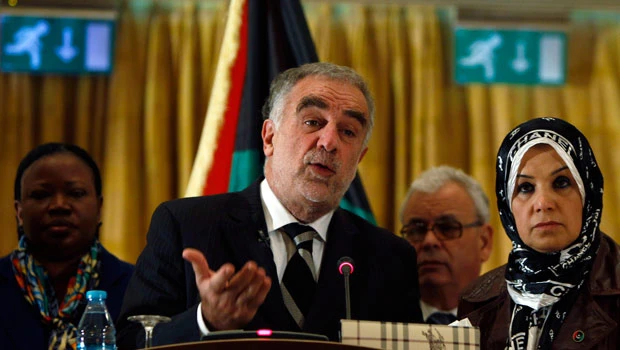
- TRIPOLI, Libya: The International Criminal Court’s (ICC) prosecutor says Muammar Qaddafi’s son Seif Al-Islam, who is being held by revolutionary fighters, will be tried in a Libyan court by Libyan judges.
The prosecutor, Luis Moreno-Ocampo, conceded on Tuesday that the Libyans have the authority to try Seif Al-Islam at home but he wants judges from the Netherlands-based court to be involved.
Moreno-Ocampo says the ICC will help Libya establish the judicial framework for the trial, which many expect to be a bellwether of the new Libyan government’s ability to uphold the rule of law.
Seif Al-Islam, once the face of reform in Libya and the leader of his father’s effort to shake off pariah status, is charged with crimes against humanity by the ICC for the crackdown on an uprising that began in February and grew into a civil war.
“Seif is captured so we are here to ensure cooperation,” Moreno-Ocampo told reporters after arriving in Libya. “If they (Libyans) prosecute the case, we will discuss with them how to inform the judges, and they can do it, but our judges have to be involved.”
The ICC has also charged ex-intelligence chief Abdullah Al-Senussi with crimes against humanity for the brutal crackdown on an uprising that began in February. Muammar Qaddafi also was charged, but the case has been terminated following his death.
Libyan Justice Minister Mohammed Al-Alagi said Wednesday that he can’t confirm reports that Al-Senussi is in custody.
Moreno-Ocampo also said he believed the former intelligence chief Abdullah Al-Senussi had not been captured.
Officials from Libya’s National Transitional Council (NTC) said on Sunday that Senussi, who is also Qaddafi’s brother-in-law, had been captured the day after Qaddafi’s son Seif Al-Islam was caught. He is believed to be held in a secret location in the southern city of Sabha.
Libya’s prime minister-designate, Abdurrahim El-Keib, later cast doubt on the reports, and the NTC has since neither confirmed nor denied Senussi’s capture, though a military commander has stood by his report of the arrest.
“I understand he (Senussi) has not been arrested,” Moreno-Ocampo said.
El-Keib, meanwhile, announced the formation of a transitional government that will lead the oil-rich country until parliamentary elections are held by the end of June.
El-Keib told a news conference in Tripoli that his focus was on forming a government that would represent all of Libya.
“Our country went through tough times, so my first priority is to provide a dignified life to our Libyan people,” he said. “And my second — and just as important — is security.”
After toppling Qaddafi’s regime in August, Libya’s new leaders are still struggling to solidify their control over the fractured nation and to begin building state institutions that were nonexistent or weak under Qaddafi’s 42-year rule.
Among the most important steps is establishing a court system.
The International Committee of the Red Cross visited Seif Al-Islam in Zintan, where he is being held, on Tuesday and said he appeared to be in good health. Steven Anderson, a spokesman for the Geneva-based body, said the visit “took place in accordance with the ICRC’s customary working procedures” and all further findings would remain confidential.
Rights groups have called on Libya to hand both men over for trial in The Hague, and Moreno-Ocampo stressed that even if Libyans want to try the two men in Libya they must still cooperate with the world’s first permanent war crimes tribunal.
The French government said Monday that it, too, was seeking Al-Senussi, who was one of six Libyans convicted in absentia and sentenced to life in prison in France for the 1989 bombing of a French passenger jet over Niger that killed all 170 people on board.
Libya is obliged by a Security Council resolution to work with the court, but that does not necessarily preclude a trial in Libya. If Libya’s National Transitional Council can convince judges in The Hague that the country has a functioning legal system that will give Seif Al-Islam and Al-Senussi a fair trial on substantially the same charges as Moreno-Ocampo filed, then the ICC could declare Moreno-Ocampo’s case inadmissible and turn it over to Libya.
“The International Criminal Court acts when the national system cannot do it,” Moreno-Ocampo said. “That’s why we are here, to understand what they are doing.”
In a statement before his arrival, Moreno-Ocampo called the arrest of Seif Al-Islam and Al-Senussi “a crucial step in bringing to justice those most responsible for crimes committed in Libya.”
In new video footage taken the day of his capture and obtained by The Associated Press, Seif Al-Islam warns his captors that Libya’s regions, which united to oust Qaddafi, will turn against one another “in a couple of months or maximum one year,” suggesting the country will descend into infighting.
There have been signs in recent months of growing tensions among Libya’s powerful regions, and even after Qaddafi’s fall in August and after his capture and killing in October, the country’s numerous and sometimes competing revolutionary factions have refused to disarm, raising fears of new violence and instability.
In the video, revolutionary fighters stand around Seif Al-Islam, who is seated in a green chair. Three of his fingers are heavily bandaged, and he occasionally winces from the pain.
In another video briefly posted by his captors on YouTube, he said the injury to his hand — which raised speculation he might have been abused — was from a NATO air strike a month ago. But it was impossible to know if he was speaking truthfully or under duress.
El-Keib’s announcement of his Cabinet showed Libya’s new leaders were so far sticking to a timeline for their nation’s transition that they set out after declaring liberation on Oct. 23. Most of the names were relatively unknown.
The formation of the Cabinet clears the way for the next key step on that timeline: the election of a 200-member national congress by the end of June.
“The first task is to form the government’s opinions, its goals and its plans,” El-Keib said. “So each minister will put forth a plan to implement this.”
Asked about accusations that some deputy ministers might have been lower-level figures in Qaddafi’s regime who are guilty of corruption, El-Keib said anyone found guilty would be removed from government.