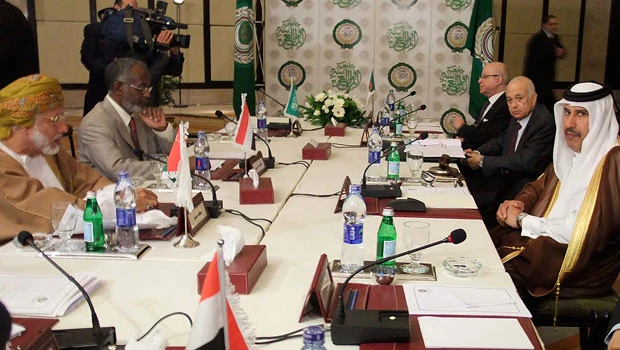
- CAIRO: The Arab League has given Syria a day to sign a protocol allowing monitors into the country or the regional body will press ahead with plans to impose economic sanctions, Egypt's envoy to the League said Thursday.
The sanctions could include a suspension of commercial flights to Syria and a halt to dealings with its central bank, the envoy, Afifi Abdel Wahab, told reporters in Cairo.
"Tomorrow is the deadline for Syria to sign. If they don't sign, the economic and social council (of ministers) will meet on Saturday to discuss economic sanctions," he said.
Iraq's foreign minister said Damascus had accepted the Arab League plan to send monitors to Syria. But there was no immediate confirmation from Syria.
France said Thursday it will seek Arab support for a humanitarian corridor in Syria, the first time a major power pushed for international intervention in the eight-month uprising against President Bashar Assad.
Foreign Minister Alain Juppe, who first floated the proposal for humanitarian intervention on Wednesday, gave more details of the plan and said he would propose it to the meeting of Arab League foreign ministers.
Juppe said international monitors should be sent to protect civilians, with or without Assad's permission. He insisted the proposal fell short of a military intervention, but acknowledged that humanitarian convoys would need armed protection.
"There are two possible ways: That the international community, Arab League and the United Nations can get the regime to allow these humanitarian corridors," he told French radio on Thursday. "But if that isn't the case we'd have to look at other solutions ... with international observers,"
Asked if humanitarian convoys would need military protection, he said: "Of course ... by international observers, but there is no question of military intervention in Syria."
He added that he had spoken to partners at the United Nations and US Secretary of State Hilary Clinton and would speak to the Arab League. On Wednesday Juppe also embraced the exiled opposition Syrian National Council as a legitimate group that France sought to work with.