- ISLAMABAD: The Pakistani government has demanded the US vacate an air base within 15 days that the CIA is suspected of using for unmanned drones.
The government issued the demand Saturday after NATO helicopters and jet fighters attacked two Pakistan army posts along the Afghan border, killing 28 Pakistani soldiers.
Islamabad outlined the demand in a statement it sent to reporters following an emergency defense committee meeting chaired by Prime Minister Yousuf Raza Gilani.
Shamsi Air Base is located in southwestern Balochistan province. The US is suspected of using the facility in the past to launch armed drones and observation aircraft to keep pressure on Taleban and Al-Qaeda militants in Pakistan’s tribal region.
Saturday’s raid plunged the US-Pakistan relations, already deeply frayed, further into crisis.
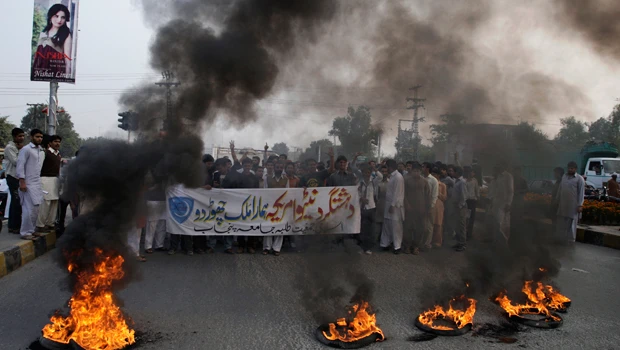
Pakistan retaliated by shutting down vital NATO supply routes into Afghanistan, used for sending in almost half of the alliance’s non-lethal materiel.
The attack is the worst single incident of its kind since Pakistan uneasily allied itself with Washington in the days immediately following the Sept. 11, 2001 attacks on US targets.
Relations between the United States and Pakistan, its ally in the war on militancy, have been strained following the killing of Al-Qaeda leader Osama Bin Laden by US special forces in a raid in Abbottabad in May, which Pakistan called a flagrant violation of sovereignty.
The Pakistani government and military brimmed with fury.
“This is an attack on Pakistan’s sovereignty,” said Gilani. “We will not let any harm come to Pakistan’s sovereignty and solidarity.”
The Foreign Office said it would take up the matter “in the strongest terms” with NATO and the United States.
The powerful Chief of Army Staff Gen. Ashfaq Pervez Kayani said that “all necessary steps be under taken for an effective response to this irresponsible act.
“A strong protest has been launched with NATO/ISAF in which it has been demanded that strong and urgent action be taken against those responsible for this aggression.”
The commander of NATO-led forces in Afghanistan, Gen. John R. Allen, said he had offered his condolences to the family of any Pakistani soldiers who “may have been killed or injured” during an “incident” on the border.
A spokesman for the force declined further comment on the nature of the “incident” and said an investigation was proceeding. It was not yet clear, he said, whether there had been deaths or injuries.
The US Embassy in Islamabad also offered condolences. “I regret the loss of life of any Pakistani servicemen, and pledge that the United States will work closely with Pakistan to investigate this incident,” Ambassador Cameron Munter said.
Two military officials said that up to 28 troops had been killed and 11 wounded in the attack on the outposts, about 2.5 km from the Afghan border. The Pakistani military said 24 troops were killed and 13 wounded.
NATO supply trucks and fuel tankers bound for Afghanistan were stopped at Jamrud town in the Khyber tribal region near Peshawar hours after the raid, officials said.
“We have halted the supplies and some 40 tankers and trucks have been returned from the check post in Jamrud,” Mutahir Zeb, a government official, told Reuters.
Another official said the supplies had been stopped for security reasons.
“There is possibility of attacks on NATO supplies passing through the volatile Khyber tribal region, therefore we sent them back toward Peshawar to remain safe,” he said.
The border crossing at Chaman in Balochistan was also closed, Frontier Corps officials said.
The United States has long suspected Pakistan of continuing to secretly support Taleban militant groups to secure influence in Afghanistan after most NATO troops leave in 2014. Saturday’s incident will give Pakistan the argument that NATO is now attacking it directly.
“I think we should go to the United Nations Security Council against this,” said retired Brig. Mahmood Shah, former chief of security in the tribal areas. “So far, Pakistan is being blamed for all that is happening in Afghanistan, and Pakistan’s point of view has not been shown in the international media.”
Other analysts, including Rustam Shah Mohmand, a former ambassador to Afghanistan, said Pakistan would protest and close the supply lines for some time, but that ultimately “things will get back to normal.”
Paul Beaver, a British security analyst, said relations were so bad that this incident might have no noticeable impact.
“I’m not sure US-Pakistan relations could sink much lower than they are now,” he said.