- Saudi participation at Abu Dhabi Art 2011
Fahad Al-Gethami launched himself onto the local art scene in 2004, having participated in an exhibition at the historic palace of Shubra Al-Taif. The lack of support and encouragement at the time did not allow him to easily further his artistic aspirations.
Without a formal education in the arts and much through self-learning, reading and analysis, his work has been represented in the past two years both regionally and internationally at Dubai Art (2010), Istanbul (Edge of Arabia 2010), China (Shanghai Expo 2010), Abu Dhabi (Abu Dhabi Art 2010) and Beirut (MENASART 2011).
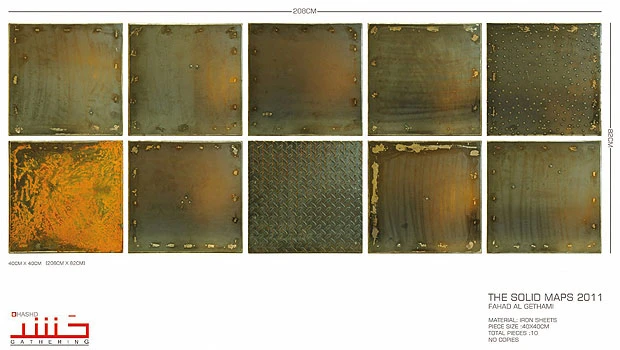
Last week he participated at Abu Dhabi Art 2011, exhibiting his work “Solid Maps” — a 10-piece metal sheet installation in a variety of surface textures.
“‘Solid maps’ is an investigation of the relationship between time, surface and material. Since the time they have been created, they tend to interact and live,” said Al-Gethami.
“The square ores have the ability to shape their properties according to different circumstances. For me, a square-shaped space comes to life and has the power to form your philosophies,” he further explained.
Al-Gethami doesn’t shy away from vocalizing the great difficulties he faced for having taken up on a choice in the arts “that the community considered a taboo,” against a stable income-generating employment post.
He quit his job at a local bank to dedicate his time to pursue arts purely “for the love of art” and considers himself an artist constantly seeking independence through the representation in his work.
“Contemporary art in Saudi Arabia has not found enough support from artists and galleries. They say they cannot understand what contemporary art is because of the poor artistic culture or maybe it is due to their inability to actually read accurately. Perhaps they believe in isolation from the art movement in the world. This is a mistake,” he further added.
Most of the artwork he has been producing in the past four years has predominantly been in the genre of contemporary art — a bourgeoning movement that needs to be led by focusing on conceptual originality and skill for the reflection of a truly artistic art movement in Saudi Arabia.
Considering the nascent stage of the emerging art market in the Middle East, there is still a remarkably strong potential for growth in terms of investment and consumer value, driven by the newfound interest from the international market.
“The important thing is that a really strong local market should be created and supported by local collectors, artists and galleries. Also, the art from the region should continue to build a profile on the international stage. The Arab Museum of Modern Art is a good example of this currently being done well,” said Michael Frahm, an art adviser and curator at the fair.
“There wasn’t a great deal of young, new talent shown at the fair. It was predominantly about the “big-name artists” introducing their works to a Middle Eastern audience. The galleries were definitely focused on established artists rather than on the young, upcoming stars,” he added.
He also stressed upon the need for the introduction of pure art academics into the educational mainstream for the internal sustainability of the art boom the region is facing.
“Increased knowledge will naturally lead to a more thriving local scene and so there absolutely should be a focus on introducing more people to art and increasing knowledge about art history.”