
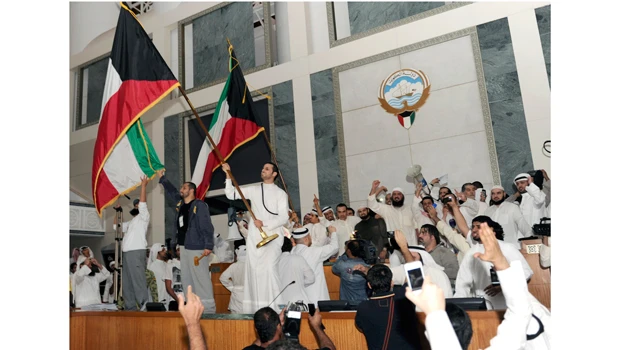
- KUWAIT: Political turmoil in Kuwait may eventually clear the way for better policy-making that boosts growth in the underperforming economy, though for now, fund managers fear it will deter fresh investment in Kuwaiti assets.
The emir, Sheikh Sabah Al-Ahmad Al-Sabah, issued a decree dissolving Parliament on Tuesday after the Cabinet resigned last month in one of the oil-rich state's deepest political crises. The decree gave no date for elections, which the constitution says must be held within 60 days.
Prime Minister Sheikh Nasser Al-Mohammad Al-Sabah, the emir's 71-year-old nephew, quit with his Cabinet after opposition lawmakers and protestors stormed Parliament, accusing him of corruption and mismanagement.
In the long run, political change could be a boon for investors in Kuwaiti stocks and other assets. By many measures, Kuwait has the Gulf's most open political system but also its most inefficient economy; feuding between parliament and the cabinet has hindered policymaking, delayed regulatory reform and slowed the disbursement of state funds for infrastructure projects. One result was that the government managed to spend only 76 percent of last fiscal year's budget.
"Kuwait is an example of a resource-rich country that has struggled to grow," London-based Capital Economics said in a report, adding that the country's annual gross domestic product growth had averaged just 2.5 percent over the past three decades compared with 4.2 percent in the Gulf as a whole.
Sheikh Nasser was originally appointed in 2006. A new prime minister, and a fresh Parliament elected with a popular mandate for reform, could potentially use Kuwait's financial resources more effectively — and given the size of the resources, even a modest increase in effectiveness could make a big difference.
"There is a good chance that reforms could be introduced. Alongside Kuwait's ambitious development plan, we could see a marked acceleration of growth in the next 10 years," said Said Hirsh, Middle East economist at Capital Economics.
"If the country were to reduce corruption and improve its business environment, we think that GDP growth could average 5 percent over the next 10 years."
In the immediate term, however, political uncertainty may keep fresh investment away. The scale of political change is unclear — for example, it is not known whether the ruling family will loosen its effective monopoly on the post of prime minister and other leading posts in the government, one of the demands of the protestors. So for most investors, it is too early to bet on a shift in economic policy-making.
"Kuwait has never been able to embark on an investment strategy as other regional governments have done, despite its massive natural resources and economic surpluses," said Rami Sidani, Middle East head of investment at Schroders.
"Kuwait continues to lack proper infrastructure and investors will continue to doubt it will be able to change the situation any time soon."
In mid-2010, the government announced a vague plan to invest 30 billion dinars ($108 billion) in improving the country's infrastructure. Bank stocks soared as investors bet the government would finance projects through local lenders.
But as the government failed to flesh out the plan with details of projects, or take much concrete action to implement it, investors sold stocks. A change of government could, initially at least, mean further delays to projects as the previous administration's decisions were reviewed.
Another deterrent to investors is the lack of a predictable regulatory framework, fund managers say. The fledgling Capital Markets Authority was set up this year, more than 30 years after the stock market was established, and so far has struggled to win the trust of investors.
A Kuwaiti court is due to rule on Dec. 25 on a challenge filed by the CMA against a Cabinet decree that ended the tenure of three of its five commissioners. Local media reports said the men were removed for violating CMA rules by holding other jobs at the same time, and the trade ministry has declared regulations enacted under their tenure are void. The CMA says it has the right to keep the men on its board.
"Kuwait still doesn't have an independent capital markets regulatory framework," said Shakeel Sarwar, head of asset management at Securities & Investment Co (SICO) in Bahrain.
Kuwait's main stock index is down 16 percent in 2011, while National Bank of Kuwait and telecommunications operator Zain — the top two listed companies by value — have fallen 11 percent and 40 percent.
Yet Kuwait's blue chips remain over-priced compared to their Gulf peers. The median price-to-earnings ratio for Kuwait's 10 largest listed firms is 21.9, based on last year's earnings, Reuters data shows. This compares with 10.8 for Qatar and 10.5 for Saudi Arabia, while Dubai is at 9.6 and Abu Dhabi at 6.6.
"There are limited investment opportunities in Kuwait, so a lot of excess liquidity in the country has been channeled into the financial markets and this has pushed up valuations to unacceptable levels given the limited growth prospects," said Sidani at Schroders.
International investors are largely staying away from Gulf stock markets this year because of the turbulence in the global financial system. Fund managers said that when those investors eventually returned to the Gulf, valuations meant other regional markets would probably be preferred to Kuwait.
"Kuwait is still at unrealistic levels and it isn't yet a bargain even after this year's sell-off," said Sarwar at SICO. "There are good buying opportunities, not only in the region but internationally, and I don't think Kuwait will attract much foreign interest just because it has fallen more than many markets."