- It may not be so easy to understand the movement of Saudi society unless you have a marvelous network of relationships.
On the other hand, you may not have a certain impression about the cultural, political or literary activities of this society unless you visit one of evenings known locally as “Athneyneyat,” or Monday evenings.
At the same time one can assume or claim that such evenings are similar or identical, so you need to attend as many as you can of them to gather enough data before making a final judgment on the intellectual and cultural trends of this society.
Due to the fact that Athneyneyat usually starts from the beginning of the week to the weekend, most of these evening or morning gatherings have become a phenomenon that should be analyzed and understood to answer some good questions raised about them, and the freedom available for participants.
Such symposiums were in fact transferred from specialized literary and cultural dialogue to more open platforms for dealing with national, regional and global developments. Some of them focus on community and family affairs besides other important literary, cultural, Shariah, social and applicable sciences along with some political and economic topics.
This dialogue and discussion deals mainly with the Saudi community reaction and interaction with various related events. Athneyneyat started in the early times before the age of the modern media and domination of new social communication networks like Twitter and Facebook that have broken privacy and ended the era of information censorship around the world.
Comparing the Saudi experience with those of neighboring Arab Gulf states, some distinguished characteristics could be identified clearly. The Saudi Athnyneyat are usually organized and sponsored by some well-known and capable dignitaries at suitable locations and continue without interruption except for official holidays.
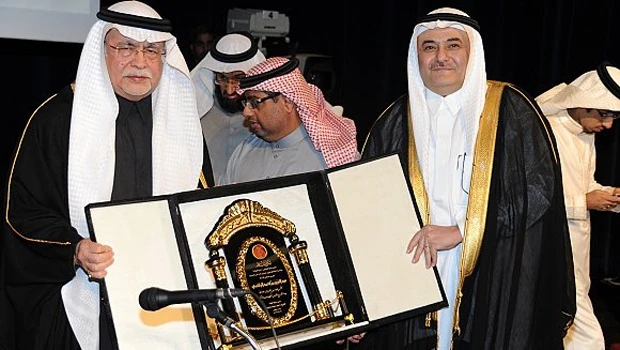
Moreover, the Saudi evenings have started as cultural and literary symposiums and later on upgraded to cover other topics. Sponsors at first confine attendance to special guests, recording what has been done then publishing items in a book or periodicals then honoring the guests.
Athnyneyat Abdulmaqsood Khoja in Jeddah and Khameesat (Thursday) were seen as the most magnificent events of their kind. These cultural and literature salons reached a peak during the 1980s, the era that witnessed a remarkable education revolution nationwide, a spread of higher education institutes, increasing number of scholarships, and the return of thousands of Saudi students from regional and overseas universities and higher education institutes.
That era was also characterized with cultural and ideological conflicts and international political polarization trends. At first, the Saudi salons were known to confine exclusively to the Saudi way of living, reflecting their cultural and literary activities. As time passed on, some changes were introduced as the result of the surrounding developments to cover more Arab and Gulf topics. To reflect the new developments, many Arab, Islamic, Western and Asian intellectuals, scholars and ideologists were invited as well as some Saudi-based senior foreign diplomats.
Despite the fact that such salons are literary, many participants have debated other issues like religious awareness, bureaucracy and administrative corruption along with the most dominating political and economic developments like the Iran-Iraq war, Iraqi invasion of Kuwait and Iranian interference in Gulf national security.
Other items of discussion include education and university issues, women's freedom, municipal elections, the Yemeni national war, Iran’s support of the Hothtyeen sector in Yemen and what is known as the Arab Spring uprising.
Such movement has come amid the existence of a number of conflicting ideological schools such as Salafeya, nationalist and liberal, and each one has its own platform for dealing with certain issues. Despite the sometimes sharp and aggressive discussions, no significant clashes were reported as the result of different opinions. Most often participants manage to find a common ground and a way out of unnecessary disputes and conflicting ideas. They draw a line that may never be crossed while the official circles carefully monitor what goes on.
For all the above-mentioned facts, no foreign observer whatever his culture could come up with a real or detailed vision on the activity of Saudi society unless he attends one of the regular weekly evenings.
Most times and during the day, you may see the Saudi individual a little bit serious, distracted, maybe indifferent on political or cultural matters.
You may get the impression that the Saudi individual is only preoccupied with financial or personal issues like how to own a house and get a nice car, how to spend leisure time, vacation and other desires. All these matters may be true due to the ever-changing demands of life, but when the evening comes, all these hopes may be set aside and everyone gets ready for fruitful dialogue and debates.
The style of life in cities always gives foreigners, specially diplomatic corps, the impression that residents are lacking in a spiritual life, and lack cultural and intellectual knowledge. Some external observers who conduct surveys about certain issues also get the same impression and believe that the capital city of Riyadh in particular is only a place of business and work. When the night comes, you might find a totally different city, more hospitable and more open for discussion and dialogue on a variety of topics.
Throughout the Kingdom, there are so money similar symposiums in the evenings or day on Mondays, Tuesdays, Wednesdays and Thursdays, ranging from Athneyneyat Abdulmaqsood Khoja in Jeddah, to Thlothyat BaMahsoon in Riyadh, Athneyenat Al-Hozaimi at Al-Rawdha, Robeyyat Al-Sedairi and Athneyneyat Al-Qasabi in Riyadh as well as other Saudi cities.
OLIVEE RAWA IN RIYADH
Olivee Rawa, a notable French scholar, was astonished when he was invited to a symposium held at King Faisal Hall in Riyadh one day. He used to wake up early and so he experienced severe congestion in the capital city in the mornings.
“I was about to feel depressed when I saw the huge number of limousines, malls and expatriates but a Saudi companion reminded me that I was not in Riyadh yet,” he said.
“I thought he just wanted to calm me down and get me out of my depression. When the evening came, I went out with my Saudi companion to visit a number of Saudi intellectuals and scholars at their homes. By then I had quickly normalized, found some people with whom I can ideologically communicate with and speak to. At that point I started to understand the fact that the evening of Riyadh extends from dusk to dawn.”
Next day, the French scholar and his Saudi companion were invited to one Athneyneyat, which had a main topic followed by other issues. The main topic was on metropolitan cultural issues. The main lecture was presented by a well-educated Saudi anthropologist that captivated the French guest, who was extremely excited and satisfied by the meaningful dialogue. After that he attended many similar cultural evenings. Later on, he used to sleep in the hotel by day and stay up all night to enjoy these gatherings and to discover the fact that some cities silent or quiet during the day are full of activities during the night.
ABDULMAQSOOD ATHNEYNEYAT IN JEDDAH
According to Abdullah Tantawi, the Monday evening gatherings started in Jeddah in 1982 when the sponsor, Sheikh Abdulmaqsood Khoja invited a considerable number of thinkers, intellectuals, scholars and writers for a meeting at his home to honor Sheikh Abdulqadoos Al-Ansari, one of the leaders of the Saudi literature and journalism movement.
The meeting was held at Sheikh Abdulmaqsood that week on Monday, which was later endorsed by the group as the day of the week when a prominent scholar or thinker would be invited to present a lecture. At first, the lecture focused on literary and cultural heritage only and the symposium was named by the media and papers as the “Athneyneyat.”
The Athneyneyat weekly gathering has not just been restricted to the main lecture but also expanded to include invitations to Arab and Islamic scholars and personalities to come and take part. Thus it had become a place where intellectuals and historians usually meet. The most astonishing thing about these symposiums is that the sponsors are the only known financiers of such activity.
WRITER AND INTELLECTUAL ALI AL-AMEEM
Al-Ameem, a notable Saudi writer, believes that these salons have widened discussion on various domestic and international events without facing any restriction or security control.
"In fact these gatherings have uncovered essential aspects of the Kingdom and reflected a mutual respect and trust between the government and people of the Kingdom to the extent that some influential princes close to the decision-makers have opened their own salons for discussion and debate with a wide margin of freedom, no matter how much opinions conflict,” he said.
Al-Ameem described the Saudi cultural salon as a deep-rooted phenomenon that started with exchanged views on various cultural, literary, historical and religious affairs and later on the discussion expanded to include some political and intellectual issues on both domestic and international levels
He said the progress of these salons has coincided with the economic growth, and scientific and educational development witnessed by the Kingdom of Saudi Arabia over the recent decades.
Moreover, Al-Ameem said, men are not only the dominant figures in these salons, but women also participate through CCTV and some of them have been seen participating effectively in Sheikh Abdulmaqsood's Athneyneyat for example.
The recording, publishing, distribution and translation of various topics in other languages have helped to discover and promote many talents and intellectuals, he said.
Al-Ameem cited a number of specialized salons with remarkable activity for more than three decades including the 25-year-old Ahadeeyah (held on Sundays) of Dr. Rashid Al-Mubarak, a notable Saudi scholar, professor and chemist.
For his part, Abdulaziz Al-Rifaie established a weekly symposium in the Riyadh suburb of Malaz in 1382H. Dr. Ayedh Al-Raddadi, one of participants, remembered that the Al-Rifaie Symposium had started in a small room of Rifaie's rented house in Malaz. Thursday evening of each week had been picked as the time for the weekly gathering in which friends and relatives took part without any advance planning.
KHAMEESEYAT HAMAD AL-JASIR
Despite the fact that the cultural salons started as small selective family meetings, they were rapidly upgraded and expanded to include many intellectuals and thinkers who were invited to present lectures on a variety of important issues. The cultural Khameeseyat of Sheikh Hamad Al-Jasir, a well-known Saudi scholar and author, has been promoted to a cultural center. It was also noticed that such symposiums concentrate around the person who sponsors the gathering. They have schedules and invitation plans that involve selecting those who might participate,
Regarding the activities of these salons and the extent to which they might react to existing developments, a special symposium was hosted at Sheikh Al-Jasir Center in Riyadh on Oct. 15 this year during which participants shed light on different aspects of such interactions.
One of the participants, Abdullah Al-Shammari, an expert on Turkish relations, cited the current events witnessed by the Arab world as evidence of how the region has been affected and influenced by the Turkish model.
This matter and other topics handled by the Al-Jasir Center prove the interaction of these salons with developments in the region. The center also discussed other hot topics including the Sept. 11 anniversary, the Lebanese media, domestic and overseas events and ideological reform of the Muslim nation as well as other issues.
The Khameeseyat was founded by Sheikh Al-Jasir and held weekly at his home in Riyadh before noon every Thursday as a gathering for his friends and students as well as some Arab scholars who used to visit the Kingdom.
The weekly symposium started at the house of Sheikh Al-Jasir in the Riyadh suburb of Malaz then transferred to his new home at Wrood district in 1403H and continued until he passed away in 1421H.
This was when his students and followers decided to establish the center that was supported by the honorary chairman of the Sheikh Hamad Al-Jasir Foundation, Defense Minister Prince Salman, former Riyadh governor.