
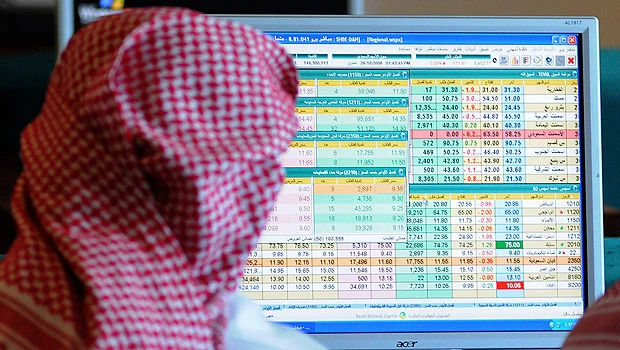
- AMMAN: Arab stock markets were volatile in the first week of 2012 as investors awaited the release of annual results to decide their future holdings, financial analysts said Friday.
They expected regional stocks to remain captive of the euro debt crisis, the Arab Spring revolts and the prospects of the world recovery.
"I believe investors are currently focusing on the fourth quarter results and annual earnings to decide the composition of their holdings for the coming weeks," an Amman-based portfolio manager told Arab News.
"For the medium and long terms, Arab stocks will certainly respond to any developments on the global scene, particularly steps taken by European policymakers to come to grips with the euro zone sovereign debt ordeal," he said.
Saudi stocks moved sideways last week as investors sought clues for the fourth quarter earnings mainly of the petrochemical and banking sectors.
The Tadawul All-Share Index (TASI) inched 0.16 percent lower to close week at 6,407.87 points from earlier week's close at 6,418.13 points.
However, analysts noticed that the benchmark's closing above the psychological level of 6,400 points for the second week in a row represented a positive gesture for investors.
"I believe the market will be testing higher levels in the coming days, especially after blue chips disclose their profits and dividends," Saudi analyst Mohammad Anqari said.
He expected the market to test the level of 6,900 points later this year as more liquidity starts to flow into the stock market in response to dividend distributions and the publication of balance sheets of leading firms in the petrochemical and banking sectors.
Anqari and other analysts contended that the Saudi stock market stood to gain from the strong economy of the world's largest oil exporting country and the huge public spending projected for the coming few years.
Kuwaiti stocks lost ground last week as investors came under pressure from the fallout of the political uncertainty in the country.
A standoff between the government and the opposition prompted Sheikh Sabah Al-Ahmad Al-Sabah to dissolve the parliament and call early elections on Feb. 2.
Kuwait's KSE all-share index lost 1.5 percent on weekly basis to close at 5,727 points, its lowest point in six years.
The benchmarks of the United Arab Emirates stock exchange of Dubai shed 0.3 percent, closing week at 1,349 points, while Abu Dhabi's index inched lower closing at 2,399 points from last week's close at 2,402 points.
Qatari stocks were the main gainer in the region last week, with the benchmark of the Doha Stock Exchange rising by 1.2 percent and closing at 8,886 points.
Bahrain's index closed week 0.5 percent in the red, at 1,38 points.
Jordanian shares continued to suffer as a result of the liquidity crunch and the fallout of the Syrian uprising, analysts said.
The all-share index of the Amman Stock Exchange (ASE) shed 0.7 percent, closing week at 1,982 points.
Egyptian shares recovered last week, drawing momentum from the improving political atmosphere, the retreating protests and the successful arrangement of the general elections' third stage, analysts said.
Egypt's AGX 30 index, which measures the performance of the market's 30 most active stocks, gained 0.8 per cent on weekly basis, to close at 3,650 points.