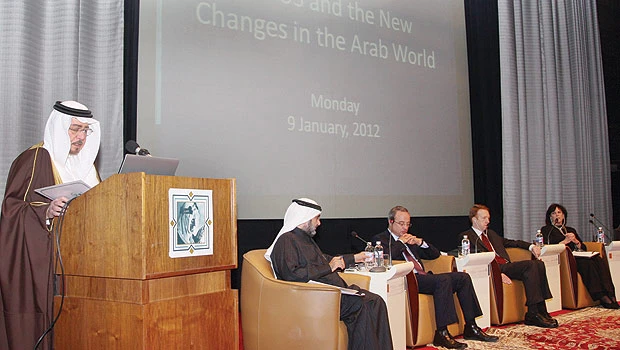
- RIYADH: Members of a global think tank gathered in Riyadh on Monday to discuss the US and new changes in the Arab world in a symposium being organized jointly by the Riyadh-based King Faisal Center for Research and Islamic Studies (KFCRIS) and Carnegie Endowment For International Peace.
The Carnegie Endowment is a private, nonprofit organization dedicated to advancing cooperation between nations and promoting active international engagement by the United States. Founded in 1910, its work is nonpartisan and dedicated to achieving practical results.
The two-day symposium was attended by high-ranking Saudi officials, princes and number of foreign ambassadors to Riyadh. Jessica Mathews, Carnegie president, who spoke on “The View From Washington”; Marwan Musher, Carnegie vice president for studies who dwelt on “Outlines of a Changing Arab World”; and Thomas Carothers, Carnegie vice president for studies, who discussed “The Arab Uprising from a Global Comparative Perspective” participated. Abdulaziz bin Sager was the moderator.
In his inaugural speech on Monday night, Minister of State for Foreign Affairs Nizar bin Obaid Madani said their approach is in line “with what the GCC is doing with the Yemen issue and the Arab world with the Syrian problem. But, at the same time, we have repeatedly condemned the bloodshed taking place against innocent civilians leading to loss of lives.” He said that for these reasons, the Kingdom did not witness any demonstrations that took place in other countries.
This is because of the government’s proactive policy that seeks to offer opportunities to its citizens and staying tuned to their needs, he said, adding the introduction of community reforms and other developmental projects are geared to the same goal. Every government, he pointed out, has the obligation to help its people in the interest of growth and development.
“For this reason we support governments that promote the rights and dignity and welfare of their citizens.”
Referring to the situation in the Middle East marked by political upheaval and violence in some parts, Madani reaffirmed the government’s policy of noninterference in the internal affairs of any country. At the same time, the Kingdom is in favor of the vast aspiration of the people, since the primary duty of every government is to serve the people.
He observed that while Saudi Arabia strongly opposes civil war and intervention that threaten a country’s national unity, “we strongly oppose any move that would cause chaos and disunity. We always seek to develop the best possible relations with all Arab countries based on the principle of noninterference in their internal affairs.”
Madani said nobody could dispute the fact that 2011 was an exceptional year for the region, where changes took place in several Arab countries. This change will continue to grab headlines in 2012 in view of the difficulties that are natural during the transitional process, he added. This explains why some regions have witnessed more violent confrontations between the people and their regimes than others.
The situation can be understood only in the light of the historical and political background as well as the socioeconomic conditions in each Arab country. The ground realities of the Arab world should not be overlooked, he stressed. On Tuesday, there was a workshop on building good governance, stability and prosperity at a time of rapid change.
Prince Turki Al-Faisal, KFCRIS chairman, presided over and acted as a moderator for the first session on the dynamics and patterns of change in the Arab uprising. Marina Ottaway presented the general overview, while Yezid Sayegh spoke on the Egyptian military and the transition in Egypt. Another lecturer, Paul Salem, discussed the impact of regional power balances using Syria as a case study, while Ibrahim Saif and Lahcen Achy talked on the economic impact and challenges. US policy and regional responses was the theme at the second session, moderated by Jessica Mathews during which Karim Sadjadpour talked on the US policy options toward Iran.
Marina Ottaway and Maria Fantappie spoke about what the US is leaving behind in Iraq. During the same session Asaad Al-Shamlan discussed the current challenges to Saudi-US relations, while Mishary Al-Nuaim presented the GCC’s point of view. Prince Abdullah bin Faisal Al-Turki and Prince Faisal bin Abdullah Mohammed presided over the last session on education for citizenship.
During lunchtime there was a talk on perspectives on Chinese political and economic relations with the Middle East by Charles Freeman. Prince Turki rounded off the event with his closing remarks. In her presentation, Mathews wondered what major global issues would define 2012. She predicted 2012 would be another historic year. She said the first thing to look at is the quartet of issues in the Middle East: Egypt, Iraq, Syria and Iran.
“Within moments after the end of the war in Iraq and the departure of US troops, (Iraqi) Prime Minister Nuri Al-Maliki made astonishing moves against Sunni leaders—on the very heels of the last American troops crossing the border. It’s too soon to say whether Iraq is going to unravel, but I wouldn’t be at all surprised if the situation gets much worse.”
She continued: “We are entering a particularly dangerous period in Iran. The latest intelligence is that Iran is planning to expand enrichment activities at an underground facility near Qom.
“Israel is engaged in a debate over whether to attack before such a facility is fully operational. The politics of this for the US administration in an election year are awful. This would be a war that Israel can start but can’t finish.”
Mathews said Republican candidates are trying to outdo each other on aggressiveness toward Iran. The United States could be drawn into military action that would cause global oil prices to skyrocket and in all probability lead to an outbreak of Shia terrorism. Mathews told the audience that any army solution to Iran would be a catastrophic mistake. She discussed how the US presidential election would shape America’s foreign policy. Mathews said there are three areas where politics will most obviously impinge on policy.
The first is China. She said the United States has a long history in which the party out of power—whether Democratic or Republican—hammers the party in power for being too nice to China.
The next issue is Israel. She said President Obama will be under a great deal of pressure to prove that he loves Israel as much as the Republicans, at the same time that Israel’s current government is, to be polite, not exactly a constructive force for peace. With the building of settlements continuing and the constant drumbeat in Israel to take action against Iran, this issue could pose a major challenge to the American administration.
The third area that could be a major focus of the campaign is a contest to see who can be the toughest on Iran. She said the truth is that the world may ultimately need to live with an Iran that has the capability to make nuclear weapons—a so-called “screwdriver’s turn away.” If the Iranians are smart, this will be their goal. The biggest threat from an Iranian nuclear weapon is not that Iran’s rulers are lunatics who will start a nuclear war, but that it will set off a nuclear arms race in one of the most dangerous regions in the world and where governments have the money to pay for it.
According to Marwan Muasher, who was a former foreign minister and prime minister of Jordan, any reforms taking place without a power-sharing process is not a serious move. “Economic reforms without political reforms will leave the abuses that have not been checked. This is what happened to Egypt and Tunis where the benefits from economic reforms went to few pockets,” he said.
He said any reforms process must create jobs. “Jobs are probably the number one issue in the Arab world,” he said, adding 70 percent of the Arab population is under 30.
He said those countries that do not have civil institutions and political parties have the best chance to succeed if reforms are carried from above. He argued economic and military reforms will not solve the problem. Talking on educational systems, Muasher said it was not wise to have an educational system in the Arab world that does not encourage critical thinking and which does not teach the values of tolerance and acceptance of others views.
Thomas Carothers, Carnegie vice president for studies, who discussed the Arab uprising from a global comparative perspective, said what happened to the world in over 30 years' outbreak of political changes in Latin America, Europe, Asia is now taking place in the Arab world.
There is similarity in the picture of what is happening today in Arab countries. The political changes took place last year can be fully understood with a deep analysis. He predicted during a discussion session that Iran would be the next to be affected by something similar to the Arab Spring.
He said it is tempting to compare the astonishing wave of political upheaval in the Arab world to the equally dramatic wave of political change that swept Central and Eastern Europe in 1989.
In the Middle East today, as in 1989, extraordinary numbers of ordinary people are courageously and for the most part nonviolently, demanding a better future for themselves and their children, he said, adding the wave broke just as suddenly and was almost entirely unexpected by experts both inside and outside the region. The situation in the Arab world is very different, he said.
"For all you hear about America's support for dictators, the Arab autocracies were, or are not, held in place by any external power framework. Rather, they survived these many decades largely by their own means — in some cases thanks to a certain amount of monarchical legitimacy well watered with oil and in all cases by the heavy hand of deeply entrenched national military and police forces."
He continued: "What's more, though citizens in some Arab countries have given their governments a hard push, the underlying regimes themselves — the interlocking systems of political patronage, security forces, and raw physical coercion that political scientists call the 'deep state' — are not giving up the ghost but are hunkering down and trying to hold on. Shedding presidents, as in Tunisia and Egypt, is a startling and significant development, but only partial regime collapses."
Carothers observed that the Arab world contains reformist monarchs, conservative monarchs, autocratic presidents, tribal states, failing states, oil-rich states, and water-poor states – none of which much resemble the sagging bureaucratic communist regimes of Central and Eastern Europe in the late 1980s.