
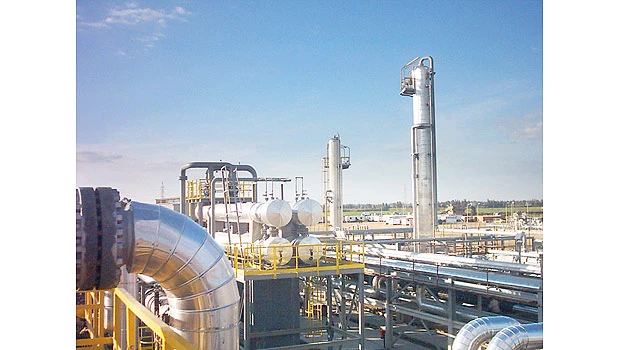
- DUBAI: The idea that "markets hate uncertainty" is a cliche, but it has proved all too correct this month for Dana Gas.
An information vacuum after a board meeting on Jan. 4 to discuss the company's financial position, coupled with uncertainty over how the company intends to repay $920 million of a $1 billion convertible sukuk (Islamic bond) when it matures in October, caused the market to turn on the UAE energy firm.
Its share price dropped 17 percent in three days and the sukuk price slid on Monday to 64 cents on the bid side in the secondary market, according to Thomson Reuters data.
"When the bonds are losing such amount of value, you really wonder what is happening behind the scenes," said John Bates, head of fixed income at Silk Invest.
All it took to stop the frenzy was one statement from the company.
"Dana Gas over the last four years has timely and consistently paid on or before the due date the sukuk profit amount and will continue to do so pursuant with its obligations," the company said in a bourse filing on Tuesday.
The ensuing rebound sent the sukuk up 9 cents on the bid to 73 cents on the day, a level at which it stabilized on Wednesday.
While expressing concern at the continued lack of clarity on exactly how the firm will handle the maturity, Chavan Bhogaita, head of the markets strategy unit at National Bank of Abu Dhabi, acknowledged the filing was "certainly a welcome change to the radio silence that prevailed recently".
The lesson from the incident — for all Gulf-based issuers of debt past, present and future — is that it's important to stay in touch with your investors.
The concept of investor relations is one which is slowly being embraced by debt issuers in the region.
"Until recently, investor relations was something considered mostly in relation to equity transactions and shareholders' communication," said Giambattista Atzeni, chairman of industry body the Gulf Bond and Sukuk Association's investor relations committee, and vice president at BNY Mellon Corporate Trust.
"After the financial crisis, the industry realized investor relations was an essential part of debt capital market transactions, as its investor base and their requirements can often be different to shareholders'."
However, embedding that thinking in a region which is culturally against revealing the inner workings of businesses has taken time.
Until perhaps 18 months ago, news that Abu Dhabi was holding a series of non-deal roadshows to update investors would have been interpreted as the pretext for a bond issue, not as a simple exercise to engage with the investor community as any mature issuer would in the West.
While there are now many examples, especially among regular issuers from the Gulf Cooperation Council, of entities holding frequent investor events, the region still struggles when things go wrong.
"The tendency is to publish good news quickly — the same should apply to bad news as well," said Jon Breach, lead partner at BDO Corporate Finance Middle East.
While the term "restructuring" has lost some of its stigma in the Gulf, companies are still reluctant to admit they have a problem.
"It's a necessary part of corporate life, when facing difficulties with funding — you not only need to work with the funders but keep the market informed of the talks and the issues," Breach added.
Such evasiveness can lead to situations like Dana Gas, where a lack of information saw sentiment drive opinion rather than hard facts. Dana is not the only example from recent times.
"The whole situation is unfortunately reminiscent of Nakheel," Bates said.
The Dubai real estate developer saw its May 2010 sukuk trade as low as 30 cents on the dollar in January 2010, after Dubai World's admission in November 2009 that it needed to restructure debt, as investors assumed the obligation would not be met.
However, a restructuring plan revealed on March 25, which proposed full repayment of the Islamic bond, saw the sukuk jump that day by 24.5 cents to 94.5 on the dollar.
On the equity side, Aldar Properties' share price dropped 11.7 percent within a week in December, hitting an all-time low; there was rampant speculation that the developer would be delisted, eventually dismissed by an executive.
Debt issuers with notable maturities this year - such as DIFC Investments and Jebel Ali Free Zone Authority - might be wise to try to limit uncertainty.
There are three key pillars to successful investor relations, in Atzeni's eyes: An institutionalized investor relations office, disseminating the right data, and having communications channels for feedback.
A note from distressed-debt trader Exotix, published on Jan. 8, said analyst calls, only started by Dana Gas for the third quarter of 2010, stopped after it reported first-quarter numbers last year. The company's head of investor relations left on Dec. 8.
"Clearly for any company considering a new issue, getting the public story right and out there is only going to be beneficial in terms of pricing and investor appetite," Breach said.
"For existing issuers, corporates always need to raise new capital to grow the business or make an acquisition, so there needs to be continual interaction and dialogue with the market to encourage a following."
By creating a following, borrowers can access the market at short notice and without the need for new investor meetings - extremely beneficial when the markets are volatile. First Gulf Bank did just that on January 11.
Being proactive can also have pricing benefits, especially now when there is less reliance on credit rating agencies and investors are doing more of their research in-house.
"Pricing risk is very important and the most difficult thing to do," Atzeni said. "If you know the risk then you know how to price it. If question marks remain, this may negatively affect pricing."