- The Haj exhibition has 209 exhibits.
- Many are physical objects of religious significance as well as of great beauty in their own right.
The journey from Timbuktu to Makkah — one of the main pilgrim routes and a grueling slog of some 5,000 kilometers rounding the northern edge of the Sahara Desert through Cairo and south to Makkah — would test the endurance of the fittest modern man or woman. To the pilgrims of hundreds years ago with crude equipment, poor health and often vulnerable to disease it must have been a test of endurance and faith we simply cannot begin to imagine. Yet the pilgrims made the journey and endured, driven on by the power of their faith.
Looking at the maps and the earliest photos of Haj, albumen prints made in 1880 by Sadiq Bey, the crude maps and the rudimentary survival equipment that these devout people carried, one can only stand in awe. It was indeed the journey of a lifetime and in more than a few cases, cost lives.
It is important to pause a while and take in the enormity of the task that faced the pilgrim and which they volunteered to take on in the name of their faith to be able to get a glimmer of the intensity of belief that they had. That belief was tested to an extent that few, if any today, ever experience. It may be uncomfortable on the crowded aircraft or air-conditioned coach, but compared with perhaps a year walking across a desert, it is nothing.
An illustration from the Maqamat of Al-Hariri by Yahya of Al-Wasiti, one of the major exhibits in the exhibition, shows the “rogue and hero of the Maqamat” one Abu Zayd haranguing the pilgrims on their travels to Makkah. It indicates that the travails of the pilgrim were already well known and describes the very core of Haj that is as true today as then.
He asks: “Do you comprehend what you are about to face…and what you are undertaking so boldly? Do you imagine that Haj is the choosing of saddle beasts the traversing of stations…that piety is the tucking up of sleeves, the emaciating of bodies, the separation of children, the getting far from your native place?
“No by Allah…it is the sincerity of purpose, for making that building there and the purity of submission along with the fervor of devotion, the mending of dealings, before working the doughty camels.”
Herein lies the essence of the exhibition; the continuity. The belief remains, the arduousness of attaining the goal of Makkah may have been relieved to a great extent, but the belief remains.
Central to Islam is the Qur’an. One of the exhibits is a magnificent example of the holy book and probably the earliest in existence. Written in the rightward-sloping ma’il script, the copy on show is from the eighth century, making it the best part of 1,400 years old. It is in superb condition and the clarity of the script and preservation of the binding belies its age. To look at this is to feel something of a link with the calligrapher who spent a large part of his life devotedly copying it with meticulous accuracy from an even earlier copy.
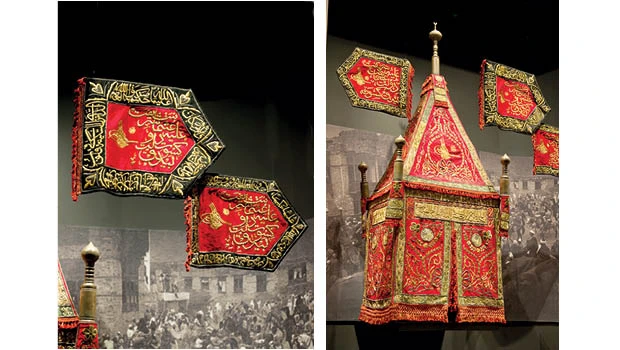
Single copies such as this were traditionally carried in mahmals, covered palanquins mounted on a camel. One of the most spectacular exhibits is the Ottoman mahmal of Sultan Abd-Al Aziz and made in his reign 1861-1876. Nearly four meters high, it stands splendidly against a dark background and with it a looped presentation show early film of mahmals on their journey to Makkah.
In immaculate condition, it is a splendid example of the spectacle of pilgrimage and must surely have been seen by hundred of thousands of pilgrims during its sacred journey.
It is however the less spectacular items on show, the ephemera of Haj, that form the connection between the present and past, between observer and original owner and what it meant to them.
A single piece of paper and a faded sepia photo are suffused with history — the letter from Lady Evelyn Cobbold, the first British woman to conduct Haj. Written in St. John Philby’s house Beit Al Baghdad to her grandson — and very carefully dated March 14, 1933, just 12 days before she performed Haj — the letter and its provenance connects in a special way the British viewer with Saudi Arabia in a way that all the protocols of formal diplomacy simply cannot.
Simple zam zam water bottles, ancient and modern, Haj certificates which are again just pieces of paper but soaked in the meaning of Haj completed and the privations endured to achieve it.
Paper again in the form of the diaries of Richard Burton who, though not a Muslim, entered Makkah, described what he saw and signaled the interest of non-Muslims in the annual gathering.
Of particular interest to British visitors might be the rather splendid 1926 edition of the Seven Pillars of Wisdom by TE Lawrence and the original illustrations of Lawrence and a camel march. The book, complete with its uncut pages and original binding, looks like the classic it is. Now famous throughout the Western world, it is now a museum exhibit such is its close connection with the Arab world and Saudi Arabia, in particular.
No exhibition is complete without a catalog and as one would expect the publication that accompanies this Haj exhibition is what would be expected from the British Museum. It is, however, not just a list of exhibits with accompanying descriptions, but rather a picaresque tale through the story of the Haj studded with gems of illustrations, some of the exhibits and others from collections not on show.
Simply, it is a masterpiece of clarity, erudition and rather surprisingly for a product of such academic rigor, readability. Packed with information and delightful asides, the catalog, edited by Venetia Porter, is a hefty 287 pages of fascinating knowledge and superbly presented images. Anyone wanting to understand the intricacies of Haj needs look no further than this book.
The exhibition runs until mid-April and is a “must-see” for anyone interested or even remotely curious in Islam and its central ritual.