- The euro ended the year as the worst performing currency, and according to calculations by Citigroup, there is more than €475 billion of euro zone government debt due to be repaid in the first quarter of 2012.
- As the old continent continues to grapple with a deep financial crisis, academic and former Labour Party MP David Marquand argues that a strong Europe requires a drastic change in its governance.
One of the major causes of the financial crisis in the Euro zone lies in a contradiction: Combining national control over taxation and public spending with a European currency. Members of the European Union (EU) have repeatedly refused to acknowledge that a monetary union requires at least a certain degree of fiscal union, but no country is ready to give up the trappings of sovereignty. Consequently, the European Central Bank controls monetary policy while member states are in charge of the fiscal policy.
Politicians have acted with a great deal of insouciance since 1992 when the Maastricht Treaty cleared the way for a full monetary union with the birth of the euro in 1999 and euro notes and coins replacing national ones in 2003. Those years were marked by the triumph of untamed and unchallenged capitalism. Self-regulating markets encouraged a gargantuan rise of risk taking that has led to the near collapse of the world’s financial system. However, this unrestricted pursuit of individual self-interests has underlined a major change, as the balance of the global economy is shifting from the West toward the East and the so-called BRICS (Brazil, Russia, India and China) countries.
In a 2008 report, the American National Intelligence Council stated that: “In terms of size, speed, and directional flow, the global shift in relative wealth and power, roughly from West to East, is without precedent in modern history.”
China and India are now regaining the rank they held in 1700 when their combined GDP were twice as large as Europe’s.
In 1793, after a notorious meeting led by Lord George Macartney, the Chinese emperor replied proudly to a British request for trade relations with China: “We have never valued ingenious articles, nor do we have the slightest need of your country’s manufactures.”
From there on, Europe became more powerful; a success due to scientific progress, the industrial revolution and its colonial conquests. By 1913, Europe’s GDP was more than twice those of India and China put together.
“Europeans took it for granted that their ‘Western’ values were predestined victors in a Darwinian struggle for moral and ideological supremacy,” says Marquand. “At the very heart of the West-East antimony of the last 2,500 years lay the proposition that the ‘West’ was par excellence the home of reason, efficiency and evolutionary success: that an unenlightened, modern, rational, and progressive ‘West’ confronted an unenlightened and backward ‘East.’”
At this stage, one wonders whether Europe will overcome its contradictions, reinvent itself and recapture a political resolve that restored faith in the future after two harsh World Wars.
In a gripping analysis of the history of the EU, the author quotes Charles de Gaulle who dreamed of a “Europe des patries,” a Europe of nations. Indeed, the founding fathers of the EU did not wish to get rid of the sovereignty of the member states but “transcend” it. This political term, “transcend,” has been, “so swathed in rebarbative academic jargon,” that very few citizens of the EU are aware of its meaning. Moreover, this lack of understanding has also uncovered a growing disinterest: The turnout in elections to the European Parliament has been declining steadily, going from 65 percent in 1979 to 43 percent in the 2009 elections.
Why are EU citizens disconnected from their respective governments? And how can one explain the return of nationalistic movements? In recent years, questions about ethnicity, the system of governance, the frontiers of Europe and the characteristics of European civilization, which had been deliberately shrouded in ambiguity, have resurfaced.
One of the biggest challenges facing the EU zone remains immigration from former colonies in the Muslim world. Islam is the fastest-growing religion in the world and a rising Muslim minority includes EU born citizens. As a result, there is growing Islamophobia, which is seen by many as a response to the threat of Muslim terrorism.
“To fit into a multipolar world, without an East or a West, Europe will have to rediscover its own complex and contested past… Bosnian Muslims are as European as Danish Lutherans or French secularists; the great Mosque of Cordoba is as much a part of Europe’s cultural heritage as Chartres Cathedral or Shakespeare’s sonnets,” writes Marquand.
However, the addition to the original European Community market with six members to the present EU of 27, raises the question of Europe’s boundaries and the nature of the European civilization.
Europe is not so much a continent, rather a subcontinent with no natural boundary between it and the rest of the Eurasian land mass. It is difficult to say where Europe ends and even more difficult to define the nature of the European identity. However, it is up to the people of Europe and not to government officials to find answers to these pressing issues.
“But the great question now facing Europe, whether as idea or fact, is not the impact of the economic crisis, the future of the Euro zone, or the admission or non-admission of new member states, important as they are. It is how to grow a European demos that can sustain a European federation, playing a worthy part in such a world,” concludes Marquand.
Before Europe finds a way to a better future, it will have to cure its many ills. High on the list is the need to re-evaluate the meaning of “West.” The “East” has to be given its due place. For too long, the “West” has been wrongly perceived as the mother of science, rationality and progress and the “East” as backward and poor.
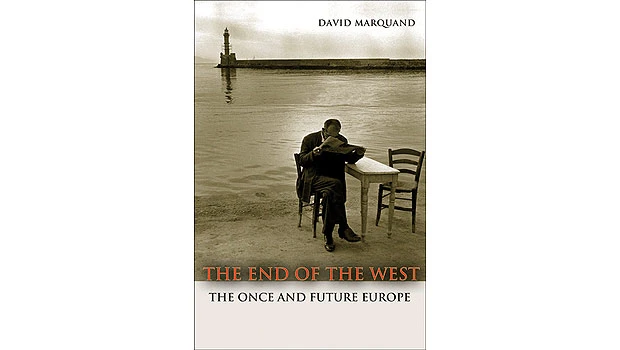
“The End of the West” is a wake-up call. It raises many questions and calls for drastic changes in the EU governance. The flaws and failures of the EU need to be addressed and solutions have to be found. The notion of an enlightened West versus a backward East is no longer true. Europeans have to acknowledge the increasing importance of the new “East” and redefine the future role Europe can play in a fast changing world.
Marquand gives us a concise and brilliant analysis of the failures and weaknesses of the EU. Readable and compact, this book helps us understand the reasons behind the present problems affecting the EU.
"THE END OF THE WEST
THE ONCE AND FUTURE EUROPE"
By David Marquand
Published by Princeton University Press
204 pages