- JEDDAH: Many commercial buildings and work places have banned smoking at offices in an attempt to stop smoking in public places.
Some smoker employees are happy with the decision, as it provides them an excuse to skive off work or take a short break every hour to smoke out of the office. Some upset non-smoker employees, on the other hand, think the decision is unfair. They say their managers know that smoker employees use it as an excuse to interrupt and delay work. Non-smokers are also bothered by smoke in the buildings’ passageways.
The attempt to ban smoking at work is not an isolated one. In a step to discourage smoking in public places, several Saudi universities initiated campaigns. King Fahd University of Petroleum and Minerals in Dhahran, for instance, launched a program in 2010 to make their university smoke-free, and Makkah’s Umm Al-Qura University launched a campaign with the same title in 2011.
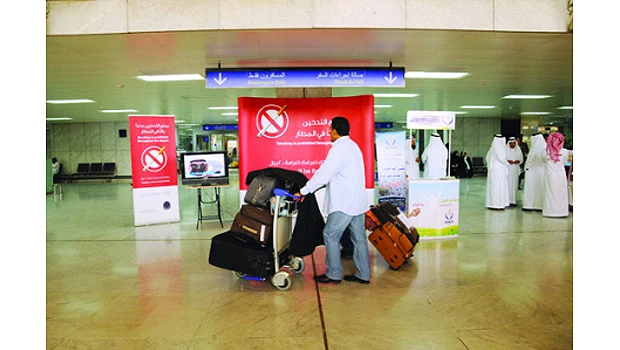
Prince Sultan banned smoking at airports across the Kingdom from the end of 2009, giving violators a SR200 fine. Consequently, the General Authority for Civil Aviation launched an awareness campaign to fight smoking in cooperation with travel agencies and government offices at the airports.
In addition, the sale of cigarettes is forbidden in the areas around the two holy mosques.
According to 2007 statistics from the Ministry of Health’s tobacco control program and the WHO, there are 38.9 percent nonsmokers in Saudi Arabia who are surrounded by smokers in public places. Furthermore, 75.4 percent thinks that smoking in public should be banned, while 60.8 percent believes secondhand smoking affects their health negatively.
Doctors say that secondhand smoking is the most important cause of serious diseases such as cancer, heart and lung diseases. Nonsmokers are more negatively affected from smoking than smokers themselves. A smoker inhales only 15 percent of the cigarette smoke, while 85 percent of it is puffed in the air, threatening nonsmokers’ lives. As secondhand smoking is more harmful than firsthand, it is preferable for nonsmokers to stay away from smoking areas.
To illustrate the severity of the issue: the number of people who died as a result of smoking around the world in the 21st century was much more than the number of war victims.
Arab News interviewed employees who use the smoking ban at work places for their own benefit.
Omar Ahmed, a Saudi employee at a private company in Jeddah, finds the ban on smoking at his work place an advantage: “I thank the person who made the decision to ban smoking at commercial buildings and work places, because it allows me to take short breaks every now and then.”
As the smoking ban applies to the entire commercial building he works in, Omar usually smokes at the entrance of the building. According to him, being outside refreshes his mind and allows him to meet people and have new friendships with employees from other companies working in the same building.
“I made new friendships with employees from the other companies during cigarette breaks. We have a little chat and go back to work in a better mood,” said Omar, adding, “The managers think we are upset about the decision, but actually we are happy. We can take a break to smoke a cigarette regularly.”
Another employee called Abdul Wahab told Arab News that the smoking ban benefits smoker employees. He said that despite being a smoker, he asked his manager to ban smoking at the office. He did so not because of health concerns about secondhand smoking, as his colleagues think, but to give himself the chance to refresh his mind, because his company does not offer its employees any breaks. Now he can smoke many times and “if I summed all smoking breaks, the total would be more than an hour.”
Abdul Wahab continued, “The management asked us if we wanted to smoke at the back ladder of the building, but the non-smoker employees rejected this, saying the ladder would become like a smoke factory. We are forced now to smoke out of the building, but to me this is a perfect solution. I can skive work many times, refresh my mind, and call my friends. It is better than spending all the time at work, sitting behind the desk and working.”
Indian employee and nonsmoker Aicha Bahir told Arab News that when her manager banned smoking at the office, she first found it a good action, as it would prevent nonsmokers from secondhand smoking. However, later she discovered that all employees smoked in the passageway to the elevator, which led the smoke to escape to the elevator. As a result, she still gets affected by secondhand smoking, and thinks the smoking ban should include the passageways of buildings.
Aleqt.com, the official website of Al-Eqtsadiah newspaper, made a quiz about the decision to ban smoking in public places. Out of 2,275 participants, 2,200 supported the ban, while 375 respondents did not support the decision, thinking one should be free to choose.