
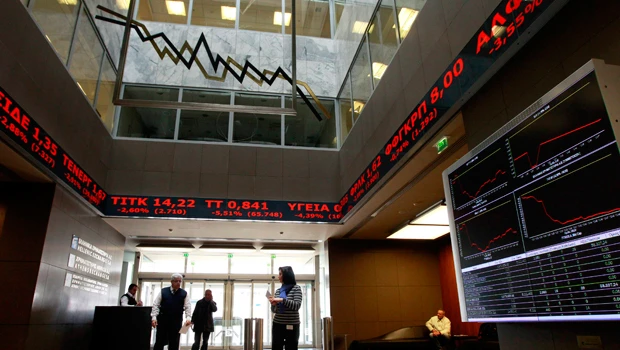
- NEW YORK: The euro fell and global shares pared gains on Wednesday as a rally that pushed Wall Street to seven-month highs weakened amid mounting concerns about a bailout of Greece and renewed doubts among Federal Reserve officials about the US economy.
The euro extended losses against the dollar, falling to a more than one week low, while the dollar pared losses against the yen after minutes from the Fed's latest meeting in January sparked fresh risk aversion.
The euro was down 0.37 percent at $1.307.
A few Fed officials believed another round of central bank bond buying would be needed before long to support the US economy, but others withheld judgment to await more data.
US stocks hugged break-even for most the session but retreated late in the day as Apple Inc pared a 3.3 percent gain to turn negative and the Dow's losses widened.
"Who would have thought that the thing that bothered the market the most was Apple getting too high?" said Larry McMillan, president of McMillan Analysis Corp of Morristown, New Jersey in a report.
"For the first time in quite a while, an early rally has degenerated into after selling," he said.
Apple fell 0.8 percent to $505.32 after earlier hitting $526.29.
The Dow Jones industrial average was down 87.00 points, or 0.68 percent, at 12,791.28. The Standard & Poor's 500 Index was down 4.83 points, or 0.36 percent, at 1,345.67. The Nasdaq Composite Index was down 5.56 points, or 0.19 percent, at 2,926.27.
Global stock markets were higher earlier in the session as data showing underlying strength in the U.S. economy and signs of economic resilience in Germany and France offset worries about the uncertain prospects for a bailout of Greece.
But European shares, which had hit fresh highs on a Greek commitment to implementing new austerity measures, pared gains on a report euro zone officials were considering delaying the bailout until after Greece holds elections in April.
"The market does not like it - if Greece cannot get a bailout by mid-March it effectively has a messy default," said Richard Batty, strategist at Standard Life Investments, which has $248.37 billion of assets under management.
"The country must act now to make the extra spending cuts as there is a danger of contagion to the rest of the market if a chaotic default occurs."
Economic data provided equities an early boost.
Overall US industrial output was unexpectedly flat in January, but the second straight month of gains in the manufacturing component pointed to a strengthening economy, data from the Federal Reserve showed.
Safe-haven US and German government bond prices rose on the possibility of delaying the bailout.
The benchmark 10-year US Treasury note rose 5/32 in price to yield 1.92 percent.
Bund futures were last up 53 ticks on the day at 139.05, and some traders said they could push to around 140 if Greece's fate continues to look uncertain.
Brent oil kept gains near six-month highs as fears of supply disruptions from Iran, other Middle Eastern producers and Africa outweighed worries about the global economy.
But concerns about the outcome of Greek bailout talks in Brussels among euro zone officials limited the day's rises.
April Brent crude traded in London at $118.91 a barrel, up $1.56.
US March crude gained $1.16 at $101.90 a barrel.