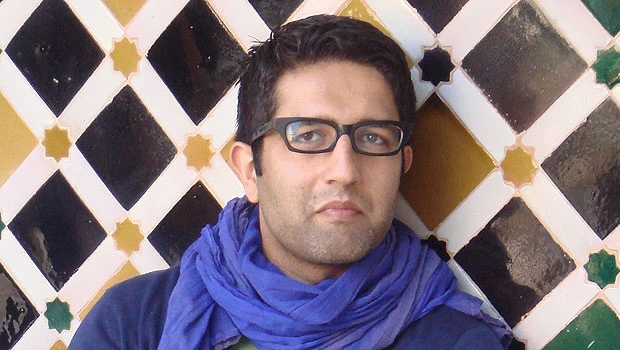
- The first thing you notice on meeting Osman Yousefzada is his gentle personality.
- He is smiling and warm, and for all his growing fame, pleasantly low key.
Thinking he had been born in Afghanistan, (his family come from Jalalabad), I asked him: “How do you feel about your troubled homeland?” To this, he answered, deadpan: “What Birmingham? Well, yes, I suppose it has its dark side.”
Indulging journalists with good humor in the hectic run up to his fabulous autumn/winter show at London Fashion Week, no doubt took a lot of patience. During the time I spent with him in his studio on a quiet street behind Selfridges Department store, I saw just how “hands on” he is with regard to all aspects of his business. When I arrived, he was conducting a private viewing for two super stylish young women. One was a close friend of his who was introducing her friend to his designs. As she paraded past in one outfit after another, it was a great opportunity to view the clothes.
What you see in each garment is a clear, pure line, an immaculate cut, and beautiful use of fabric and color. What you also see is how focused on detail Yousefzada is; he gave his full attention to the customer, making adjustments to the length of dresses and trousers, moving or removing pockets according to her wishes, and clearly wanting her to feel completely at ease in his garments. She was obviously impressed, and ordered a whole range of day and eveningwear.
“If you want to create a great product, you need to be hands on. The only way a garment is going to stand out is through the amount of love you pour into it, and the amount of attention you give it,” he said.
His love of fashion began as a child, when he would observe his seamstress mother working in the back room of their house. “As a 10-year-old, I used to do all her haberdashery resourcing and stuff like that,” he recalled.
Birmingham has a vibrant South Asian community, which formed the backdrop to his early experience of textiles and patterns.
“It was a mad, colorful world — and still is today. I used to love going to the fabric shops where the guys used to take out all the bolts of cloth, and it would fall on the floor and you could marry up the chiffons,” he said.
That early fascination stays with him to this day. “I don’t think I will ever lose the enthusiasm. I think the drug for me is seeing people try something on and it actually transforms them. I think that’s my fix,” he said.
Yousefzada studied Fashion Design at Central Saint Martins before launching his own label in 2005. He received NEWGEN sponsorship for three seasons. He was nominated for the annual Designs of the Year 2007 award at the Design Museum, which features the best 100 designs internationally, selected from all design disciplines. 2008 saw the launch of his Little Black Dress collection for Mango, which was sold in over 203 stores worldwide. Last year, he was short-listed for the 2011 British Fashion Council/Vogue Designer Fashion Fund.
Yousefzada acknowledges that having high profile personalities wear his clothes is “exciting.” However, key to everything is finding the space and time to design and stay true to his vision. With the commercial pressures of running a business, that is no easy task.
“I work on design when everyone leaves the studio at 6 p.m., which shouldn’t really be the way. But during the day, I’m trying to make it all happen — going through the whole process with the cutter, the machinist, the press, clients — to make sure everything is right,” he explained.
As we spoke, an assistant zoomed up to say that a particular zip he had requested was available. “Good, what’s the price?” he asked. The assistant hadn’t checked and Yousefzada for a moment was exasperated. “You must come to me with all the information,” he said. He clearly expects his staff to live up to his own high standards.
His clothes are made to be cherished and his designs transcend seasonal themes.
“I want the pieces to last and for someone to hand them down to their daughter in 20 years’ time, but for them still to be cool and speak to another generation,” he said.
His Autumn/Winter 2012 collection is influenced by the work of the philanthropist Albert Kahn, whose team of photographers took the earliest known color photos in a massive project commencing in 1909. They traveled the globe to document the peoples and cultures of over 50 countries. Yousefzada was struck by the pictures documenting the collapse of the Austro-Hungarian and Ottoman Empires.
“There was a huge diaspora with a massive exodus to Turkey. That was the starting point for my mood board. The collection is minimal in shape but quite opulent with richer fabrics,” he said.
The colors are black and white punctuated with jewel reds and moss greens, and lime and fuchsia brocades on a black base. The fabrics include double bonded techno cottons, luxurious leathers and hand loomed brocades.
He prefers to work with a mix of synthetic and natural fabrics, because he likes the fluid yet sculpted finish. His materials are predominantly sourced from Italy.
For Yousefzada, relaxing entails watching a movie or drawing, or gaining inspiration from galleries and museums.
“I can’t just sit, or rather I can only do that after three to four months constantly on the go, and then I have to have a day or two just to completely relax,” he said.
With his growing reputation around the world, it looks like finding time to wind down is going to be a big challenge.