- DAMMAM: An architectural expert from the prestigious Harvard University was in Dammam on Wednesday to study the architecture and development of urban areas in the Gulf.
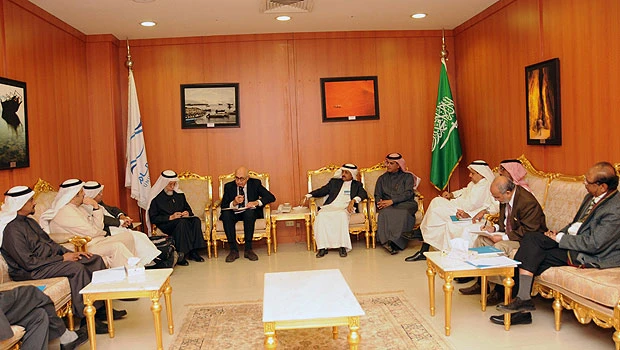
Nader Ardalan of the university's Graduate School of Design was hosted by Dammam University’s College of Architecture and Planning. He interacted with the faculty members, researchers and students at the university to get a first-hand knowledge of current architectural developments and rapid urbanization.
Hani Mohammad Al-Qahtany, faculty member at Dammam University’s College of Architecture and Planning, is coordinating the research project in Saudi Arabia, and it was he who introduced Ardalan to local researchers and academics.
Ardalan is a senior research associate for the Gulf Encyclopedia for Sustainable Urbanism (GESU) project. His university is carrying out a multi-faculty and multi-year research on the entire Gulf region, looking at the development in eight countries including Saudi Arabia, Kuwait, the UAE, Oman, Qatar and Bahrain.
Talking to Arab News, Ardalan said he first visited Saudi Arabia in 1973. “I was commissioned by Saudi Arabia’s Ministry of Finance to document the history of the Holy Kaaba and to write about the first major expansion of the Grand Mosque in Makkah,” he said. “His research was published in a book form by the ministry.”
Ardalan performed Haj in 1973 and has since then visited Saudi Arabia many times.
Explaining the finer details of his current research, Ardalan said: “The main focus of the commissioned research is the future of urbanism in the coastal region, on a sustainable basis, both environmentally and socioeconomically. The coastal region has been selected since coastal cities have an impact on each other through the water body, regardless of their own country, and the Gulf region is in a key geopolitical location, amidst global trade routes and with substantial natural resources.”
As part of the project, 10 cities in this region have been selected for detailed study. “Dammam is one of them, and we have felt that in order to understand Dammam we should also study Hofuf because it is a traditional city.”
He said the study is divided into three parts. “To study the history of how people have built this area; to study how they are building their cities now, their benefits and their shortcomings; and finally to make recommendations on how to build energy efficient, culturally relevant and environmental friendly buildings,” Ardalan said.
Al-Qahtany said the location of the Gulf is of strategic importance to worldwide researchers. “The Gulf region is the powerhouse of the world; this project is called GESU which stands for Gulf Encyclopedia for Sustainable Urbanism...it is a holistic work and covers many scientific aspects,” he told Arab News.
Al-Qahtany explained the importance of the project. “The name of the project itself reflects the aims and the focus of the research that is being undertaken. It is being sponsored by a private group. We can extend it to all other cities in the Gulf. However, this needs manpower, researchers, agencies, and a full-fledged team. More important than everything, it needs financial support, either by the government or the private sector.”
The focus is on two cities in the Eastern Province — Dammam and Hofuf. “The project has been going on for less than a year and its progress is excellent,” said Al-Qahtany. “Intellectuals, corporate houses, establishments, municipalities and literary clubs can participate in this project and contribute their views and opinions of the development of this region,” he said.