- In a major blow to the repressive regime of Syria, the United Nations’ main human rights body condemned Damascus yesterday for the “brutal” use of heavy weapons on residential areas, killing innocent people and persecuting opponents.
- It is its fourth rebuke to President Bashar Assad since an uprising began last year.
Delivering opening remarks yesterday at the urgent debate on the human rights and humanitarian situation in Syria, Bandar Bin Mohammed Al-Aiban, chief of the Kingdom’s Human Rights Commission (HRC), urged the international community to unite in sending a clear message to the Syrian authorities to stop the killings and the Security Council to assume its responsibility to protect the country’s population.
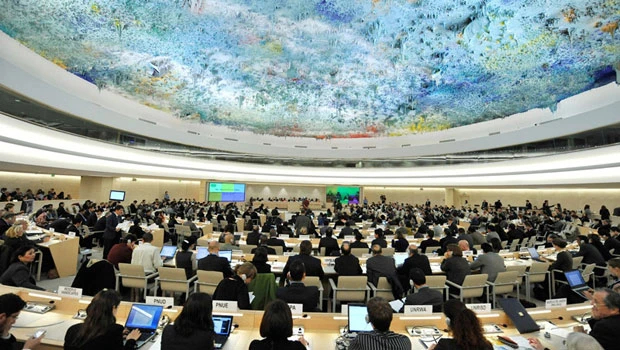
The urgent debate at the UN Human Rights Council came at the request of Turkey and three Gulf countries, Saudi Arabia, Qatar and Kuwait, along with Western partners.
Addressing the members attending the 19th session of the UN Human Rights Council in Geneva, Al-Aiban said the current session of the council is being held in very critical circumstances.
“We can see and feel the serious deterioration of the human rights situation in Syria,” said Al-Aiban.
Saudi Arabia has earlier warned against the serious and tragic consequences for the human rights situation in Syria on several occasions in the past, he added. Yesterday, the 47-member forum in Geneva were set to back a resolution condemning Syria’s “continued widespread and systematic violations.”
Referring to the Kingdom’s stance on Syria and its keen resolve to ensure peace and security in the Middle East at large, Al-Aiban said: “The economic and social prosperity as well as political stability are important pillars of building societies and promoting their rights.”
Saudi Arabia pays adequate attention to achieve comprehensive and sustainable development with the aim to raise the standard of living, ensure prosperity and stability, and provide work opportunities, he added. To this end, the HRC chief said Saudi Arabia has allocated 24 percent of the approved expenditure in its 2012 budget for the education and training sector and 26 percent for health services and social development. He also highlighted the efforts exerted by the Kingdom in order to promote human dignity and preserve human rights, noting the Saudi government has established the National Anti-Corruption Commission to promote the principle of transparency and protection of human rights.
“As part of enhancing the active participation of Saudi women in the comprehensive development witnessed by the Kingdom, Custodian of the Two Holy Mosques King Abdullah has issued a decision granting women the right to the membership of the Shoura Council,” said Al-Aiban amid cheers from the guests.
On the question of Syria, he called on the international community to unify ranks and file and work hard to ensure peace and security in the country.
“Syria is in urgent need of help from Arab nations and the international community,” said Al-Aiban.
The resolution to be adopted by the UN Human Rights Council condemns “the use of heavy artillery and tanks to attack residential areas … that have led to the death of thousands of innocent civilians.”
It also voices alarm at the humanitarian crisis in areas lacking food, medicine and fuel and calls for aid agencies to be allowed to deliver vital supplies to civilians in heavily-hit areas, especially Homs, Deraa and Zabadani in Syria.
Assad sent units of an elite armored division into Homs yesterday as rebel-held districts came under the heaviest bombardment of a three-week-old offensive, opposition sources in the city said.
The Syrian Arab Red Crescent managed to enter the embattled Homs district of Baba Amro on Monday and evacuate three people, said a Reuters report, adding that one of two injured Western journalists, Paul Conroy of the Sunday Times, had been smuggled out of Homs to Lebanon.
The Human Rights Council in Geneva, opened its annual four-week session on Monday, days after UN investigators accused the highest levels of the Syrian government and army of ordering crimes against humanity including murder, rape and torture.
“The commission of inquiry clearly established that crimes against humanity are being committed,” French Foreign Minister Alain Juppe said in an interview with Swiss television. “As long as we have not halted the massacres, we are impotent, but we are not inactive,” Juppe said.
Juppe told the forum on Monday the Assad government should be referred to the International Criminal Court (ICC).
UN High Commissioner for Human Rights Navi Pillay and Esther Brimmer, US assistant secretary of state, were among more than 70 speakers to address the Geneva-based forum later yesterday.
In her address, Pillay welcomed the decision to hold an urgent debate on the situation in Syria.
The Human Rights Council continued with its high-level segment, hearing statements from 14 dignitaries who spoke about the human rights situation in Syria, the Universal Periodic Review and the Special Procedures, and national efforts to promote and protect human rights, among other issues.
During the meeting, many speakers condemned the indiscriminate and brutal attacks against civilians in Syria and supported the course of action undertaken by the Arab League and the efforts deployed by the United Nations to find ways to re-establish peace and dialogue, with a view to settling this crisis.
“People are demanding freedom: Freedom from fear, and freedom from want,” Pillay said, referring to the global protests in support of political, social and economic rights. These movements have demonstrated, she said, that human rights is as important a pillar of UN action as development and peace and security.
Pillay called for an immediate humanitarian cease-fire in Syria, saying the situation in the country has deteriorated rapidly in recent weeks. She said the international community has to take action to prevent Syrian security forces from continuing their attacks against civilians, which she said had resulted in “countless atrocities.”
There must be an immediate humanitarian cease-fire to end the fighting and bombardments, Pillay added. Pillay reiterated her call for Syria to be referred to the International Criminal Court “in the face of the unspeakable violations that take place every moment.”
A huge majority of the members, except Iran, Russia and a few other states, “conveyed a strong and unanimous message from the international community condemning the violence and repression of legitimate popular demands for greater democratization and respect of human rights.”
Nassir Abdulaziz Al-Nasser, President of the UN General Assembly, Qatar, in his address said the work of the Council at this time had never been “as critical, pivotal or as pressing.”
He also paid tribute to the Council for its response to several recent urgent human rights situations in various countries.