
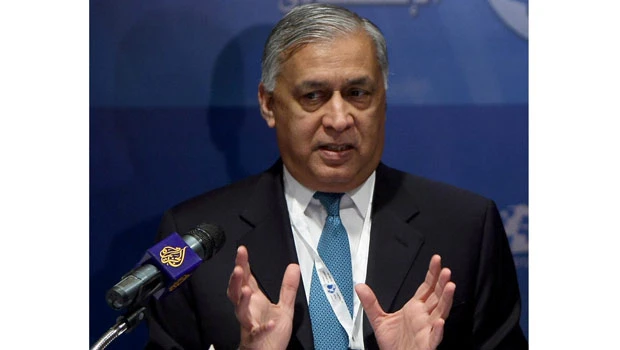
- JEDDAH: Saudi Arabia’s economic and political relations with Pakistan continue to grow because they are based on close fraternal ties and solid foundations, said Pakistan’s former Prime Minister Shaukat Aziz.
Speaking to Arab News on the sidelines of the Jeddah Economic Forum, he said the ties are rock-solid. “Our geopolitical relations continue to guide our bilateral ties … Everyone in Pakistan respects Saudi Arabia, its farsighted rulers and the Saudi people … We have always had close people-to-people contacts. Since the Kingdom is home to the Two Holy Mosques, this is the most influential factor in guiding and solidifying the links between our two countries,” said Aziz.
As one of the speakers at the 12th Jeddah Economic Forum, he was part of the panel discussion on “Beyond BRICS (Brazil, Russia, India, China and South Africa) — Seeking Economic Growth in an Era of Debt Beyond Borders.”
“Leaders of both countries often visit each other … Saudi Arabia is considered a true friend of Pakistan,” he said. “What is more, thousands of Pakistanis have been visiting the Kingdom to perform the annual Haj and the year-round minor pilgrimage (Umrah).”
Aziz is considered a top international banking expert and he served as Pakistan’s prime minister from 2004-2007. He was the country’s finance minister for five years from 1999. He said his country has a huge potential for development. “Pakistan is developing, but the events in neighboring Afghanistan have overshadowed our economic progress … Once the situation improves in Afghanistan, our economy will get a big boost," said Aziz.
He said the Kingdom had made progress in various sectors. “Saudi Arabia’s education system is getting better and better. The demographic situation is much better than the last 20 years. Saudi Arabia’s location is very good. It is ideally situated between the East and the West. The Kingdom’s infrastructure is excellent and it is attracting foreign direct investment, and for any country’s economic development foreign investment is crucial,” said Aziz. "I am an eyewitness to the Kingdom's economic development as I spent considerable time here in the country as a banker," Aziz added.
On Pakistan-India relations, Aziz shared the optimistic view expressed earlier by Anil Gupta, professor at the University of Maryland and chief adviser to the China India Institute. “The relations between the two countries are good and improving. There are some issues between the two countries, but they will be resolved amicably,” said Aziz. “Trade ties between the two countries are also improving and once the political issues are sorted out there will be a great potential for expansion.”
On Europe’s debt problem and its impact on other countries, Aziz admitted that it has affected BRICS countries. “There is no doubt about that,” he said. “The slowdown in Europe has affected and will affect the rest of the world.”
According to him, Europe is going trough many challenges. “But they are addressing them. For multilateral groups such as the European Union to work, countries have to agree to give up some of their economic sovereignty to Brussels, and giving that up is not easy. That process has posed certain challenges. This in turn has disrupted cohesion, which is what Europe required.”
On the proposed monetary union among Gulf Cooperation Council countries, Aziz said there is no reason why it cannot succeed. “If there is a political will it can be done,” he said.
He said rising prices of oil cannot be blamed on OPEC. “They are result of geopolitical events,” said Aziz.
According to him, Africa is providing the most attractive opportunities for investors. “Africa is a mining continent and provides market-based opportunities for investors; its agricultural potential is huge and there is worldwide investor interest in the continent,” he said.