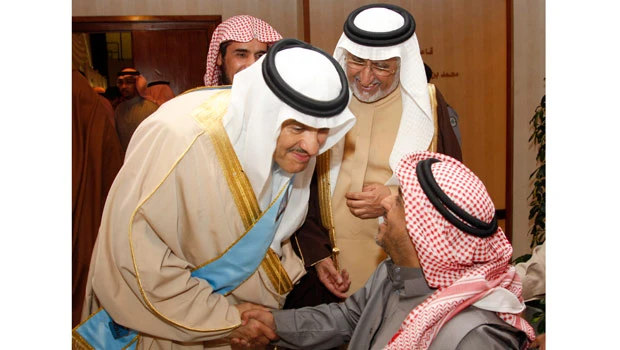
- Saudi Commission for Tourism and Antiquities chief Prince Sultan bin Salman yesterday delivered a lecture at Imam Muhammad bin Saud Islamic University where he talked about his success in the development of the tourism sector in the Kingdom and his space trip.
Meeting university students and employees at the university’s Sheikh Mohammed bin Ibrahim Al-Asheikh Hall, Prince Sultan also talked about his other achievements in the tourism sector.
The lecture comes as part of a program adopted by the university rector, Suleiman bin Abdullah Aba Al-Khail, involving the promotion of talent leadership, creativity and excellence and aims to instill confidence in its students and harness their potential.
Prince Sultan is among the most prominent speakers to be featured at the university out of a host of talented scientists and prominent thinkers who set clear steps and achieved milestones due to the political, scientific and intellectual skills they enjoy.
Prince Sultan was the founder and the chairman of the Saudi Aviation Club and chairman of the Children with Disabilities Society in Saudi Arabia.
He founded and chaired the Prince Sultan bin Salman Award for Architectural Heritage and is chairman of the Prince Salman Center for Disability Research’s executive committee, among others.
Dean of talent, creativity and excellence Abdullah bin Thani said: “Prince Sultan reviewed his space trip and the story of his success in the development of the Saudi Commission for Tourism and Antiquities and the most important points of his life. Students should be encouraged to hold the prince as an example for them to work hard for future success.”
Prince Sultan talked about his achievements to improve and develop tourism and the main agreements he signed with many countries to strengthen the sector in the Kingdom.
The lecture featured certain highlights of Prince Sultan’s CV, including founding and chairing the Prince Sultan bin Salman award for Qur’an memorization for children with disabilities and he was the founder and president of the not-for-profit Heritage company.
In the lecture, it was revealed before his space trip, the prince went through high-level training including learning how to deploy the Arab satellite at a distance of 320 km from the Earth's surface as well as how to use a camera to take pictures of the Arabian Peninsula.
On June 17, 1985, shuttle “Discovery” made history with the launch of the first Arab and Muslim astronaut in space.
On the first day of the trip television screens broadcast the deployment of satellites. On the second day an Arab satellite was launched and on the third day Prince Sultan and his colleague Patrick Baudry conducted a series of experiments to monitor the human body in the absence of gravity.
The prince’s successful space trip continued and he eventually returned to a great reception in Riyadh on July 11, 1985.
The university students expressed their great appreciation to the prince for his visit and commented on his interesting space journey into space and how tourism in the Kingdom has greatly increased.
One university student said: “I benefited a lot from the lecture and this will encourage me to start a journey to secure a good future.”