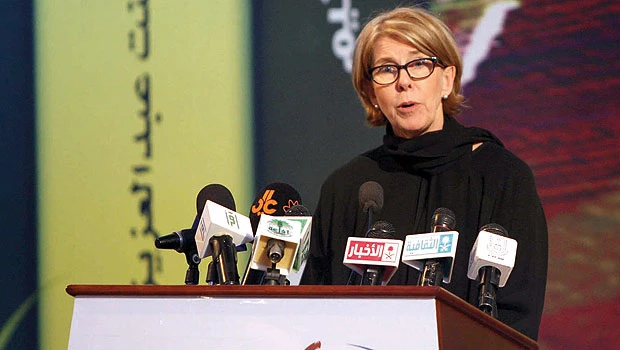
- The participation of Sweden in the Riyadh Book Fair 2012 has given an opportunity to Saudis to find out more about the European country, said a leading Swedish official at the event yesterday.
“It is my privilege to attend the Riyadh Book Fair at a time when mutual knowledge and appreciation of Swedish and Saudi culture, society and arts can be increased on our part,” said Director General of the Swedish Institute Annika Rembe, who headed the Swedish delegation.
“Through literature and mutual travel, I hope relations between Sweden and Saudi Arabia will continue to develop at all levels of society and through business, friendship, and culture.”
She noted the program would include a meeting between poets from Saudi Arabia and Sweden.
“As an avid reader, I look forward to this Book Fair as an opportunity to learn more about Saudi literature — both current and from a historic perspective. It is my belief that culture, and the written word, plays an important part in shaping a society in the same way exchanging books with a friend can be a way to get to know them better,” she added.
“Translations and exchange of literature provide a way to reach increased cultural understanding and openness.”
Rembe said when a friend gives another a book to read, he or she rarely does so without an introduction.
“In order to understand a book — or an entire culture — it is important to view it in its historical context. What influences has shaped the author, and his view of his work?” she said.
“What view of the world did his readers share? Before we open each other’s books here at the Riyadh Book Fair, I would like to say a few words about some influences that shape authors in Sweden. I do this without being a scholar of literature — but from a perspective where literature merges with other factors that shape society.”
Rembe said Sweden places great importance on literature. Aside from the Nobel Prize, Sweden also awards the largest international award for children’s literature, she added.
“Both these awards honor literature of the highest quality from all over the world. But literary merits are not the only aspect by which winners are judged — their works must also promote a humanistic tradition. This is a reflection of the role of literature in Sweden rather than enjoyment and entertainment. Literature has also been a vital ingredient in creating an inventive and open society,” she said.
More than 160 years ago in 1842, the Swedish government decreed that schooling was mandatory for all Swedish children and it should be provided at the expense of the public sector, she said, adding at the same time the development of public libraries began all over the country. This was the beginning of an important rise in literacy and education, which fundamentally impacted the development of Swedish society.
Equality of educational opportunities along with access to literature and self-education through public libraries have led to a high level of mobility within Swedish society, and a large number of students in secondary and university education, she said.
“This in turn has proved beneficial to research and innovation. Today, Sweden ranks among the most innovative nations and is home to a number of high-tech, research-driven corporations in fields such as clean-tech, medicine and communications technology,” she added.
She said children’s literature has been a vital ingredient in schools and through public libraries, creating a clear link between high quality literature for those beginning to read and important developments in the fields of economic, environmental and social importance.
She said this link is also true in reverse. Because of the importance placed on book reading among children, the status of children’s literature is high in Sweden, leading to a number of excellent authors and illustrators focusing mainly on children’s literature, she added. This has led to a number of artistic, sensitive and high-quality work taking the perspective of the child and advocating children’s rights, she said.
“Another important effect of the high level of mobility and education that we have enjoyed is the number of authors coming from quite humble backgrounds, who shape our understanding of our history by writing their experiences. Among Swedish classics, starting around the turn of the last century, a number of the most important works depict life among the working-class, in the countryside, and in industries,” she said.
“As each new generation comes to know these stories, we gain an openness and understanding between different geographical and socioeconomic regions within the country. In later years, a number of very interesting works by immigrants and descendants of immigrants have come to join this canon.”
She said a society that places a premium on reading naturally provides a wide variety of genres to cater to differences in taste among the readers. In Sweden, detective and crime fiction has a very high readership among broad layers of the population, she said.
“This hungry market creates opportunity for a large number of writers within that field — and some of these have proven to do quite well with international audiences as well. It is my firm belief that having a population that views reading as a natural occupation facilitates the emergence of successful writers,” she said.
“Over the next few days, our invited experts will give their in-depth analysis of a number of different perspectives in ways that literature has impacted Swedish society.”
She said Larry Lempert of the Astrid Lindgren Memorial Award will speak on public libraries and their role in promoting reading among the youth. Ulf Stark, distinguished author of numerous children’s books, will discuss the role of literature in increasing mutual understanding and globalization. Professor Joseph Nordgren will give his views on the subject of education-research-innovation as a strategic triangle for development.
“I am convinced that our Swedish delegation and experts will learn as much from dialogue with their Saudi counterparts, as they can give to their audiences here at the fair. I would like to close by extending a warm and open invitation to all Saudis. It is my sincere hope that the interest you show in Swedish literature may be transformed into a visit to our country,” Rembe said.
“Though it is far up north, and snowy in the winter, I can promise you a very warm welcome whether you choose to bring your family to a country of stunning nature and fresh air, whether you travel on business to one of our major urban regions, or whether you come as a student to one of the 22 Swedish universities that are acknowledged by the Saudi Ministry of Higher Education and the King Abdullah Scholarship Program.”