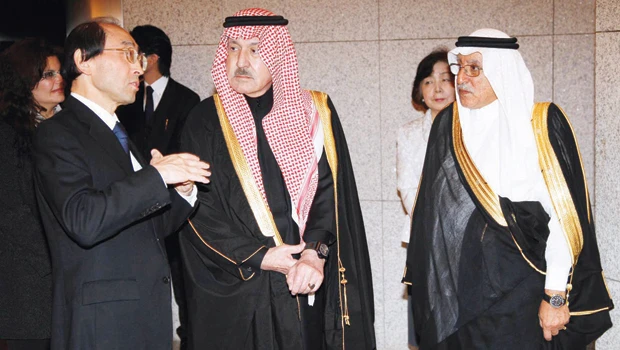
- RIYADH: The Japanese Embassy in Riyadh commemorated the Great East Japan Earthquake that occurred last March at a solemn ceremony held in the presence of Riyadh Gov.
- Prince Sattam in Riyadh on Thursday.
“A year has passed since March 11, 2011 when the earthquake hit the east of Japan. Impacts left by the unprecedented earthquake and tsunami are still too extensive and deep to be contained. Japan is currently working very hard for reconstruction,” Japanese Ambassador Shigeru Endo said at the commemoration at his residence.
The function was largely attended by senior government officials, members of the diplomatic corps and well-wishers of Japan.
“The ceremony is organized to reiterate our deepest appreciation for the support and encouragement extended by the government and people of Saudi Arabia and numerous countries around the world. We would also like to reaffirm our unwavering resolution to overcome the formidable challenge,” the envoy said.
The ambassador revealed that 160 countries and 40 international organizations offered assistance following the natural disaster.
After a moment of silence, representatives from Saudi Arabian Oil Company and the Alwaleed Bin Talal Foundation received certificates of appreciation from the ambassador.
Photos showing Japan’s efforts for recovery and reconstruction were displayed. The exhibits included pictures of Sedai Airport which was damaged and flooded by tsunami waters but was repaired and put back in service in a month as well as a completely disrupted motorway which was mended in a week.
Deputy Foreign Minister for Protocol Affairs Alauddin Al-Askar expressed the Kingdom’s sentiments on the tragedy in which more than 20,000 people died and 340,000 became homeless.
Earlier, Endo said that the supply chain for the manufacturing sector has been completely restored. “Production levels in the mining and manufacturing sectors have now recovered to levels prior to the disaster,” he said, adding that 80 percent of disaster-stricken local governments have completed formation of a reconstruction plan. It includes ambitious targets to become global models for the introduction of renewable energies and development of hubs for advanced medicine.
“Through the realization of these plans, it is our aim to generate reconstruction-led demand in a tangible way.” He pointed out that at the end of the last year, a state of cold shutdown of the nuclear reactors was achieved in the process to their decommissioning.
“Japan will continue to give first priority to food safety and the health management of residents in the vicinity of the power station. Nearly all regions have returned to normalcy. We hope that people will come to Japan for work, tourism and study with peace of mind,” he said, hoping foreign investments will follow from Japan’s partners in the reconstruction work.
The envoy said his country is prepared to share the knowledge and lessons learnt from the disaster with the rest of the world and leave this knowledge for posterity. “We remain committed to making information available to all countries with a maximum degree of transparency, particularly in areas such as enhancement of nuclear safety and disaster prevention.”