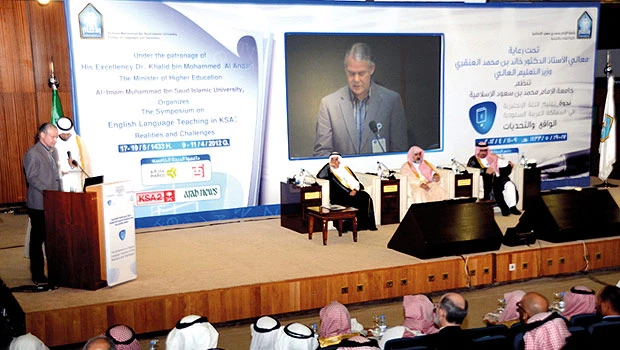
- An American-Arab academic stressed more focus should be placed on the teaching of literacy skills, reading and writing in order to promote the teaching of English in Saudi Arabia.
He said to compete globally, study skills and learner autonomy need to be emphasized in any future English curricula.
Dr. Mohammed Errihani highlighted these points in his keynote presentation on the second day of the symposium on the teaching of the English language and its realities and challenges being organized by the College of Languages and Translation at Imam University.
Errihani, assistant professor of English and director of the English language program at Purdue University Calumet in the US, said these are the most daunting challenges that Saudi students face in learning the language in America in his presentation on preparing Saudi students in the Kingdom to be successful in the USA.
Speaking on academic challenges, Errihani said a lack of accountability, motivation and excuses for not completing assignments are some of these challenges as well as poor study skills.
Other shortcomings that have to be overcome include poor time management and note-taking and preparing for the next class.
“They have difficulty in reading for academic purposes and for pleasure, and vocabulary is limited because of the lack of reading, no positive transfer and very few aids to reading and understanding vocabulary. Students also face writing challenges, be it a paragraph or an essay. They also cannot distinguish between upper and lowercase letters or when to capitalize. Punctuation rules in Arabic are much looser than they are in English. Similarly, there are misuses of relative and adjective clauses, because the rules of English grammar are alien to the speakers of Arabic language,” he said.
There are also problems in stylistic and rhetorical devices such as exaggeration, assertion as part of the Arabic linguistic tradition and is true in both written and spoken language, he added.
He added: “Sentence level mastery is not the ultimate goal of ESL students, who are required to learn English syntax and its logic and rhetoric. That’s why knowledge of contrastive rhetoric is necessary for the English teacher.”
Composition in Arabic consists of a series of parallel constructions with coordinating conjunctions, while English relies heavily on subordination, he said.
“Other academic challenges are literacy avoidance strategies. For instance, asking the teachers of another student to explain assignment directions instead or reading the material themselves. Also, they wait to see what other students will do first. They rely on oral pre-reading discussion for comprehension of a text instead of relying on the written text. They take pictures of homework on the board, besides not taking notes during a lecture, not willing to re-write, or are handicapped by their inability to proof-read their own writing so as not to repeat the same errors.”
The lecturer said these methodologies, combined with ineffective study skills, could severely impair the literacy drive in the Kingdom.
He also wanted teachers to integrate students into the learning process by letting them set their own goals as well as identifying and developing learning strategies to achieve those goals.
Abdulrazak Mohamed Elsagheer from Al Baha University said in light of a study on the challenges of teaching and learning English, it is recommended to train the new EFL teachers to use English as a medium of instruction during the process of English language teaching instead of depending on Arabic.
Other recommendations is to draw the attention of EFL teachers to the need for integrating the language skills of listening, speaking, reading, and writing during the teaching of English rather than dealing with these skills as separate language skills and providing pre-university schools with language labs and multimedia so that both teachers and students can use them in teaching and learning English.
In order to overcome the challenges, Elsagheer suggested solutions such as using language as a communication tool, using EFL sources of knowledge, variance of teaching methods, make use of additional materials, adopting the communicative approach, clarity of the lesson objectives, and using the multimedia language lab by integrating language skills.