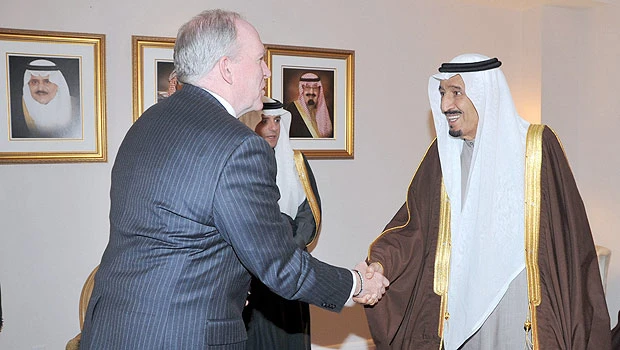
- Defense Minister Prince Salman started his official visit to the United States to boost bilateral relations amid volatility in the region in which Iran has been posing a threat to its stability.
- On his arrival on Wednesday at the Pentagon, Prince Salman met his American counterpart, US Secretary of Defense Leon Panetta.
Prince Salman also met with President Obama in the White House to discuss bilateral issues. After conveying him greetings of Custodian of the Two Holy Mosques King Abdullah, Prince Salman engaged in productive talks with the president with regard to a wide range of bilateral and regional issues. Prince Salman was accompanied by Minister of State Musaed Al-Aiban and Saudi Ambassador to the US Adel Al-Jubeir.
As Saudi Arabia has been backing the Syrian people’s right to freedom, the crisis in Syria was the focus of the prince’s discussion with officials in Washington. “Clearly, both countries share a concern about what is happening in that country,” Pentagon press secretary George Little told reporters after Prince Salman and US Defense Secretary Leon Panetta met.
All along, the Saudi officials have been arguing that the Syrian regime is untrustworthy. They also believe that Assad has been buying time to crack down on protesters in his desperate bid to survive politically. However, it seems that the people in Syria are adamant to rid their country of this regime. For this reason, Riyadh has been on record calling for arming rebels to enable them to win over the regime. And yet, the United States is not keen on arming the rebels before they get united. On more than one occasion, the American administration stressed out that Washington is in favor of providing rebels with non-military assistance.
It is not clear yet whether the talks with the American secretary of defense touched the burning issue of arming rebel fighters in Syria. The American position is clear: “to put political and economic pressure on the regime to try to stop the violence against civilians in that country,” press secretary George Little said.
The meetings came as Syria announced it would honor Kofi Annan’s plan for a truce. Earlier, Annan had said he had obtained a written pledge from the Syrian government promising to cease fire, but top American officials expressed their skepticism about the sincerity of the regime.
In his meetings with the Americans, the Saudi prince insinuated that although his country is interested in keeping the strategic relationship with the United States, Riyadh is not happy with some of the American policies in the region. Saudi Arabia has been an element of stability in the region, and the United States should listen to the voice of this important regional player.