
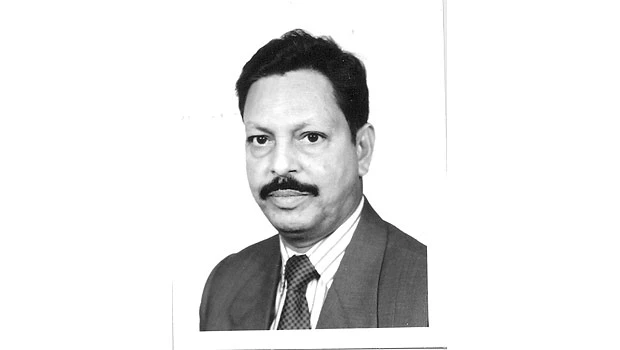
- After 36 eventful years, a senior Indian geologist is leaving the Kingdom for good with fond memories of his “home away from home.”
Mohammed Najmuddin, who has seen the Kingdom developing over three decades, is leaving the country on April 26, with his wife Khadija Farzana. They described their residency as “eventful and satisfying.” Their only child Qudsia, who was born in Jeddah in 1988, is happily married in Hyderabad.
Najmuddin said during his stay in the Kingdom, he went through many memorable moments. “But my visit to India, my motherland, as a member of the Saudi delegation, which was part of Custodian of the Two Holy Mosques King Abdullah's visit in 2008, is the proudest among all and will always hold a special place in my memory,” he said.
“This trip was very important to me for many reasons. First, it was an honor to be a member of such a high-profile delegation and secondly, it gave me a golden opportunity to interact with my Indian counterparts and other experts and enrich my knowledge,” Najmuddin said.
A nostalgic Najmuddin vividly recollects the day he arrived in Jeddah. “It was a pleasant evening in September, in 1976, that I first arrived in Jeddah from Beirut, where I stayed for three months. I just fell in love with the Bride of the Red Sea,” he said.
“It was love at first sight.”
Speaking about old Jeddah, Najmuddin said, “It was a small city with a population of just 270,000; its northern limit up to the Pepsi Bridge on Madinah Road. I will not say life in Jeddah was bad, but it was of course challenging those days. Water supply was on donkeys.
Hawkers used to ferry water on their shoulders and charged SR4 for two cans. The only mode of public transport was the private coacher service,” he said.
Born in Hyderabad in 1950, Najmuddin got a bachelor's degree in geology from Osmania University in 1971. He went to the prestigious Aligarh Muslim University to get his master's in 1974. He was awarded a British fellowship in 1982.
Najmuddin had joined the United Nations Development Program's (UNDP's) Master Plans for the Western Region of Saudi Arabia in 1977.
When he was transferred to Iraq in 1979, he quit the job preferring to stay in Jeddah instead. He joined British Geological Mission, under the Saudi Ministry of Petroleum and Mineral Resources, the same year.
Najmuddin, who has seen Jeddah expanding and developing over the past 36 years, said: “Balad was the only market place those days. It was also the place to meet friends and relatives. There were no shopping malls like today. When Al-Mukhtar Super Market opened a few years later, it became an instant hit.”
The popular fast food chain Al-Baik had opened in 1974 (with a different name). Its first outlet was in Al-Dakheel Building, better known as La-ilaha-illallah Building, on Madinah Road. The initial response was lackluster. The outlet was serving not more than 100 customers a day during the first 90 days, Najmuddin said.
Not only that Najmuddin has seen Jeddah changing, he also saw the changing color and content of Arab News.
“Arab News started publication in 1975 and when I arrived, it's just a rag-tag bunch of news collected from different newspapers. Gradually, it became a world-class newspaper, giving a vivid picture of the rich Saudi culture and heritage. Its contributions, specially in women's empowerment and spreading educational awareness, can never be ignored,” said Najmuddin.
While speaking about his experiences in the Kingdom, Najmuddin became emotional. He was nostalgic when he spoke about the holy Ramadan of yesteryears. “I will miss our Saudi friends and the iftars with them during Ramadan. It has given me many unforgettable and beautiful moments.”
The departing expatriate praised Saudi Arabia and its citizens for their honesty, simplicity and generosity. “It still is the safest place on the face of earth with a friendly and hospitable people, making it the ideal learning ground for expatriate workers,” he said.