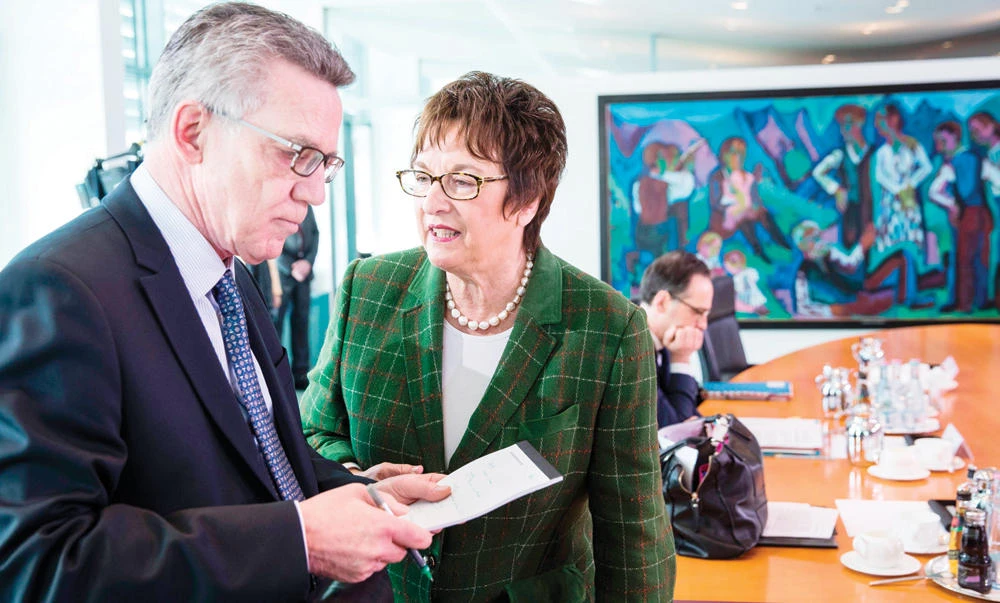
BERLIN: The “America First” trade policy advocated by US President Donald Trump is no recipe for generating more economic growth and jobs and it is up to Europeans to convince him of that, Germany’s economy minister said.
Brigitte Zypries cited a study by the Paris-based Organization for Economic Cooperation and Development (OECD) as showing that open trade was crucial to economic prosperity.
“So it is all the more important that we in Germany, that we as Europeans, convince the US that ‘America First’ is not a strategy for more growth and jobs,” she said at a business event hosted by her center-left Social Democrats (SPD) in Berlin.
Trump wants an “America First” trade policy with better-negotiated trade deals and stronger enforcement of US trade laws.
Financial leaders of the world’s biggest economies dropped a pledge earlier this month to keep global trade free and open, acquiescing to an increasingly protectionist US after a two-day meeting failed to yield a compromise.
Breaking a decade-long tradition of endorsing open trade, G-20 finance ministers and central bankers made only a token reference to trade in their communique at the meeting in Baden Baden, hosted by German Finance Minister Wolfgang Schaeuble.
Zypries said the change of US policy under Trump’s administration meant it would be hard for Germany to make progress during its presidency of the G-20 this year.
“We saw at colleague Schaeuble’s meeting in Baden Baden that things are not particularly easy in the G-20 framework at the moment,” she said, adding that Trump’s administration had also played a “backwards role” on data protection and climate policy.
“The US has not only loosened environmental standards but also data pro tection standards,” she said.
“Not good news for us,” she added, and this would make it harder to make a success of a debut meeting of G-20 ministers responsible for digitization in early April.
In a related development, a recent survey by the tourism marketing agency Brand USA revealed that some international travelers are citing politics as a factor in whether to visit the US this year.
The survey for Brand USA asked travelers from 11 countries how the political climate influenced the likelihood of them visiting the US in the next 12 months.
Those saying the political climate made them less likely to visit increased from December to February among travelers from every country surveyed but China.
Travelers from Mexico registered the most concern over political sentiment as a factor against visiting.
Travelers from Canada, Germany, Australia, the United Kingdom and France registered moderate sensitivity over political sentiment.
Travelers from India, Japan, Brazil and South Korea were the least sensitive to the US political climate as a factor against visiting, but their likelihood of visiting also decreased over the three-month period, just less dramatically than the others.
Chinese travelers were the only nationality in the survey who said the US political climate made them more likely to visit.
Brand USA surveys typically provide a multiple-choice list of factors influencing travel plans. Last summer, respondents began writing in issues related to politics as a factor.
“So we created a discreet option for that and began to measure that,” Carroll Rheem, Brand USA economist, said.
When international travelers were asked in December and again in February “what if any impact the political climate has on their likelihood to visit the US... over the course of time we saw an increase in that as a reason for people being discouraged from visiting the US,” she said.
International arrivals to the US last year experienced the first sustained decline since the US economy began to recover from the recession, according to newly released and revised arrivals data from the US Department of Commerce National Travel and Tourism Office.
Between April and August of 2016, international arrivals to the US dropped nearly 4 percent compared with the same five months of 2015, declining from 17.8 million to 17.1 million, the data shows.
Prior to the second quarter of 2016, international arrivals to the US had climbed every quarter year-over-year since late 2009.
It takes months for arrivals data to accurately be compiled from all US international airports and border crossings, so whether the downward trend continued into fall 2016 and winter 2017 won’t be clear for some time.
BOOKING DATA
Despite concerns raised by arrivals and survey data, Rheem said preliminary data on airline bookings to the US for 2017 shows continued growth. That booking data “is consistent with what we’re hearing from the trade,” Rheem said.
“They have said things are stable if not growing. So some of the headlines out there about dramatic downward shifts or challenges in bookings are not really consistent with what we’ve been seeing in that data.”
Rheem cautioned that it is “hard to tell” what the impact of the political concerns showing up in surveys might be. Arrivals data shows what’s already happened, but surveys merely hint at future behavior.
“There’s a good group of these people who have concerns who have a wait-and-see approach” about vacation planning, she said.
“And there are others who are somewhat impacted or slightly negative but at the same time will end up booking. It’s not a complete deterrent, but it’s a bit of a concern.”
Sentiment versus booking behavior “don’t always break in the same direction,” she said.
Brand USA adjusts its marketing strategies in response to survey trends in an effort to make travelers feel secure about concerns that might prevent a visit.
One strategy involves inviting “influencers” — individuals with large online or social-media followings — to visit the US and then tell stories about their (hopefully positive) experiences.
Brigitte Zypries cited a study by the Paris-based Organization for Economic Cooperation and Development (OECD) as showing that open trade was crucial to economic prosperity.
“So it is all the more important that we in Germany, that we as Europeans, convince the US that ‘America First’ is not a strategy for more growth and jobs,” she said at a business event hosted by her center-left Social Democrats (SPD) in Berlin.
Trump wants an “America First” trade policy with better-negotiated trade deals and stronger enforcement of US trade laws.
Financial leaders of the world’s biggest economies dropped a pledge earlier this month to keep global trade free and open, acquiescing to an increasingly protectionist US after a two-day meeting failed to yield a compromise.
Breaking a decade-long tradition of endorsing open trade, G-20 finance ministers and central bankers made only a token reference to trade in their communique at the meeting in Baden Baden, hosted by German Finance Minister Wolfgang Schaeuble.
Zypries said the change of US policy under Trump’s administration meant it would be hard for Germany to make progress during its presidency of the G-20 this year.
“We saw at colleague Schaeuble’s meeting in Baden Baden that things are not particularly easy in the G-20 framework at the moment,” she said, adding that Trump’s administration had also played a “backwards role” on data protection and climate policy.
“The US has not only loosened environmental standards but also data pro tection standards,” she said.
“Not good news for us,” she added, and this would make it harder to make a success of a debut meeting of G-20 ministers responsible for digitization in early April.
In a related development, a recent survey by the tourism marketing agency Brand USA revealed that some international travelers are citing politics as a factor in whether to visit the US this year.
The survey for Brand USA asked travelers from 11 countries how the political climate influenced the likelihood of them visiting the US in the next 12 months.
Those saying the political climate made them less likely to visit increased from December to February among travelers from every country surveyed but China.
Travelers from Mexico registered the most concern over political sentiment as a factor against visiting.
Travelers from Canada, Germany, Australia, the United Kingdom and France registered moderate sensitivity over political sentiment.
Travelers from India, Japan, Brazil and South Korea were the least sensitive to the US political climate as a factor against visiting, but their likelihood of visiting also decreased over the three-month period, just less dramatically than the others.
Chinese travelers were the only nationality in the survey who said the US political climate made them more likely to visit.
Brand USA surveys typically provide a multiple-choice list of factors influencing travel plans. Last summer, respondents began writing in issues related to politics as a factor.
“So we created a discreet option for that and began to measure that,” Carroll Rheem, Brand USA economist, said.
When international travelers were asked in December and again in February “what if any impact the political climate has on their likelihood to visit the US... over the course of time we saw an increase in that as a reason for people being discouraged from visiting the US,” she said.
International arrivals to the US last year experienced the first sustained decline since the US economy began to recover from the recession, according to newly released and revised arrivals data from the US Department of Commerce National Travel and Tourism Office.
Between April and August of 2016, international arrivals to the US dropped nearly 4 percent compared with the same five months of 2015, declining from 17.8 million to 17.1 million, the data shows.
Prior to the second quarter of 2016, international arrivals to the US had climbed every quarter year-over-year since late 2009.
It takes months for arrivals data to accurately be compiled from all US international airports and border crossings, so whether the downward trend continued into fall 2016 and winter 2017 won’t be clear for some time.
BOOKING DATA
Despite concerns raised by arrivals and survey data, Rheem said preliminary data on airline bookings to the US for 2017 shows continued growth. That booking data “is consistent with what we’re hearing from the trade,” Rheem said.
“They have said things are stable if not growing. So some of the headlines out there about dramatic downward shifts or challenges in bookings are not really consistent with what we’ve been seeing in that data.”
Rheem cautioned that it is “hard to tell” what the impact of the political concerns showing up in surveys might be. Arrivals data shows what’s already happened, but surveys merely hint at future behavior.
“There’s a good group of these people who have concerns who have a wait-and-see approach” about vacation planning, she said.
“And there are others who are somewhat impacted or slightly negative but at the same time will end up booking. It’s not a complete deterrent, but it’s a bit of a concern.”
Sentiment versus booking behavior “don’t always break in the same direction,” she said.
Brand USA adjusts its marketing strategies in response to survey trends in an effort to make travelers feel secure about concerns that might prevent a visit.
One strategy involves inviting “influencers” — individuals with large online or social-media followings — to visit the US and then tell stories about their (hopefully positive) experiences.