PARIS: French nuclear group Areva has confirmed record net losses in 2014 of 4.8 billion euros ($5.3 billion) after it was forced to absorb costs linked to delays to its flagship next-generation reactor.
The mostly state-owned company, which had forecast losses of 4.9 billion euros, said it would make savings worth around one billion euros over the next few years and announce a financing plan by the end of March.
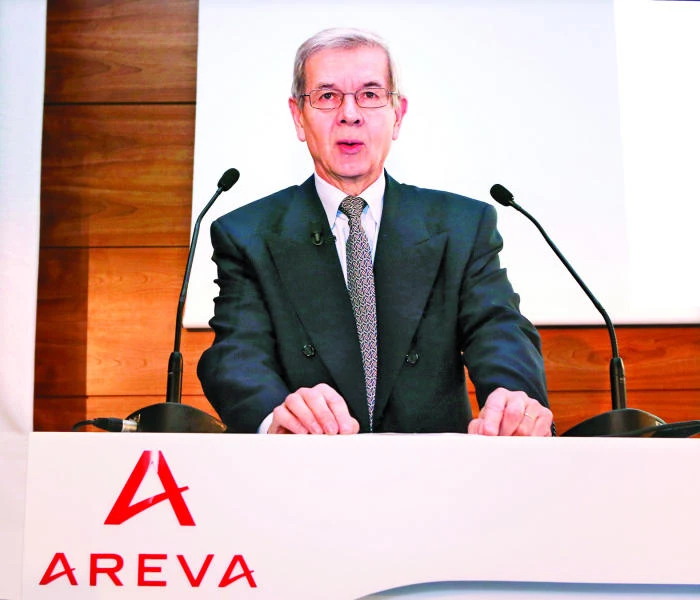
“The scale of the net loss for 2014 illustrates the two-fold challenge confronting Areva: continuing stagnation of the nuclear operations, lack of competitiveness and difficulties in managing the risks inherent in large projects,” CEO Philippe Knoche said in a statement.
Areva has taken a particular hit in the past year from delays in building its Olkiluoto 3 nuclear plant in Finland, as well as difficulties with its renewable energy contracts.
The company also said earlier there were impairment charges tied to the modernization of its uranium conversion plant, the Comurhex II project in France.
Write-downs in the value of its assets and losses on projects came to 4.35 billion euros.
The company, which is 87-percent owned by the French state, has suffered in recent years as interest in nuclear power has cooled following the 2011 Fukushima catastrophe in Japan.
Areva announced in October that it would cut investments and step up sales of non-strategic assets as it tries to shore up its finances.
“The challenge for all of us today is to implement the transformation plan in all its aspects, to make Areva, in the French nuclear industry, a refocused, simplified, competitive group in a position of recovery,” said Knoche.
Investments at the company, which hasn’t turned a profit since 2010, are expected to fall by 1.6 billion euros over the next three years compared with the previous three-year period to three billion euros.
More assets are to be sold than the 450-million-euro target announced last October.
Areva said it hoped increased efficiencies and refocusing on key nuclear activities would allow the company to return to margin levels “comparable to those of our competitors in different global markets” within three years.
The group is also hoping to expand its construction of nuclear plants in China, and secure new contracts elsewhere in surging, energy-hungry Asian economies.
But during a press conference after the announcement, Knoche said he couldn’t exclude job cuts, although Labor Minister Francois Rebsamen said no layoffs were planned.
“We will do everything so that if there are departures that it will be done on a volunteer basis,” said Knoche.
With unemployment running at near record levels in France, job cuts at major companies, particularly state-owned companies, are politically sensitive.
Unions responded with concerns not only about job cuts, but whether the cost-cutting plans were sufficient to cover the financial hit of the nearly five billion euro loss.
“It is clear that recapitalization is necessary,” said Jean-Pierre Bachmann, a representative of the French Democratic Labour Confederation union at Areva, who said the threat to jobs was only part of his problem with the restructuring plan.
“The group has not yet been saved. The state must assume its responsibilities.”
On Wednesday, Economy Minister Emmanuel Macron rejected the notion of direct state recapitalization of Areva as “premature.”
But other ways of injecting badly needed cash into company coffers are being considered.
Knoche held out the possibility of talks with EDF, the French state-owned electricity firm which is Areva’s top customer, about it taking a stake in the company.
France’s leftist government has backed further consolidation of the country’s nuclear energy sector, including through increased cross-holding stakes between the two companies.
“The state will examine proposals by the managements of EDF and Areva, which have begun discussions in view of a refoundation of the French sector... (which) is an essential factor in the energy independence of our country,” said a joint statement from Macron, Energy and Evironment Minister Segolene Royal and Finance Minsister Michel Sapin.
Areva nuclear group announces $5.3 billion loss