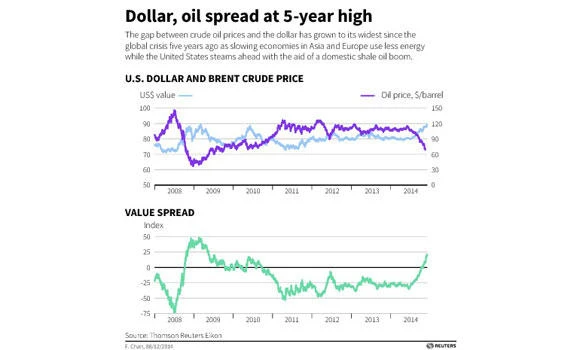
Lower oil prices will have a direct impact on the balance of payments and fiscal position of the Kingdom as Brent crude oil fell almost $2 a barrel on Monday to a new five-year low, analysts say.
However, the government is expected to maintain elevated fiscal expenditures; negative sentiment associated with fiscal deficits could slow down nonoil economic activity.
John Sfakianakis of Ashmore Group, said: “Obviously, any decline in oil prices could impact Saudi revenues as they comprise 90 percent of total revenues. However, Saudi Arabia has substantial fiscal buffers to withstand lower oil prices. Fiscal priorities will have to be adjusted but that is perfectly normal given the context of oil prices. Saudi Arabia can cover many years of worth of government expenditures.”
He added: “Oil prices have been exaggerated on the downside and they have been under pressure but there are enough catalysts in 2015 that will help stabilize prices at a higher level from where they are now. Emerging markets will enter a higher growth phase next year and that will help fuel greater demand.”
Sfakianakis said: “OPEC will have to continue to maintain its strategic position as the most important supplier of oil in the international oil market.”
Fahad Alturki, chief economist and head of research at Jadwa Investment, said: “Lower oil prices will have a direct impact on the balance of payments and fiscal position of the Kingdom. While the government maintains elevated fiscal expenditures, negative sentiment associated with fiscal deficits could slow down nonoil economic activity.”
He added that oil prices have fallen due to a combination of long-term factors (accelerating US supply and increased OECD fuel efficiency) and short-term factors (weaker than expected global economic growth, stabilization in geopolitics and a rising dollar).
“A number of variables could result in different price levels over the next two years but prices of $85/83 per barrel for 2015-2016 are most likely. At this level, prices would assist global economic recovery and push some US shale oil out of the market,” Alturki said.
Basil M. Al-Ghalayini, CEO of BMG Financial Group, said: “I believe the Saudi government will continue its commitment to finance the mega projects, which have been listed in the previous budgets. However, 2015 budget, which could be set at a price of $65, might witness expenditure cut across all service-driven ministries by 25 percent.”
Commenting on Monday’s Tadawul fall, Al-Ghalayini said: “As for the Saudi stock market, the unclear direction of the oil prices had its negative impact on traders’ sentiment where the index hit below the 9,000 mark.
The Tadawul All-Share Index closed Monday at 8,785.73, down 1.74 percent.
Paul Gamble, director, sovereign group, FitchRatings, told Arab News: “Falling prices, combined with our expectation that oil production will be cut in 2015, will push the budget into deficit. This could well cause the government to lower capital spending.”
However, he said: “Some big projects, such as the Riyadh metro, will be financed by drawing down deposits, rather than through the budget, so will not be affected.”
Fitch forecasts Brent to average $ 83 per barrel in 2015 and $90 per barrel in 2016.
Some OPEC members will be much more challenged than others, depending on the level of oil prices needed to balance their budgets. Those countries that need higher oil prices have historically been those that did not adhere well to agreed OPEC production quotas. The challenge for OPEC will be agreeing how to share out any production cuts if it feels prices are too low.
In a report dated Dec. 5, the US investment bank said oil prices could fall as low as $43 a barrel next year. The bank cut its average 2015 Brent base-case outlook by $28 to $70 per barrel, and by $14 to $88 a barrel for 2016.
Brent crude for January was down $1.45 at $67.62 a barrel by 1030 GMT, having fallen $1.72 to $67.35 — its lowest since October 2009.
US crude was down $1.16 at $ 64.68 a barrel, after hitting a session low of $64.63. The US contract, also known as West Texas Intermediate, touched $63.72 last week, its lowest since July 2009, Reuters said.
Economists expect oil price fall to impact Kingdom’s fiscal position