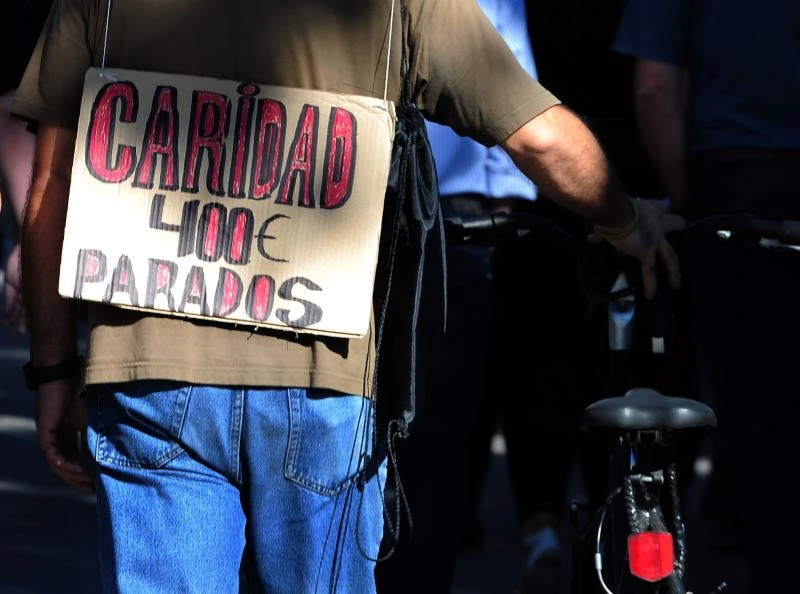
BRUSSELS: Jobless numbers across the euro zone hit a record 18 million in July, said grim new figures released yesterday as recession takes grip across the debt-stricken 17-nation currency area.
The 18,002,000 headline jobless figure released by Eurostat was the highest since records began in 1995 — and left the European Commission fretting over potential unrest on the streets of Europe’s capitals.
An additional 88,000 people joining the ranks of the unemployed throughout July, the European Union data agency said — well over 100 people per hour.
Upwardly-revised June data meant that the unemployment rate monitored by statisticians was unchanged at 11.3 percent, but an estimated 25.254 million were listed as unemployed across the full EU, which also includes non-euro heavyweights Britain and Poland.
Coupled with annualized inflation rising to 2.6 percent in August according to a separate Eurostat release, the figures had analysts warning of ever-tighter household spending acting as a drag on governments’ hopes of recovery.
Recalling an agreement by EU leaders at their last summit to create “more dynamic labor markets,” a Commission spokesman said the jobless numbers were now at a “critical” level and would pose a “serious threat to social cohesion” without concerted action.
Focused on the desperate youth unemployment particularly in Spain and Greece, the spokesman said governments had to do everything possible to avoid a “lost generation.”
The euro zone is faring far worse than its main international economic rivals. Japan’s unemployment rate was flat at 4.3 percent in July even as the US rate rose to 8.3 percent.
The news emerged as the International Labour Organization warned of a “catastrophic” rise in unemployment, especially among the young, if debt-wracked Greece were to leave the euro zone or if the bloc were to split.
Ekkehard Ernst, a senior economist at the UN body, told a German daily that close to one in 10 would be without a job even in powerhouse Germany by 2014 — nearly twice the current level.
At 5.5 percent, today’s unemployment rate was much lower in Europe’s leading economy than the average, likewise neighboring Austria and the Netherlands.
According to Christian Schulz of Berenberg bank, German jobs growth over recent months was already “past its peak.”
Unemployment in Germany rose for the fifth month in a row in August, with nearly three million out of work there, what ING economist Carsten Brzeski said was “a clear signal that the best times of the German labor market are over.”
France has even higher numbers, upcoming August data seemingly sure to crash through the three-million mark.
More than one in four are still out of work in Spain, meanwhile.
Annual unemployment increases in Spain and Greece were easily the highest, and both countries, laboring under sovereign and banking debt crises, logged jobless rates among the key under-25s age-group of more than 50 percent.
In a note released in advance, analyst Patrick Arbus of Paris-based Natixis warned that rising unemployment coupled with austerity was leading directly to “destruction of growth potential.”
Politicians on the left also saw the figures as alarming evidence that a change in course was required.
Criticizing the “excruciatingly high” jobless toll and vowing a sustained bid to overturn euro zone governments’ adherence to austerity, Hannes Swoboda who leads the pan-EU Socialist MEPs in the European Parliament said “enough is enough.”
The euro zone posted a 0.2-percent contraction in the second quarter, a key business activity survey then showing a seventh consecutive monthly decline in August — with contraction gathering pace in Germany.
According to research firm Markit, the euro zone is facing a fall of up to 0.6 percent in gross domestic product for the third quarter, which would meet the widely accepted definition of recession, two successive quarters of economic contraction.
Euro zone jobless hit record 18 million