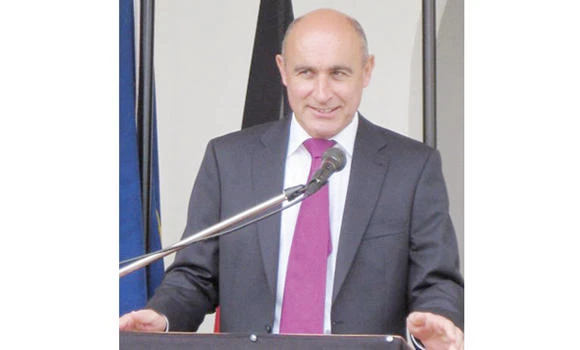
German Ambassador Dieter W. Haller has underscored the excellent bilateral ties binding Saudi Arabia and Germany.
Top industrial groups such as Siemens and Linder are giving a new direction to commercial ties between the Kingdom and Germany, he says.
Germany has also planned several commercial missions.
“We will have a number of business delegations visiting the Kingdom during the next three months,” the envoy told Arab News.
“We are enjoying a very strong and dynamic relationship with very positive developments in various sectors, ” he said in an interview to mark Germany’s National Day
“On the political front, we are joining hands to promote peace, progress and stability in a rapidly changing world – especially in this troubled region,” said Haller, while giving an overview of the progressively growing Saudi-German relations in different sectors.
He said Germany had launched special partnership programs with some Arab countries fully in line with the Saudi endeavors to support stability there.
Germany is heavily engaged in alleviating the suffering of the Syrian refugees. It assists the UNHCR in Jordan and receives Syrian refugees in important numbers in Germany, said Haller.
In close consultation with the Saudi government, we actively participate in the ‘Friends of Syria’ and ‘Friends of Yemen’ groups,” he said, while referring to the identical positions of Riyadh and Berlin on a range of regional and international issues.
Referring to the commercial ties that have grown from strength to strength, Ambassador Hall said that the two countries have seen a substantial increase in bilateral trade over the last 18 months, which reflects the growing resolve on both sides to embark on joint ventures in much larger numbers than before.
The businessmen of the two countries have, of late, evinced keen interest to promote trade and investment, he added.
On cultural front, he said the strong educational and cultural ties with Saudi Arabia can be gauged from the fact that 13 premier German universities and academic institutions participating in this year’s exhibition on higher education – the largest number ever.
“Especially in the cultural field we do see, however, many more opportunities for enhanced exchange,” said the envoy.
He was pleased to note that the Saudi government organized cultural events in Germany and the Saudi side is still working to organize cultural days in Germany in the near future. These events will greatly help to cement a better mutual understanding, he added.
“We are also confident to establish the envisaged German Language Center in Riyadh with more attractive language courses for Saudi nationals,” he said.
The German envoy said the economic relations are the backbone of the German-Saudi partnership.
“We in the midst of a process of transforming our excellent commercial relations into an industrial partnership with a strong focus on forging joint ventures, increasing mutual investments and organizing technological know-how transfer,” he added.
The Saudi interest in diversifying its economy, especially in creating a broader manufacturing basis, meets with our high German expertise and elaborate technological capabilities, he said, while speaking about transfer to technology and know-how from Germany to Saudi Arabia.
As an example, he mentioned the ACWA Holding, which bought the German Flapy company, which is very strong in the production of concentrated solar power mirrors.
“It is exactly in the field of renewable energy where we see a lot of potential for more mutually beneficial joint ventures. We are equally pleased to see that a number of our flagship companies like Siemens and Linde are doing extremely well in the Saudi market,” said the ambassador.
About 250 German companies operating in the Saudi market are eager to share their expertise with their Saudi partners, he said.
This, in my view, is one of our greatest strengths apart from our continuous strive for innovation, said the envoy, adding that Germany seeks to develop a real partnership further with Saudi Arabia on an equal footing and for mutual benefit.
He said the Saudi business will be mostly attracted by those sectors of the German economy in which the Kingdom has a strategic interest, namely renewable energy, automotive, and of course the petrochemical sector as well as the sectors downstream such as pharmaceuticals.
“There are no special incentives packages in Germany like in the Kingdom, but some of the framework conditions for investments in Germany are clearly negotiable, e.g some cities or regions offer tax breaks or favorable loans,” said the ambassador.
(Continued on Page 15)
“As I already stated, we are amidst the process of taking our commercial relations to a new level. The sectors where we do see more potential for the future are renewable energy, the automotive sector, especially the possible production of automotive components as a start of a new industrial key as well as health and urban infrastructure,” said the envoy.
“We have also started a new program of offering young Saudis internships in German companies,” he added.
He, while speaking about regional uprisings in the Middle East, said: “Like our partners in the Gulf, we utterly deplore the immense loss of human lives and unprecedented destruction in Syria.”
He said: “For us Germans, the use of force in resolving a conflict is always the very last resort after all other peaceful means have proven to be unsuccessful. This approach is deeply engrained in the collective German mind. “
He pointed out that Germany had offered its full support to destroy the Syrian chemical weapons arsenal.
“We think that the door for negotiating a cease fire is still open,” said the envoy, adding that Germany shared the Kingdom’s concerns about Syria with equal amount of pain.
He said that Syria is a country with a long history and rich culture with impressive contributions to civilization. As a member of the Middle East Quartet, Germany has always supported direct negotiations between Palestinians and Israelis.
“We still believe that there is room for a two-state solution, that is the formation of a sovereign state of Palestine coexisting peacefully with the state of Israel,” said Haller.
The German government has criticized Israel for constructing new settlements in the occupied territories.
“We regard this as an obstacle for a lasting solution to the conflict,” he said. On Iran, he added, “we want to make sure – like the Kingdom of Saudi Arabia – that the Iranian Nuclear program serves peaceful purposes only.”
In view of the limited cooperation on the Iranian side so far, Germany as a member of the EU 3-Group have implemented the most severe economic sanctions ever taken in the history of the European Union, he noted.
The signals coming from Teheran after the last presidential elections are encouraging, said the ambassador, adding that Germany and Saudi Arabia have similar position on Iranian nuclear issue.
On Afghanistan, the envoy said Germany was chairing the ‘International Afghanistan Contact Group’.
“Our commitment there will continue…we have decided to withdraw the bulk of our military contingent by 2014,” he said.
He said Germany had made enormous contributions, especially in the north of Afghanistan to help achieve economic and social progress.
From 2014 onwards, he said, “we will have a limited number of military experts on the ground to continue the training of the Afghan army.”
The developments in Afghanistan shows how important it is to focus on developmental issues, when pacifying a war-torn country, he said.
He said that Germany is a real multi-cultural society where everyone, irrespective of creed and nationality, can fully enjoy the freedoms guaranteed by its constitution. Freedom of religion is one of those key freedoms.
“More than four million Muslims live in Germany and enjoy the same rights as everybody else,” said the envoy.
“You will find mosques in practically every city with a number of Muslims living like a community,” said the ambassador.
There are no restrictions whatsoever for Muslims to study in schools and universities, he stressed.
“As much as we respect our Muslim citizens, we also expect them to respect our constitutionally guaranteed principals like the gender equality and the freedom of religion,” he said.
In reply to a question about German companies, he expressed happiness that Siemens is a member of the consortium that plans to build metro lines 1 and 2 in Riyadh.
Other German companies will hopefully also contribute as subcontractors to various parts of this challenging project called Riyadh Metro.
“The timeframe for completing is very ambitious, but we are confident that the companies involved will meet all expectations,” he said.
Linde, on the other hand, is supplying the technical gases package to SADARA, and stands ready to invest in a supply network for technical gases for all of the planned expansion of Jubail Industrial City, he said.
Linde is a market leader in this field, well-known to Saudi partners including Saudi Aramco and SABIC, and eager to increase its footprint in the Kingdom.
These companies, he said, are giving a new direction to the Saudi-German commercial ties. Germany has also planned several commercial missions.
“We will have a number of business delegations visiting the Kingdom during the next three months,” said the envoy.
“I am sure that immediately after the formation of a new coalition government in Berlin, we will also see German ministers and hopefully even the chancellor traveling to the Kingdom,” he added.
Industrial giants give new direction to strong Saudi-German partnership