RIYADH: The contribution of oil income to Saudi Arabia’s revenues is projected to drop to 73 percent, from an average of 90 percent in the past decade, an economic report said.
Saudi economic growth is set to slow further in 2016, it predicted
Jadwa Investment forecast the Saudi economy would grow by 1.9 percent next year, down from 3.3 percent this year and 3.5 percent in 2014.
Jadwa expects the oil sector to grow by 0.9 percent on an average crude production of 10.2 million barrels per day.
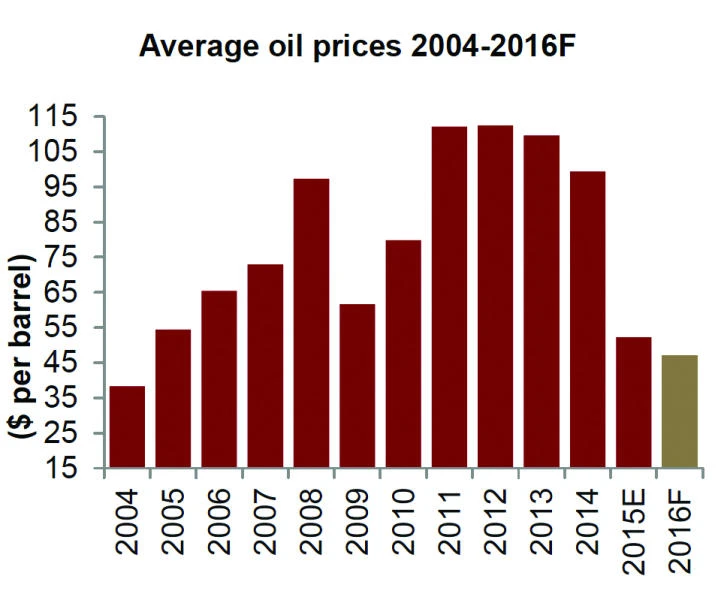
Jadwa Investment says the current period of low prices is set to remain throughout 2016, pulled down primarily as a result of persistently high oil supply.
All- out competition between members of OPEC will be the main reason for continued oversupplied markets, said the report.
In OPEC’s recent meeting the notional idea of production quotas was dropped, paving the way for even more intense competition in an already heavily-oversupplied market.
Even as non-OPEC supply begins to slow during 2016 the additional supply coming on-line from Iran will mean global oil markets will be looking at demand to lift prices out of the doldrums.
With global economic activity not picking up significantly in the year ahead, this will translate to moderate yearly growth in oil demand.
OPEC data shows that non-OPEC supply will decrease by 0.2 million barrels per day (m bpd), year-on-year, in 2016.
Among the largest non-OPEC players, both the US and Russia will see year-on-year declines in production.
For Russia, the combination of international sanctions preventing Russian oil companies’ access to international finance and government proposals for higher crude taxes to boost state revenue will mean crude production, which reached record post -soviet levels in 2015, is expected to slow slightly in 2016.
According to latest Energy Information Agency (EIA) data, total US oil production will decline by 6 percent or 600 thousand barrels per day (tbpd), year-on-year, in 2016.
“We forecast OPEC supplies rising by around 600 tbpd year-on-year to average of 32.1 million bpd in 2016,” said the report.
“Most of the OPEC rises are expected to come from increased Iranian supply when nuclear- related sanctions are lifted at some point in Q1 2016,” the report added.
“Although Iraq saw an estimated 11 percent increase in production year-on-year in 2015, this has been attributed to investment in the upstream sector since 2009. Further substantial increases in Iraqi production will be more difficult due to the country’s deteriorating fiscal situation as a result of lower oil prices, higher military spending, and costs associated with civil conflict,” said the report.
Jadwa: Low oil prices to remain throughout 2016