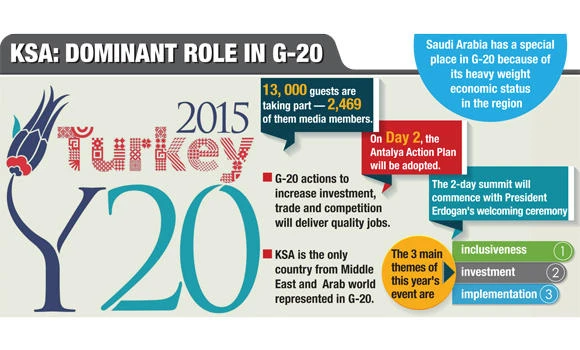
JEDDAH: Saudi Arabia has a special place in G-20 because of its heavy weight economic status in the region, according to economists.
“Saudi Arabia will continue to be an essential member of the G-20, given its size, role and weight not only in global energy markets but its wider stabilizing role in the Middle East and Islamic world,” said John Sfakianakis, Middle East director at Ashmore Group.
The leaders of the world's top 20 industrialized nations meeting in Antalya, Turkey, are set to deal with a packed agenda on issues ranging from Syria, to tax avoidance to climate change.
On Saturday, Turkey's President Recep Tayyip Erdogan received in Antalya Custodian of the Two Holy Mosques King Salman, who is leading the Kingdom's delegation at the G-20 Summit.
President Erdogan held a luncheon banquet in honor of King Salman.
During the banquet, they discussed a number of issues on the summit's agenda as well as bilateral relations and issues of common interest.
Analysts, who spoke to Arab News on the summit’s significance, highlighted Saudi Arabia’s dominant role in driving global economic growth.
Ihsan Bu-Hulaiga, head of the Joatha Consulting, said Saudi Arabia will continue to play pivotal role in G-20 in years to come.
“Saudi Arabia is diversifying its economy. In the first half of 2015, oil revenues went down by 50 percent but the Kingdom’s economy grew by 3.8 percent, which is better than the average of G-20 growth,” Bu-Hulaiga said.
He added: “Saudi Arabia is taking certain measures to make the growth sustainable.”
He said Saudi Arabia’s participation in G-20 Summit in Turkey is very important. It submitted to G-20 its plan to enhance economic growth; had a number of meetings with other countries to invigorate growth within membership countries equal to average GDP growth in global economy.
G-20 is aiming for 2 percent above the global growth. Saudi Arabia is to be part of that. They are taking number of measures which shows that they will be able to create more job opportunities and support SMEs to enhance growth in nonoil sector, he added.
Fawaz Alfawaz, a Riyadh-based economic consultant, said it really highlights the centrality of Saudi Arabia in the world, not only economically but politically as well. This grouping, while it is economic in nature, the recent developments in the region and beyond will likely be dominated by political events especially as it is not far from Syria physically and figuratively.
“The economic challenges are many; they range from the pending rise of US interest rates probably next month, to the upcoming environment focused summit meeting in December, in France. These issues have implications for the Kingdom, there are issues like the tax haven will be more important for the Kingdom if we manage to move to a more tax based economy. I think anybody expects much In terms of a major trade deal.”
Commenting further, Sfakianakis said: “The challenge is not one of trade and financial stability for the wealthiest countries but as we have now seen global terrorism. On trade issues, Saudi Arabia believes in free trade practices that have helped bring prosperity since the first GATT (General Agreement on Tariffs and Trade) agreement. The prosperity of Saudi Arabia positively trickle to the rest of the wider region either via trade mechanisms, investments or remittances and aid.”
Ibrahim Kalin, spokesman for the Turkish presidency, earlier said that the focus of the summit will be on how the G-20, both collectively and individually, proposes reforms to significantly raise global growth by more than 2 percent over the next five years, to about $2 trillion.
“A mechanism was established to put forward these reforms. Its details will be discussed comprehensively at the summit by world leaders,” Kalin said.
Stating that the global economy is faced with many challenges, Kalin said: “One of the most critical issues here is ensuring sustainable and balanced growth. When thinking about growth, it is important to take into account its quality as well as its quantitative aspect. We want to express that improving growth involves increasing employment creation capacity as well as utilizing available resources most effectively.”
Kalin said there will be six working sessions during the summit, of which, a few of them are business dinners. The final package of measures proposed by the Organization for Economic Co-operation and Development (OECD) as part of its base erosion and profit shifting (BEPS) project will be presented to G-20 leaders in Turkey.
The rules are designed to improve transparency, close loopholes and restrict the use of tax havens. The new proposals are intended to restrict international companies from making use of low-tax countries and tax havens.
The OECD projects that these proposals could raise up to $250 billion a year in extra tax revenue, especially for developing countries, if they are implemented.
“Consisting of 15 specific actions, the BEPS Action Plan has covered a very comprehensive set of issues including, among other things, the digital economy, harmful tax practices, interest rate deductions and transfer pricing,” Turkey’s Deputy Prime Minister Cevdet Yilmaz said in a speech on Oct. 9.
“To maintain the success of these actions and ensure their applicability, a very large group of countries and jurisdictions have been involved during the studies. During the process, we have respected the sovereignty of each country, and encouraged the participation of non-G20 countries, particularly the developing ones, on an equal-footing,” he added.
Azerbaijan, Spain, Malaysia, Senegal, Singapore and Zimbabwe will also participate in the Antalya Summit together with the G-20 members. Approximately 13,000 guests — of which 2,469 are media members — will participate in the two-day summit.
The strengthening of SMEs as economic forces that boost global employment, and the integration of SMEs into the global economy have been discussed, leading to the founding of the World SME Forum — a first during the Turkish presidency.
The three main themes of this year's G-20 Summit were chosen as inclusiveness, investment and implementation based on the Turkish presidency's priorities.
Within this framework, strengthening the global economy and making it more inclusive, deepening the dialogue and cooperation between G-20 countries and low income developing countries (LIDCs), sustainable development, increasing investments, and implementation and follow-up on G-20 commitments will be the main topics discussed in the summit this year.
The Summit will commence with President Erdogan's welcoming ceremony of the G-20 leaders on Sunday and will continue with a working lunch in which the topics of development and climate change will be discussed.
During the summit, apart from the sessions that will gather leaders, the Women-20 engagement group formed during the Turkish G-20 presidency will be represented.
Kingdom’s economic resilience in global spotlight as G-20 leaders gather in Turkey