Saudi Arabia’s nonoil exports have suffered from the slowdown in China and a varied economic performance from its other main markets in East Asia. The outlook for Chinese demand appears weak in the short run, but in the longer term the huge potential of the Chinese automotive industry indicates that demand for speciality chemicals of the type that Saudi Arabia has carefully invested in will grow. Other Asian countries should also continue to suck in Saudi intermediate goods as demand for Asian manufactures in the US and, to a lesser extent the euro zone, picks up again.
The expected strength of the dollar will hamper Saudi export growth to some extent, but this will at least make imported inputs cheaper for Saudi firms, according to a report by Samba Financial Group.
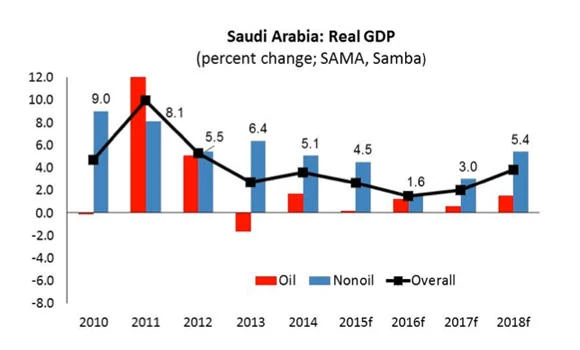
“Drawing these strands together, we expect Saudi nonoil GDP growth to ease to 4.5 percent in 2015, from 5.1 percent in 2014. This represents a slowdown from the five-year average of 6.8 percent, but remains decent and certainly compares well with most other emerging markets,” the Samba report said.
Nonoil growth is expected to cool to 1.6 percent in 2016, as the tighter fiscal stance feeds through (and as the calendar reverts to 12 months), before gathering pace again in 2017 and 2018 as rising oil prices restore some private sector confidence. By 2018 the nonoil economy to be expanding at a 5.4 percent pace.
With the oil sector contributing little growth, the trend in overall real GDP growth is expected to be very similar to that of nonoil GDP, growing by 2.6 percent this year, before dipping down to 1.5 percent in 2016. Growth of 2 percent is in prospect for 2017 before an acceleration to 3.8 percent in 2018. Clearly, though, this is a fair way off and any projection is hostage to developments in oil market fundamentals, which remain fluid.
Inflationary pressures are expected to remain muted over the next three years. Domestically, the main inflationary impulse will come — as ever — from rents. Despite plans for a publicly-led surge in home-building, there remains a large deficit of dwellings, particularly at the affordable end. External inflationary dynamics are likely to remain benign. A series of good harvests and decent growing conditions have seen agricultural commodity prices fall quite sharply this year. For Saudi Arabia, the most important commodities are wheat and sugar, both of which have come down in price.
A strengthening dollar should help to keep a lid on most commodity prices for the rest of the year and beyond (assuming reasonable harvests). Industrial commodities have been kept in check, largely by weakening Chinese demand and still-strong gains in global production. Allied to the stronger dollar, this should help to soften imported input prices for Saudi firms, who are in any case prepared to absorb costs in a bid to protect market share.
“Thus, although rental inflation will likely remain fairly robust, we think that this will be more than offset by weakening external pressures, and overall inflation is expected to remain comfortably below 2.5 percent through the forecast period,” the report said.
Kingdom’s real GDP is expected to grow by 2.6% in 2015