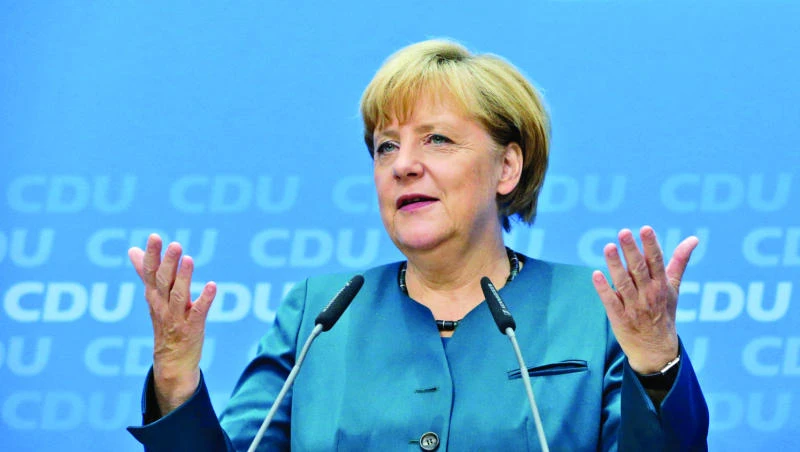
The German voters have shown their immense support for Chancellor Angela Merkel’s handling of the European financial and debt crises as she romped to a historic win and her position now is even stronger following her third election victory.
A federal election was held on Sept. 22 to elect members for the 18th German Bundestag.
The Christian Democratic Union/Christian Social Union (CDU/CSU) of Chancellor Merkel won its best result since 1990.
They won 41.5 percent of the total vote, with German poll analysts calling the win a personal victory for the 59-year-old.
Merkel is now on track to overtake Margaret Thatcher as Europe’s longest-serving female leader and emerging as one of the most powerful leaders in Europe.
She has become just the third post-war German chancellor to secure three election wins, after Adenauer and Helmut Kohl, who brought her into the party.
Final results gave the CDU/CSU 311 seats, the Social Democrats 192, the Left party 64 and the Greens 63 seats.
Since the financial and debt crisis erupted five years ago, the leaders of most big European countries — Britain, France, Italy, Spain — have been unceremoniously dumped by their voters.
Following the recession, out of 17 countries in the euro zone, 12 governments have fallen.
But Merkel has bucked the European trend by becoming the only leader in the euro zone, whether from left or right, to be re-elected since the snowballing of the euro crisis in 2010.
The third term for Merkel is indicating the level of protection felt by Germans from the economic crisis under her leadership.
She has sworn support in return for reform to overcome the crisis in euro zone and the Germans who voted for her have sent a powerful signal that they look forward to a better future prospect under her visionary leadership.
The German chancellor’s landslide victory also boosted her Christian Democrats’ share of the vote to its highest since German unification in 1990.
Such a remarkable win after eight years in office during such a rocky period makes her the undisputed leader not just of Germany but of Europe.
“This is a super result,” Merkel told cheering supporters after the results were announced.
“Together, we will do all we can to make the next four years successful ones for Germany,” she added.
Commenting on Merkel’s historic victory as a result of her successful management of the euro crisis, Dieter W. Haller, German ambassador to Riyadh said Germany as a middle power in the heart of Europe has “a historic responsibility in and for the euro zone and Europe.”
He said the third term for the German Chancellor could create a momentum for structural reforms in Europe and that the outcome of the election might strengthen the economic perspectives for Germany and Europe.
He maintained that the wellbeing of Germany is crucial for the wellbeing of Europe and vice versa and that Merkel’s calm and steady leadership during the euro zone crisis has made her highly popular at home as well.
This sentiment was echoed when German expatriates from different backgrounds and quarters, including the business community gathered at the German embassy in Riyadh at a reception organized by the embassy staff.
Numerous members of the German community present at this event could closely follow the live coverage of the outcome of the German election on a big screen along with Saudi journalists and international guests including diplomats.
German investors were also seen buying into this political optimism and were also happy with the third term for their chancellor as they believe this win is important to bail out the region from economic crisis in the euro zone.
One of the issues of the German election was also the Syrian crisis, where Germany played a constructive role by helping to create avenues to overcome the blockade in the security council and thus allowing a resolution on the use of chemical weapons in Syria.
Germany is also a member of a group of countries which help Syrian refugees.
In addition to the several thousand Syrian refugees who already have come to Germany, more than 5,000 additional refugees from the war-torn country will be received by Germany in the next weeks.
Germany has also got its first black MP and Muslim winner for the first time for Chancellor Angela Merkel’s party. Karamba Diaby, 51, a Senegal-born chemist has become Germany’s first black federal lawmaker and Cemile Giousouf, a woman of Turkish origin has become the first Muslim elected to German Parliament from Chancellor Angela Merkel’s conservative party.
Merkel’s bloc, which won the election with 41.5 percent of the vote, now counts a Muslim lawmaker among its ranks with Giousouf elected in the western town of Hagen.
The 35-year-old was born in Germany to Turkish immigrant parents.
Several lawmakers of Turkish origin have previously been elected to the lower house of the German Parliament, but most of them were with the Social Democratic Party, which Diaby represents, the environmentalist Green Party or the Left Party.
One fifth of Germany’s 80 million people are immigrants or the children or grandchildren of immigrants, but few have made it into the federal legislature. Until now there were no black lawmakers in Parliament, despite more than 500,000 people of recent African origin believed to be living in Germany.
Diaby, who moved to the city of Halle in 1986 after receiving a scholarship to study in East Germany, gained German citizenship in 2001.
He said his priority would be to promote equal opportunities in education. He believes every child born in Germany should have the chance to be successful in school regardless of their social background or the income of their parents.
Two are among 34 lawmakers with immigrant backgrounds to win seats in German federal election, up from 21 in the previous term.
The other black lawmaker elected was Charles M Huber, a 56-year-old actor born in Munich to a Senegalese father and a German mother. Huber is a member of Chancellor Angela Merkel’s Christian Democratic Union, which won the election.
But despite such interesting facts and figures Merkel’s triumph was tarnished because her coalition partner, the Free Democratic Party (FDP), fell short of the 5 percent threshold vote needed to get into the Bundestag, denying them seats in the Bundestag for the first time in their history, since its inception in 1949.
Now the Free Democrats will reinvent themselves as more convincing proponents of liberalism. As Merkel’s party had not won an absolute majority, she needs to find a new coalition partner in one of the Left or the Greens to form a new coalition government.
The choice of coalition partner for the CDU and its Bavarian sister party, the CSU is also important for European policy.
The possible partners, the SPD or the Greens, prefer to weaken the austerity measures and pursue government-driven stimulus programs.
Whereas to embark on the ongoing euro crisis, common currency must be maintained effectively in the euro zone.
Though they have common currency, the euro zone does not have common micro-finance policies and need to be addressed properly to overcome the crisis.
Moreover, strong financial policies are essential to sail through the crisis and Merkel will need her ally’s support to take decisive measures.
However, the election’s outcome is vital for Europe’s future as the overwhelming victory will help deepening the causes of strengthening euro and it will help German economy to prosper.
The date of the federal election is governed by the Basic Law for the Federal Republic of Germany (Germany’s de facto constitution) and the Federal Election Law (Bundeswahlgesetz) as Article 39 of the Basic Law states that the Bundestag shall be elected between 46 and 48 months after the beginning of the legislative period.
As the 17th Bundestag convened on Oct. 27, 2009, the election was scheduled between Aug. 27 and Oct. 27, 2013 but a date in late September is usually chosen to avoid school holidays in Germany.
The Bundestag is elected using mixed-member proportional representation. Voters have 2 votes. With their first vote they elect a member of Bundestag for their constituency. With the second one they vote for a party.
Subject to a party obtaining a minimum threshold vote, the overall seat assignment in the Bundestag is proportionally distributed according to the second (party) votes.
A party who wins more districts in a given state than it is entitled to according to the number of party votes it received in that state keeps these ‘overhang’ seats.
A party must either win 5 percent of the vote or at least three constituency seats in order to qualify for MMP.
Merkel pushes for euro reforms after historic election victory