ZURICH: Nestle, the world’s biggest food maker, followed European peers in reporting first-quarter revenue growth that exceeded estimates as price increases offset weak sales of convenience meals in North America.
Organic sales rose 4.4 percent, with pricing contributing 2.5 percentage points of the growth, the Vevey, Switzerland-based maker of KitKat bars and Perrier water said in a statement.
Analysts expected a 4.2 percent increase.
Unilever and Danone have also topped first-quarter predictions as business in Europe starts to improve after an economic slump.
The rebound in Nestle’s home region comes as it faces a sluggish Chinese market and seeks to revive the ailing Lean Cuisine frozen-food brand in North America.
The company said it expects measures it has taken to improve business in that market to “gain traction” throughout 2015.
“The beat to expectations was slightly less compelling than that of Unilever given it was driven more by price,” Andrew Wood, an analyst at Sanford C. Bernstein, said in a note.
The first-quarter sales growth included gains of 3.7 percent at Nestle’s Americas unit and 5.3 percent at the Europe- Middle-East-North Africa business. Revenue in Asia-Oceania- Africa declined 0.2 percent, mainly due to China.
“The big negative is Asia, Oceania and Africa,” said Jean-Philippe Bertschy, an analyst at Bank Vontobel in Zurich. “That’s going really poorly.”
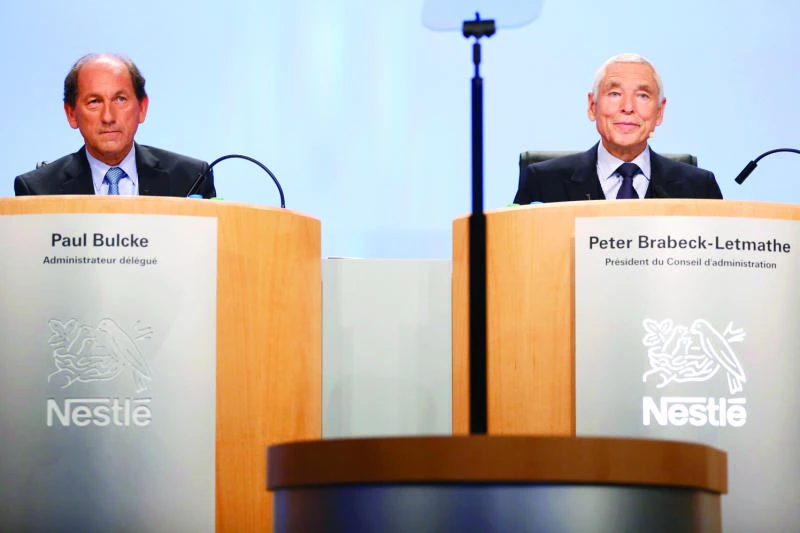
Chairman Peter Brabeck-Letmathe said the Nespresso maker needs to speed up structural changes as industry mergers and acquisitions threaten to heighten competition.
Kraft Foods Group announced plans last month to merge with H.J. Heinz, while Mondelez International is combining its coffee unit with the maker of Douwe Egberts.
In a quest to revamp its portfolio to revive sales, Nestle has jettisoned brands like Jenny Craig diet foods and PowerBar snacks.
It’s also in talks to sell its European frozen-food business Davigel to Bain Capital’s Brakes Group and it aims to fix such brands in North America.
“We shall see how Nestle’s frozen-food initiatives turn out, but if it doesn’t improve by the end of the year, I think it’s possible Nestle could sell parts of the business or even the whole block of it in a monster deal,” Bertschy said.
Total revenue rose to 20.92 billion francs, missing the 21.2 billion-franc median estimate of analysts polled by Bloomberg as growth was almost wiped out by declines of currencies against the Swiss franc.
Revenue from Nestle’s bottled-water unit rose 7.3 percent, with double-digit growth in emerging markets and mid-single- digit gain in developed countries.
The maker of Lean Cuisine frozen meals confirmed its forecasts for 2015. Nestle expects organic revenue growth of about 5 percent, which is the low end of a long-term target. Nestle also said it aims to achieve improvements in margins and underlying earnings per share in constant currencies.
Nestle’s definition of organic growth excludes acquisitions, divestments and currency shifts.
Nestle first-quarter sales beat estimates on higher prices