- Banking, exploration and production sectors played a key role in the index upsurge
- Likely allocation of Rs17 billion disaster support fund, slight rupee stability encouraged bullish close
KARACHI: Pakistani shares rebounded on Wednesday by recording gains of 1,195 points or 3.57 percent, closing the benchmark KSE 100 index at 34,637 on the back of a market support fund likely to be allocated for the Pakistan Stock Exchange next week, analysts said.
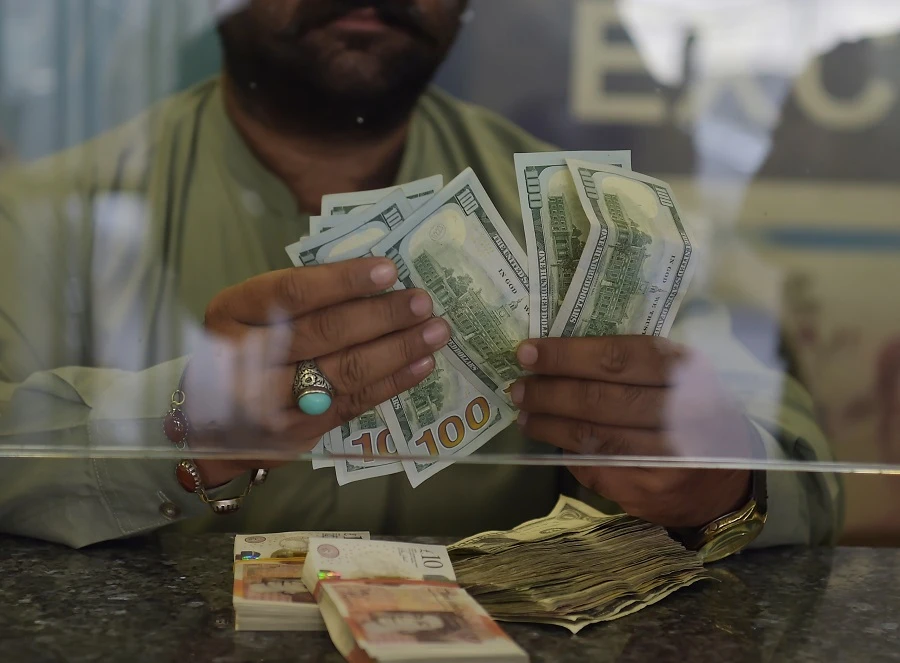
Pakistan’s rupee had reached a new record low on Monday, selling at 153 against the dollar in the interbank market to continue a slide that saw it lose more than 5% last week in the wake of a $6 billion loan accord with the International Monetary Fund.
“Massive buying by state funds, upbeat data on $11.58 billion current account deficit for Jul-April 2019 amid falling imports and surging remittances, the likely allocation of a Rs17 billion disaster support fund next week and slight rupee stability against the dollar played a catalyst role in the bullish close,” said Ahsan Mehanti, Chief Executive of Arif Habib Corporation.
Adviser to the Prime Minister on Finance, Abdul Hafeez Shaikh, had accepted the proposal to form the fund to support the crashing market after a meeting with PSX board of directors and senior stockbrokers last week.
“Market is showing signs of a bull run in the wake of the state fund that will likely buy scrips of state-owned and listed entities,” said Samiullah Tariq, Head of Research at Arif Habib Limited. “The increase is the highest during the past 7 months. The last time the market gained massively was October 24, 2018 when it increased by 1,556 points or 4.3 percent.”
During the trading session on Wednesday, the banking and exploration and production sectors played a key role in the index upsurge.
Market participation for the 100 index increased to 140.6 million from 127.5 million in the previous session (10.3% on d/d basis). Daily traded value for the 100 Index decreased to $31.7 million from $32.5 million, according to Next Capital Limited.
The sliding rupee has caused alarm in Pakistan, which is already facing inflation likely to average over 7 percent for the year and surging costs for fuel and power, which are both heavily influenced by the dollar exchange rate.
The new IMF accord, which must still be approved, foresees a “market-determined” rate for the rupee. At present, the currency - which many analysts consider overvalued - is managed by the central bank in a de facto controlled float.
The State Bank of Pakistan, which lifted interest rates by 150 basis points on Monday to 12.25%, said it was watching the foreign exchange market closely and would act in the case of “unwarranted” volatility.
It said the recent slide “reflects the continuing resolution of accumulated imbalances of the past and some role of supply and demand factors.”