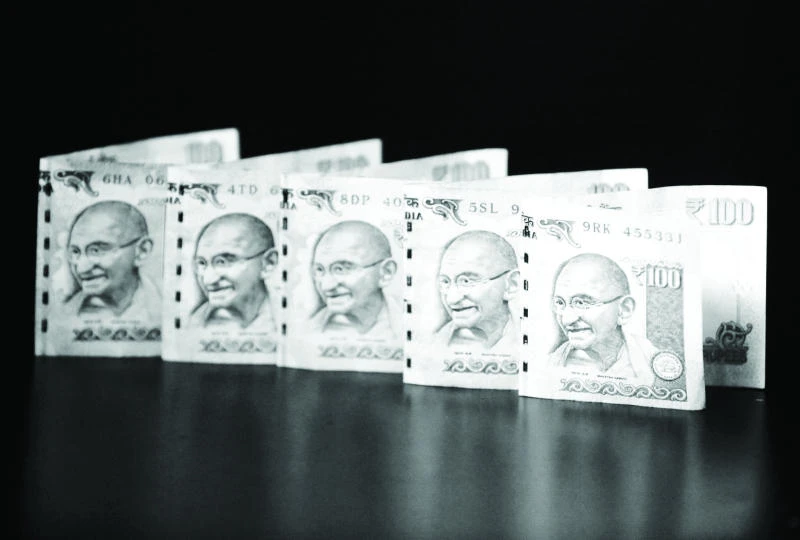
MUMBAI: India's central bank intervened to curb the slide of the rupee after it skidded to new lifetime lows, a government official confirmed, but added monetary authorities were not defending "any particular rate".
The intervention on Tuesday by the Reserve Bank of India (RBI) lifted the rupee off its record low struck earlier in the day of 58.98.
The Indian currency strengthened further yesterday to 58.12 rupees to the dollar.
"We're not defending any particular rate," Montek Singh Ahluwalia, deputy head of India's Planning Commission, told India's CNBC-TV18 financial news channel yesterday.
"But at the same time the RBI intervenes when it thinks things are being pushed a little too far," he added.
"They did intervene yesterday which would suggest they felt market pressures were pushing the currency to an unnecessary low point and that did lead to some reaction," he said.
"I don't think that one can say anything more than that when you're dealing with an exchange rate that's market determined," Ahluwalia said.
The RBI was suspected to have "intervened at around the 58.97 level by selling dollars", a private bank dealer, asking not to be named, told AFP.
The rupee has been hit by speculation that the US Federal Reserve will cut back on asset purchases which have fueled flows into emerging markets and as well as by growing concern about India's economic weakness.
Emerging market currencies across the world have been hit by dollar strength triggered by an encouraging US jobs report.
"The panic has subsided for the near-term," said Abhishek Goenka, chief executive with India Forex, a consultancy firm said.
Goenka called yesterday's rupee pullback a mix of a "technical correction" and "improved sentiment".
"The market certainly required some type of confidence building measure," Goenka said, referring to the central bank intervention.
But he cautioned that the rupee's stronger tone was likely to be short-lived.
The Finance Ministry's chief economic adviser Raghuram Rajan told reporters in New Delhi on Tuesday that Indian authorities "will take action as warranted" to curb the rupee's fall.
The RBI has a policy of not commenting on movements in the foreign exchange market and of intervening only to curb volatility.
Analysts say the bank cannot intervene heavily to buttress the currency as it must retain enough foreign reserves for imports. It only has sufficient reserves for seven months of imports — the lowest cover in 13 years.
Rajan said he believed the rupee was "oversold" and that the rupee had fallen below "what is warranted by (economic) fundamentals".
Meanwhile,India's industrial output grew by a weaker-than-expected two percent in April but the grim data yesterday was offset by global ratings agency Fitch raising its investment rating outlook to stable from negative.
The two percent year-on-year output growth at the factories, mines and utilities of Asia's third largest economy undershot market expectations of a 2.4 percent rise and was down from a 3.4 percent jump the previous month.
The production numbers dismayed business, with the Associated Chambers of Commerce and Industry of India branding them "pathetic".
But in a rare piece of good news for Prime Minister Manmohan Singh's beleaguered Congress government, battling charges of economic mismanagement and corruption, Fitch revised India's sovereign rating to stable from negative.
The revision "reflects the measures taken by the government to contain the budget deficit", Fitch said in a late afternoon statement.
The move was a reversal of the negative investment outlook Fitch assigned to India in June 2012 and came after rival rating agency Standard and Poor's upheld its negative outlook last month.
Fitch noted the government trimmed the fiscal deficit to 4.9 percent of gross domestic product in the last financial year to March 2013 from 5.7 percent the previous year.
It said the revision also was a recognition of "albeit limited" progress in tackling hurdles to growth, such as delays in government approvals of projects to upgrade dilapidated highways and other infrastructure.
Fitch's announcement, which came after the stock market closed, could boost investor confidence and give a lift to India's currency, which clawed its way higher from a lifetime low of Rs. 58.98 to the dollar that it hit Tuesday.
But yesterday's industrial output figures highlighted the economic headwinds facing India as the government watches for a growth turnaround before elections due in the first half of 2014.
The government is forecasting at least six percent growth this year but most private economists expect it to be in the upper five percent range at best.
Manufacturing, which accounts for three-quarters of the Index of Industrial Production, grew 2.8 percent in April year-on-year, down from 4.2 growth in March.
Capital goods output of machinery and other products, seen as a sign of corporate investment plans, rose just one percent after soaring nine percent in March.
Consumer durables production slid 8.3 percent, the largest decline since January 2009, and was mirrored by weakness in car sales which shrank more than 12 percent last month.