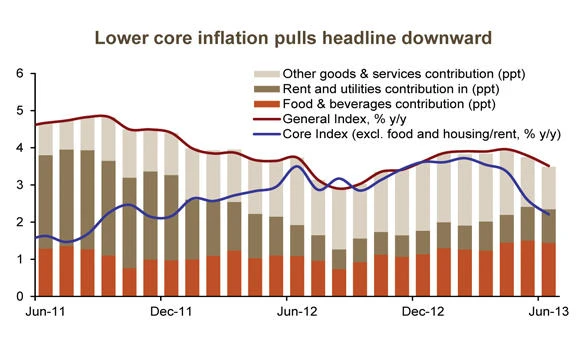
The Central Department of Statistics and Information (CDSI) released Consumer Price Index (CPI) inflation data for June, showing prices rising by 3.5 percent year-on-year compared with 3.8 percent in the previous month. On a monthly basis, prices slightly increased by 0.2 percent compared with 0.1 percent in May.
The department’s estimate of Saudi core inflation, which excludes food and rental and housing-related services, maintained its downward trend for the fourth consecutive month. It fell to 2.2 percent year-on-year in June compared with 2.6 percent in May. Core inflation was mainly driven by the restaurant and hotel group (4.4 percent year-on-year) followed by furnishings, household equipment and maintenance (2.8 percent year-on-year).
Saudi Arabia’s cost of living index rose in June 2013 by 1.2 percent to reach 157.2 points compared to the same month last year, the statistics department said.
Prices of beverages rose by 5.6 percent, equipment and transport 4.3 percent, chemical products 3.8 percent, foodstuffs and livestock 2.4 percent and oil and ghee 0.4 percent.
"The prices of other goods declined by 14.1 percent," the department said. The index for wholesale prices fell by 0.3 percent from 157.6 to 157.2 points. "The wholesale price index for three main sections remained the same without any change, the department pointed out.
The Riyadh-based Jadwa Investment said in its inflation update that with core inflation falling, the contribution of food and rent and housing-related services groups to the overall inflation increased to 66 percent compared with 64 percent in the previous month. Food inflation, however, slowed to 6.1 percent year-on-year (0.1 percent month-on-month) in June compared with 6.4 percent (0.2 percent month-on-month) in May.
Despite the decrease in food inflation in June, it remained high by historical standards and the largest single contributor to overall inflation, adding 1.4 percentage point. “We expect food prices to reverse the trend and rise in July in line with the trend ahead of Ramadan,” Jadwa said in its report.
According to the CDSI's statement, all subcomponents of the food and beverage group increased last month compared with a year earlier, with a noticeable increase in bread and cereals (9.6 percent year-on-year) and meat and poultry (8.8 percent year-on-year). The food price inflation is in line with the trend of the FAO food price index which increased by 5.4 percent year-on-year in June compared with 5.1 percent in May.
The rent and housing-related services inflation was unchanged at 3.6 percent year-on-year last month. On monthly basis, however, the rent and housing-related services inflation decelerated to 0.3 percent compared with 0.7 percent. As the rental sub-component remained unchanged at 4.2 percent year-on-year in June, the deceleration in the housing-related services was mostly due to a fall in housing maintenance inflation to 1.8 percent year-on-year compared with 3 percent in May. Despite the slower inflation in the rental and housing-related services group in June, rental inflation will remain under pressure with an upside potential owing to strong housing demand.
“While the external factors contribution to inflation in the Kingdom will remain subdued owing to a stronger USD and low trading partner inflation rates, we expect domestic inflationary pressure to remain relatively strong particularly during Ramadan and into the Eid holidays,” Jadwa said.
High consumer spending, rising bank lending, exceptionally low interest rates and rising demand deposits will maintain the current demand pull inflation. While it is expected that the recent labor market reform will lead a higher labor cost part of which is expected to be passed to consumers, the current trend shows this is not the case, at least for now. “The fall in our core index supports the view that food (demand driven) and housing (shortage of supply) are the main drivers of headline inflation,” the Jadwa report said.
Furthermore the staff cost segment of the recent HSBC's Purchasing Managers' Index points to unchanged staff costs in the last few months.
Saudi core inflation maintains its downward trend in June