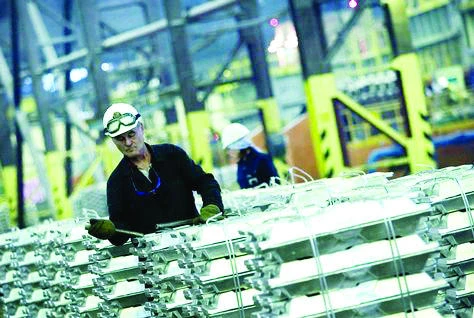
LONDON: Global aluminum production growth is on a surge again.
True, the latest figures from the International Aluminium Institute (IAI) showed daily average output in May falling marginally from April's 158,100 tons to 157,800 tons. But that shouldn't distract from the underlying trend, which is rising and at an accelerating pace.
The world's smelters produced 4.892 million tons of aluminum in May, up almost 12.0 percent year-on-year. That was the fastest growth rate since 2011.
No surprise that China is once again driving the global trend, as it has been for many years.
May's output of 2.67 million tons represented year-on-year growth of 22.3 percent with cumulative output of 12.46 million tons over the first five months of this year up 13.5 percent.
China's soaring production and its massive exports of semi-manufactured products are attracting ever more negative scrutiny from non-Chinese producers.
But production outside of China is also rising again thanks to a combination of new plants ramping up and idled capacity being restarted.
The aluminum price, on the other hand, has deteriorated rapidly over the last couple of months with physical premiums collapsing and the basis London Metal Exchange price hovering around one-year lows.
The combination is surely unsustainable, putting producers under renewed pressure to take the ax to loss-making capacity.
Aluminum production in regions such as Latin America is still trending lower on the back of the last round of production cuts, most recently the shuttering of the Alumar smelter in Brazil.
But elsewhere producers are moving in the opposite direction, having been incentivised by what was, until a few weeks ago, a higher price environment.
West European production, for example, has risen by 5.2 percent so far this year and May's annualised run-rate of 3.74 million tons was the highest since December 2011.
And while we're on the subject of Western European smelters, one, it seems, has rejoined the IAI reporting fold.
The Institute revised higher its regional production figures for 2013 and 2014 to the tune of 91,000 tonnes and 82,000 tons respectively.
This is apparently down to one smelter failing to provide data for those years or for the first part of this year. The "missing" smelter has since resumed reporting and has provided back data.
Outside of China a new driver of production growth has emerged to replace the Gulf region.
Output growth in the Gulf was a stellar 27 percent last year, reflecting the full ramp-up of the new Maaden smelter in Saudi Arabia, but that growth rate has slowed to just 4 percent this year.
This will merely mark a pause in the region's longer-term ascendancy in the world of aluminum production.
Aluminium Bahrain has just announced another major 514,000-ton expansion which will lift capacity to 1.45 million tons once completed in 2019.
For now, though, the baton has been passed to other Asian producing countries with cumulative output rising by just over 20 percent in the first five months of this year.
The main driver appears to be India, where Vedanta Resources is currently in the process of firing up two greenfield smelters.
At the time of its Q1 results the company said the new 325,000-ton per year Korba II plant had commissioned 84 pots with full ramp-up due over the Q2-Q3 2015 period.
The much larger 1.25-million ton per year Jharsuguda II smelter also produced its first 19,000 tons of metal in the January-March quarter, reflecting the commissioning of the first 312,500-ton potline.
Quite evidently, Jharsuguda II will be a core driver of rising Indian production for many months to come.
Rising production both in China and the rest of the world promises to tilt the global market back into surplus, assuming it was ever in deficit in the first place.
Global demand for the light metal slowed sharply to 3-4 percent in the first quarter from 7.3 percent last year, according to analysts at BNP Paribas.
BNP is forecasting full-year demand growth of 5.0 percent this year, which would be the envy of just about every other industrial metal market.
However, in the context of the current production trends, that is still too low to absorb all the extra aluminium being produced, let alone sufficient to eat into all the millions of tons of legacy inventory gathering dust in warehouses around the world.
BNP is among those analysts pegging the global market in deficit last year. But this year it is forecasting a global surplus of 750,000 tons, albeit one weighted towards that weak first quarter.
Moreover, "aluminum will certainly be in large structural surplus in the sense that smelter capacity will remain far greater than needed to meet demand."
All of which suggests that the pressure is building for producers to embark on another round of capacity closures.
Since this will almost certainly not happen in China, where loss-making smelters are being kept afloat by local governments fearful of losing jobs and industrial production capacity, the ax will have to fall outside of China.
In truth, such has been the speed of the collapse in premiums and "all-in" aluminum price that the industry once again risks a period of over-production.
Only one major producer, Alcoa, has been actively reassessing its portfolio.
Others are either hoping for the best or still coming to terms with a price that has imploded so spectacularly and so rapidly.
The problem is that after two major rounds of closures, the first in 2009 in the wake of the financial crisis and the second extended over 2013 and 2014, all the "easy" decisions have been made.
The next round of cuts will be harder.
Expect producers therefore to delay as long as possible in the hope of some price recovery.
But how will there be a sustainable price recovery if the world is still producing too much aluminum?
Such has been this market's long-running dilemma. And one, it seems, that will be around a while longer yet.
Surging aluminum production promises more pain ahead