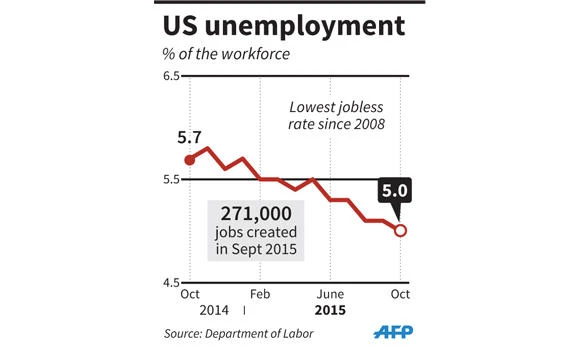
WASHINGTON: The US jobs machine powered up in October, proving the economy's resilience amid a global slowdown and supporting the first Federal Reserve interest rate hike in nine years in December.
The Labor Department reported Friday that the economy pumped out a strong 271,000 net new jobs last month, nearly double the September number, sending the jobless rate down to a seven-and-a-half year low at 5.0 percent.
It was a far better performance than expected, and came after a two-month slump that had raised worries that a global growth stall was infecting the domestic economy.
Instead, the numbers confirmed a firm upward trajectory for growth and a tightening of the labor market, signals the Fed has been looking for to justify beginning to raise interest rates in December after an unprecedented holding of them at the zero level for almost seven years.
The October numbers were nearly all strong.
Wage growth picked up after several flat months, with average hourly earnings up nearly 2.5 percent year-on-year.
The number of people forced to work part-time fell, and there was a slight rise in the employment-to-population ratio, potentially representing more holdouts are returning to the jobs market.
Job gains were strongest in retail sales, health care, and restaurants, signs that US consumers are spending more. Construction jobs also jumped.
Taken together, the data represented a solid rebound after two weak months and a general slowdown in economic activity in the third quarter.
The average pace of job creation is enough to keep pushing down the unemployment rate, even as more people return to the jobs market, economists said.
Markets took it as a green light for the Fed to embark on a series of interest rate hikes at its December meeting, which Fed Chair Janet Yellen said on Wednesday was a distinct possibility if economic growth holds up.
The dollar surged sharply to $1.0739 per one euro, its strongest level since April, and US bond yields jumped, the 10-year Treasury rising to 2.34 percent, the highest since July.
Wall Street was little-affected in late-morning trade after an early fall on the data: the Dow Jones Industrial Average was off 0.12 percent.
"The case for tightening in December — and a lot more in 2016 — looks increasingly strong," said Jim O'Sullivan, chief US economist at High Frequency Economics.
Prospects for a rate rise has already provoked turmoil in global markets, with emerging-market currencies sinking and capital costs for governments and companies rising.
Some said a December rate increase was still not a sure thing, because there were some signs of weakness in the October data.
The labor force participation rate remained low at 62.4 percent, for example.
Dean Baker of the Center for Economic and Policy Research noted that manufacturing wages are still rising at a poor 2.0 percent pace, and that the data shows that workers still do not feel comfortable with opportunities in the market: The number voluntarily leaving their jobs remains very low.
US creates 71,000 new jobs in October