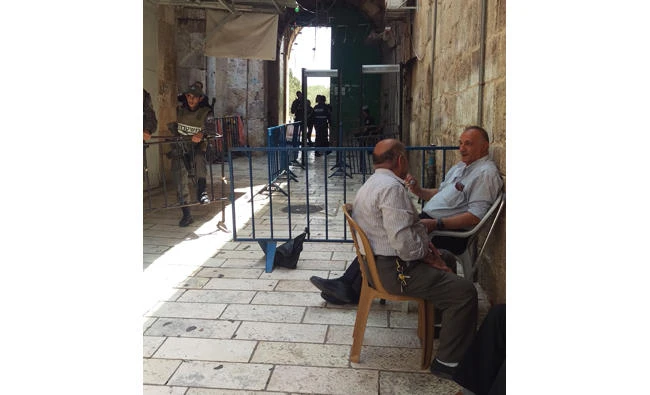
JERUSALEM: The Israeli security officer at Lions’ Gate was surprised as I approached her and seven male armed Israelis at a checkpoint.
“Where are you going?” she asked. “Al-Aqsa,” I replied. Surprised to hear that someone actually wanted to enter, she asked if I was sure.
Another security officer asked where I was from. “Jerusalem,” I replied. “You can go to Al-Aqsa, but you have to go through these metal detectors,” he said, pointing to gray and white arches through which no one was entering or leaving.
I came to Jerusalem on Thursday to write a story about the steadfastness of the city’s Palestinians.
I was not about to cross a picket line they had created in opposition to Israel’s unilaterally imposed electronic gates, so I went to the next gate.
Not far from the Lions’ Gate security barricade, about 50 women were squatting and repeating religious chants. After they finished I approached one of them, Um Mohammed.
She said she was from the village of Shahd near Nazareth. “We’re brought over by bus once a month by the Islamic movement,” she said proudly.
But Um Mohammed was unhappy that many of her friends did not come this time. “Only 18 of us came this time; we’re usually about 60. They’re afraid.”
Next to her was Um Said, a Jerusalemite who said the women were hoping the metal barricades would be removed so they could pray in Al-Aqsa as they usually do.
A few tourists and fewer Palestinians were walking into Jerusalem’s Old City via Lions’ Gate at 11 a.m. on Thursday.
Walid Abu Hawah has a souvenir shop on the main cobbled road, but no buyers. “Your business has had a rough week?” I asked. “I don’t care about business,” he replied.
I asked whether Palestinian Jerusalemites would remain united in boycotting the metal gates. “I hope so. I hope we win this one,” he said, with the passion of a person rooting for his favorite football team.
Tourists kept traveling past on the Lions’ Gate road, including a large contingent of Indian Muslims and a group from South Korea. I saw Christian tourists as I approached the Via Dolorosa’s fourth station.
Going down Al-Wad Street toward Al-Majles Gate, I saw larger groups of Palestinians. The road leading to the gate was lined with people sitting on plastic chairs. The crowds included many locals and people coming in solidarity against the metal detectors.
The African-Muslim community, located just before the gate leading to the mosque, has taken it upon itself to serve the people.
The community came to Jerusalem in the 14th century, and feels very strongly about protecting Al-Aqsa. I was told that at mealtimes, community members provide hot meals to all protesters.
Adnan was going around with cold water and plastic cups, while his cousin Mutaz had a large plastic bag making sure no one was littering.
I asked Mutaz what motivated him to help. “This is God’s home,” he replied without hesitation, adding that he volunteered for the love of God and to help after the Israelis blocked entry to the mosque.
Two gray metal detectors could be seen, and beyond them an empty mosque could be gleaned through the open Al-Majles Gate.
I asked a middle-aged man, Ali, if the Israelis were still visiting the mosque compound. “Yes,” he replied, adding that three groups had made the visit already this morning.
I wanted to know whether the numbers had increased or decreased because of the Palestinian boycott.
He took out his mobile phone and looked up a recent entry on WhatsApp apparently by Jordanian Al-Waqf guards.
“The three groups that entered today were made up of 39, 60 and 26 people, respectively,” he read from the message.
Under a 2014 agreement between Jordan, Israel and the US, small groups of non-Muslims can visit the mosque during non-prayer morning hours on condition that they not pray.
While discussing the situation, a member of the African community offered us peeled cactus fruit, and a well-dressed man came with a large plastic bag to ensure no one was littering.
As we were chatting, a young American tourist of Moroccan origin came by. This was the last day of his trip to the Holy Land, so he really wanted to visit the mosque. After some discussion with protesters, he said he was going to visit it.
As he was wearing shorts, Israeli police manning the Islamic site gave him sweatpants so as to be properly dressed, and allowed him in after he went through the metal detectors.
• Photos by Daoud Kuttab
“Where are you going?” she asked. “Al-Aqsa,” I replied. Surprised to hear that someone actually wanted to enter, she asked if I was sure.
Another security officer asked where I was from. “Jerusalem,” I replied. “You can go to Al-Aqsa, but you have to go through these metal detectors,” he said, pointing to gray and white arches through which no one was entering or leaving.
I came to Jerusalem on Thursday to write a story about the steadfastness of the city’s Palestinians.
I was not about to cross a picket line they had created in opposition to Israel’s unilaterally imposed electronic gates, so I went to the next gate.
Not far from the Lions’ Gate security barricade, about 50 women were squatting and repeating religious chants. After they finished I approached one of them, Um Mohammed.
She said she was from the village of Shahd near Nazareth. “We’re brought over by bus once a month by the Islamic movement,” she said proudly.
But Um Mohammed was unhappy that many of her friends did not come this time. “Only 18 of us came this time; we’re usually about 60. They’re afraid.”
Next to her was Um Said, a Jerusalemite who said the women were hoping the metal barricades would be removed so they could pray in Al-Aqsa as they usually do.
A few tourists and fewer Palestinians were walking into Jerusalem’s Old City via Lions’ Gate at 11 a.m. on Thursday.
Walid Abu Hawah has a souvenir shop on the main cobbled road, but no buyers. “Your business has had a rough week?” I asked. “I don’t care about business,” he replied.
I asked whether Palestinian Jerusalemites would remain united in boycotting the metal gates. “I hope so. I hope we win this one,” he said, with the passion of a person rooting for his favorite football team.
Tourists kept traveling past on the Lions’ Gate road, including a large contingent of Indian Muslims and a group from South Korea. I saw Christian tourists as I approached the Via Dolorosa’s fourth station.
Going down Al-Wad Street toward Al-Majles Gate, I saw larger groups of Palestinians. The road leading to the gate was lined with people sitting on plastic chairs. The crowds included many locals and people coming in solidarity against the metal detectors.
The African-Muslim community, located just before the gate leading to the mosque, has taken it upon itself to serve the people.
The community came to Jerusalem in the 14th century, and feels very strongly about protecting Al-Aqsa. I was told that at mealtimes, community members provide hot meals to all protesters.
Adnan was going around with cold water and plastic cups, while his cousin Mutaz had a large plastic bag making sure no one was littering.
I asked Mutaz what motivated him to help. “This is God’s home,” he replied without hesitation, adding that he volunteered for the love of God and to help after the Israelis blocked entry to the mosque.
Two gray metal detectors could be seen, and beyond them an empty mosque could be gleaned through the open Al-Majles Gate.
I asked a middle-aged man, Ali, if the Israelis were still visiting the mosque compound. “Yes,” he replied, adding that three groups had made the visit already this morning.
I wanted to know whether the numbers had increased or decreased because of the Palestinian boycott.
He took out his mobile phone and looked up a recent entry on WhatsApp apparently by Jordanian Al-Waqf guards.
“The three groups that entered today were made up of 39, 60 and 26 people, respectively,” he read from the message.
Under a 2014 agreement between Jordan, Israel and the US, small groups of non-Muslims can visit the mosque during non-prayer morning hours on condition that they not pray.
While discussing the situation, a member of the African community offered us peeled cactus fruit, and a well-dressed man came with a large plastic bag to ensure no one was littering.
As we were chatting, a young American tourist of Moroccan origin came by. This was the last day of his trip to the Holy Land, so he really wanted to visit the mosque. After some discussion with protesters, he said he was going to visit it.
As he was wearing shorts, Israeli police manning the Islamic site gave him sweatpants so as to be properly dressed, and allowed him in after he went through the metal detectors.
• Photos by Daoud Kuttab