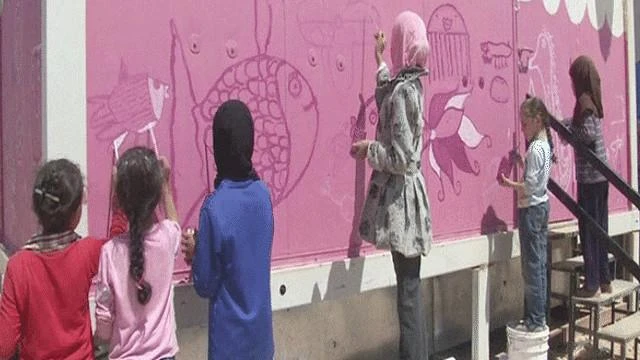
They may have witnessed brutality and war atrocities that would have left permanent scars on their fragile minds. But when it comes to expressing creativity, Syrian children at the Al-Zatari camp in Jordan are virtually setting an example for adults by being positive about life and their dreams as reflected in their drawings and paintings.
The misery that they carry in their hearts gave way to creativity in a drawing exhibition organized by “For Syria” which is on display in Amman.
Inside the camp, a group of 17 kids aged six to 17 trained and drew paintings that reflected their concerns and dreams. Their preparation for the exhibition took 45 days, but at the end of it all, it was well worth it.
Says 12-year-old Salim Ali: “We want to focus on the positive things in a Syrian, and this Syrian is not only a refugee but he can create.”
Tanya Ahmed, another 12-year-old who participated in the drawing exercise, said she and her friends wanted to attend the exhibition and see their paintings, but they were not allowed to leave the camp.
Mahmoud Sadaqa, the project organizer, said: “There is a lot of misery and deprivation in Camp Al-Zatari, but we want to focus on the positive things out there, and to show that Syria is a country of creativity.”
“Esraa Fadel would train the children to paint after her work, and was with them in preparing for the exhibition. They turned one of the caravans into a small painting room, and they brought the necessary colors and tools,” Sadaqa said.
Media Coordinator for the project Melia Aidmoni said the exhibition of paintings will also be displayed in Dubai, and they will be put up for sale, with the proceeds going toward a development project for children in Syria.
Rolla Al-Ejjah, a member of “for Syria,” said organization hoped that the exhibition will be a success in Amman and Dubai. The organization is seeking to educate the children through scholarships to secure a better future for them, she said.
“I noticed that when you give a child a paper and ask him to draw, his immediate instinct is to draw destroyed homes, aircraft bombing and war. They are influenced by those experiences, but we tried to keep out such thoughts on the drawing board,” she said.
She said she regretted the inability of the children to leave the camp and attend their show after the organization worked on their permits. “Things were moving smoothly but it didn’t work out in the last minute,” she said.
“The camp management did not allow the children to accompany us to the show. I am trying to visit them tomorrow in Al-Zatari and show them pictures of the show and guests,” Al-Ejjah said.
Sara Ahmed, a visitor at the exhibition, was interested in seeing the children’s painting since she wanted to know what was going on in their minds and how they see things. “The first thing I expected when I came to the show was to meet the young artists, but was disappointed when I came to know that they couldn’t make it,” she said.
Stating that she was glad that the children could draw vivid details despite the long time spent under difficult conditions in the camp, she said: “They gave me hope for a better tomorrow, they are the future of Syria and this means that there is still hope.”
Despite fatigue and bitterness in some drawings, upholding life was demonstrated in the rest of the paintings through the details of nature and the countryside painted by the little Syrian artists.
Al-Zatari artists highlight a positive Syria