HOMS/BEIRUT: A first group of trapped civilians was evacuated from besieged rebel-held areas of Syria’s third city Homs Friday as Damascus finally confirmed it will join new peace talks next week.
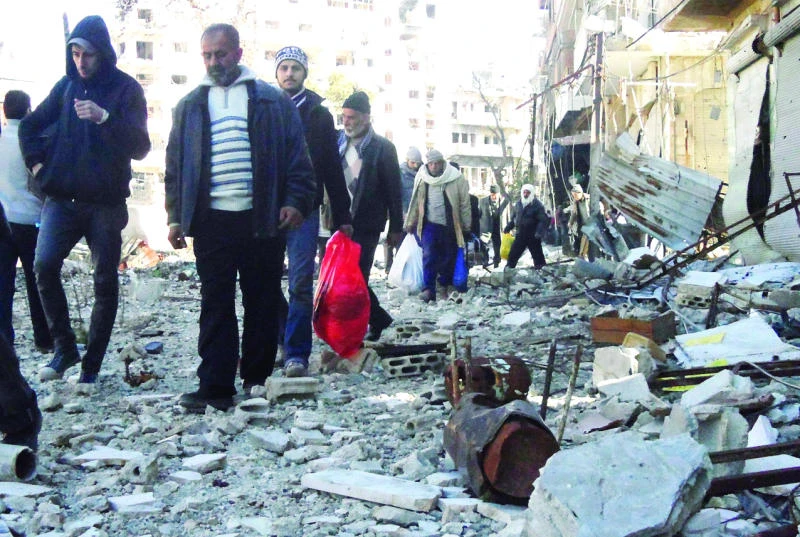
Some 12 civilians came out on the first bus from the rebel enclave which has been under tight army blockade for more than 600 days, an AFP correspondent reported.
The evacuation is part of a surprise deal brokered by the United Nations between the two sides on Thursday after months of negotiations that will also see desperately needed aid delivered to the rebel enclave during a “humanitarian pause” in fighting.
But the first consignment of food and medicines will not go in until Saturday, Homs governor Talal Barazi told AFP.
The relief supplies had been held up in a UN warehouse in a government-held area of Homs just kilometres (miles) away from the rebel-held Old City while the negotiations for relief access dragged on.
About 200 people are expected to leave the besieged area in the first stage of a humanitarian deal to evacuate civilians and allow aid to be delivered, a regional official said.
Speaking to Syrian state television, Homs governor Talal Al-Barazi said the atmosphere was “positive” ahead of the operation which is expected to begin around midday and allow women, children and elderly to leave the besieged old city.
The UN welcomed reports of the agreement on Thursday, although Washington questioned the sincerity of the government’s intentions.
Some 2,500 civilians are trapped under siege, surviving on little but olives and wild cereals, the Syrian Observatory for Human Rights says.
But the first consignment of food and medicines will not reach the hundreds of civilians who have been under army blockade for more than 600 days before Saturday, Homs governor Talal Barazi told AFP.
Most of those on the first bus out were elderly, an activist inside the rebel enclave, who gave his name only as Ghaith, told AFP via the Internet.
“According to our advice from the UN, the number of people expected to leave today (Friday) is nearly 200,” the Homs governor told AFP.
“Tomorrow (Saturday), the first consignment of food and other relief supplies will reach those in need in the Old City,” Barazi said.
The rebel-held Old City and adjacent neighbourhoods have come under near-daily shelling since the army imposed a blockade in June 2012 after recapturing most of Homs in a counter-offensive launched that February.
But the government agreed to observe a “humanitarian pause” and opposition activists in Homs said the rebels had agreed to observe a four-day cease-fire.
In the first year of the uprising against President Bashar al-Assad’s rule that erupted in March 2011, activists had dubbed Homs the capital of the revolution.
But the army’s bloody 2012 assault confined the rebels to a small enclave in the city centre, which was further reduced in a new advance last summer after pro-government forces recaptured the town of Qusayr, cutting off the rebels’ supply route to neighbouring Lebanon.
The enclave’s plight was on the agenda of long-awaited peace talks between the government and the opposition in Switzerland last month, but the talks broke up without a hoped for agreement on access for relief supplies.
It was left to UN representatives in Damascus to broker the deal between the two sides.
The Syrian government had left open whether it would even attend a second round of peace talks due to open on Monday, but deputy foreign minister Faisal Muqdad finally confirmed Friday that Damascus would take part.
“It has been decided that the delegation of the Syrian republic will take part in the second round of negotiations in Geneva,” state news agency SANA quoted him as saying.
“The Syrian delegation wishes to pursue the efforts it deployed during the first round in Geneva, and insists that the discussions focus on all clauses in the Geneva I communique, beginning with the first clause.”
In the first round of talks last month, the two sides failed to agree on a single point despite persistent pressure from UN-Arab League envoy Lakhdar Brahimi, and co-sponsors Russia and the United States.
On Tuesday, Syrian National Coalition chief Ahmad Jarba met Foreign Minister Sergei Lavrov of Russia, a key Damascus ally, in Moscow.
As they met, Russia’s deputy foreign minister indicated that Moscow expected Assad to state firmly his delegation’s intention to join the new talks.
Damascus calls rebels “terrorists,” and insists that the priority in the Geneva talks must be to focus on “terrorism.”
For the opposition, the central point of the negotiations is the transition foreseen in the Geneva I communique.
It was adopted by world powers in 2012 but is ambiguous, in that it calls for an interim government but is unclear on Assad’s future, which Damascus insists is not up for discussion.
On the ground Friday, troops retook most of Aleppo’s prison, lost to rebels a day earlier, in fighting that has killed at least 46 people over two days, the Observatory said.
First group of trapped Syrians evacuated from besieged Homs