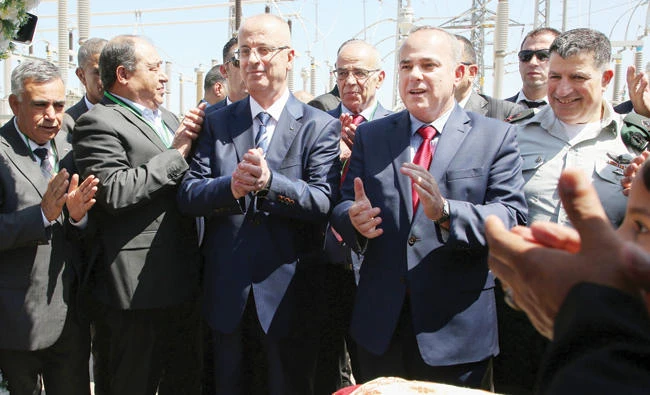
JALAMAH, Palestinian Territories: Energy Minister Yuval Steinitz made a rare appearance by a high-ranking Israeli official in the occupied West Bank on Monday to sign an agreement on electricity with the Palestinian Authority.
Steinitz attended the ceremony in Jalamah near the northern West Bank city of Jenin alongside Palestinian Prime Minister Rami Hamdallah.
They announced a boost in electricity supply in the area that comes with a payment guarantee from the Palestinians and unveiled a new substation.
The ceremony was held with a top adviser to US President Donald Trump, Jason Greenblatt, set to hold another round of meetings in Israel and the Palestinian territories in the coming days.
Trump’s administration has urged Israel to take measures to improve the Palestinian economy as he seeks ways to restart peace talks.
“Of course we hope to achieve peace and security; it is important for all nations — but meanwhile it is important also to improve the infrastructure,” Steinitz said.
Hamdallah said: “We do not want to depend on Israel forever.
“We are about to build a power plant in Jenin that will generate 450 megawatts in the Jenin area. I hope this power plant will start operating in 2020.”
But the ceremony came in stark contrast to a severe electricity shortage in the Gaza Strip, the other Palestinian territory run by militant movement Hamas.
Palestinian President Mahmud Abbas, whose Fatah party is based in the West Bank, has sought to pressure his rivals from Hamas in recent months notably by withholding payments for electricity.
Israel recently reduced its supply of electricity to the Gaza Strip after Abbas slashed the payments.
The cut left the impoverished territory of more than 2 million people with as little as two hours of mains electricity a day.
As an interim measure, Egypt stepped in to deliver fuel to Gaza’s sole power plant, but Hamas at the weekend accused Palestinian Authority of blocking fuel payments to Egypt.
Hamdallah on Monday said: “In 10 years, we have spent more than $15 billion from the Palestinian state’s treasury on Gaza while Hamas collects the revenues and spends it on itself and not on the people.”
Those who can afford electricity have generators to power their homes and businesses in the Gaza Strip.
Israel coordinates with the Palestinian Authority, but not Hamas, which it considers a terrorist organization and has fought three wars since 2008 with Palestinian militants in Gaza.
The Gaza Strip has been under an Israeli blockade for a decade, badly damaging the enclave’s economy, and its crossing with Egypt has also remained largely closed in recent years.
UN officials have called for the blockade to be lifted, citing deteriorating humanitarian conditions, but Israel says it is necessary to prevent Hamas from importing weapons or materials that could be used to make them.
Steinitz attended the ceremony in Jalamah near the northern West Bank city of Jenin alongside Palestinian Prime Minister Rami Hamdallah.
They announced a boost in electricity supply in the area that comes with a payment guarantee from the Palestinians and unveiled a new substation.
The ceremony was held with a top adviser to US President Donald Trump, Jason Greenblatt, set to hold another round of meetings in Israel and the Palestinian territories in the coming days.
Trump’s administration has urged Israel to take measures to improve the Palestinian economy as he seeks ways to restart peace talks.
“Of course we hope to achieve peace and security; it is important for all nations — but meanwhile it is important also to improve the infrastructure,” Steinitz said.
Hamdallah said: “We do not want to depend on Israel forever.
“We are about to build a power plant in Jenin that will generate 450 megawatts in the Jenin area. I hope this power plant will start operating in 2020.”
But the ceremony came in stark contrast to a severe electricity shortage in the Gaza Strip, the other Palestinian territory run by militant movement Hamas.
Palestinian President Mahmud Abbas, whose Fatah party is based in the West Bank, has sought to pressure his rivals from Hamas in recent months notably by withholding payments for electricity.
Israel recently reduced its supply of electricity to the Gaza Strip after Abbas slashed the payments.
The cut left the impoverished territory of more than 2 million people with as little as two hours of mains electricity a day.
As an interim measure, Egypt stepped in to deliver fuel to Gaza’s sole power plant, but Hamas at the weekend accused Palestinian Authority of blocking fuel payments to Egypt.
Hamdallah on Monday said: “In 10 years, we have spent more than $15 billion from the Palestinian state’s treasury on Gaza while Hamas collects the revenues and spends it on itself and not on the people.”
Those who can afford electricity have generators to power their homes and businesses in the Gaza Strip.
Israel coordinates with the Palestinian Authority, but not Hamas, which it considers a terrorist organization and has fought three wars since 2008 with Palestinian militants in Gaza.
The Gaza Strip has been under an Israeli blockade for a decade, badly damaging the enclave’s economy, and its crossing with Egypt has also remained largely closed in recent years.
UN officials have called for the blockade to be lifted, citing deteriorating humanitarian conditions, but Israel says it is necessary to prevent Hamas from importing weapons or materials that could be used to make them.