- Mostafa Kamal Madbouly calls for ‘genuine and comprehensive reform’ of Security Council
- AI should reflect world’s ‘linguistic and cultural diversity,’ with greater Arab and African representation
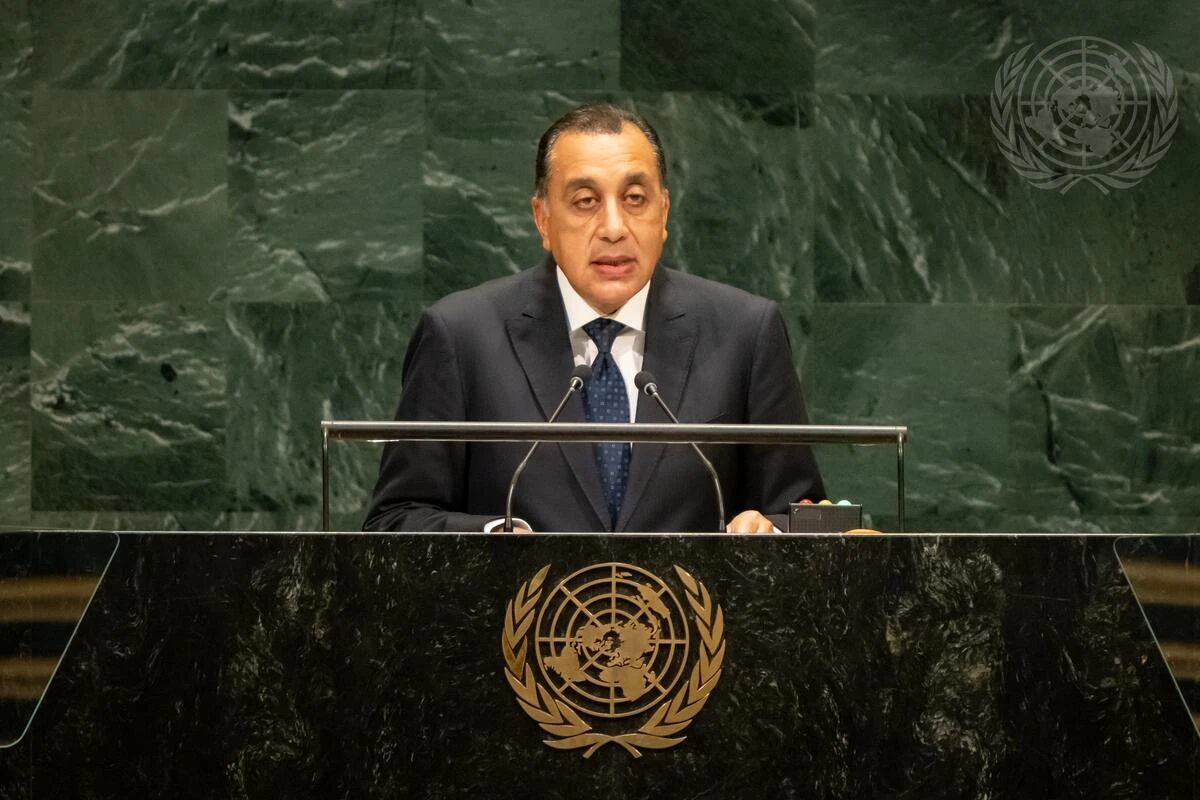
TORONTO: The Palestinian issue remains “the clearest example of the existing dysfunction” in the international system, and the suffering endured by Palestinians must not be allowed to become “a normalized reality or a protracted crisis,” Egypt’s prime minister told the UN General Assembly on Friday.
Securing the Gaza ceasefire, ending Israeli violations, completing troop withdrawals, guaranteeing aid efforts, and enabling recovery and reconstruction are not merely humanitarian steps but also “the essential gateway to a serious political process that addresses the root causes of the conflict and resolves them,” said Mostafa Kamal Madbouly.
Egypt categorically rejects any attempt to displace Palestinians, and holds the international community responsible for stopping “systematic Israeli violations of international law,” he added.
Palestinian rights should be recognized as “inalienable rights, not as bargaining chips to be granted or withheld according to power balances, political posturing or electoral calculations,” he said.
“The experience of our region confirms that managing crises rather than resolving them doesn’t create stability; rather, it postpones the explosion and increases its costs.”
Across the Middle East’s crises, details may differ, but a “capable national state that embraces all its citizens and legitimate institutions remains the only true foundation for stability,” so these crises cannot be treated in isolation, he said.
Madbouly called for a security architecture built on state sovereignty, territorial integrity and political settlements rather than the backing of militias or separatist agendas.
He stressed that Egypt’s water security is “an existential issue that isn’t open to compromise,” and shared water resources should be governed through binding agreements rather than unilateral action.
“The Nile isn’t merely an economic resource; it’s the lifeline upon which the existence and development of Egyptian society has depended throughout history.”
More than 80 years after the UN’s founding, Madbouly said, institutions such as the Security Council “still reflect historical balances that have become outdated. Institutions that were created for a different world can’t maintain full legitimacy and effectiveness if they don’t reflect the world they’re meant to serve today.”
Egypt, therefore, advocates “genuine and comprehensive reform” of the council, particularly to “mend the historical injustice suffered by Africa,” he said, adding that the imbalance in political representation is adjacent to the imbalance in the global economy.
Developing countries are squeezed between debt burdens and the cost of financing development, he said, calling for more representative financial institutions, expanded concessional lending and faster, fairer debt relief.
“Countries shouldn’t be forced to choose between debt servicing and financing education, healthcare, food security and essential infrastructure,” he added. “Development isn’t charity. It’s a right and a shared interest.”
Similarly, artificial intelligence, while promising, could open “a vast new divide in power,” he warned.
Madbouly stressed the need for governance frameworks that treat emerging technologies as a “global public benefit” and “not an exclusive privilege enjoyed by a limited number of states or corporations.”
AI should also “reflect the linguistic and cultural diversity” of the world, giving Arab and African languages fair representation in data and models, he said.
He concluded by reaffirming Egypt’s commitment to “a balanced system of disarmament and non-proliferation free from double standards,” and a Middle East free of nuclear arms and other weapons of mass destruction.
Madbouly said: “Egypt will continue to support every effort that restores trust and effectiveness to our multilateral international system and contributes to managing the transformations of our rapidly changing world in a fair and participatory manner, serving the interests of our peoples and future generations.”