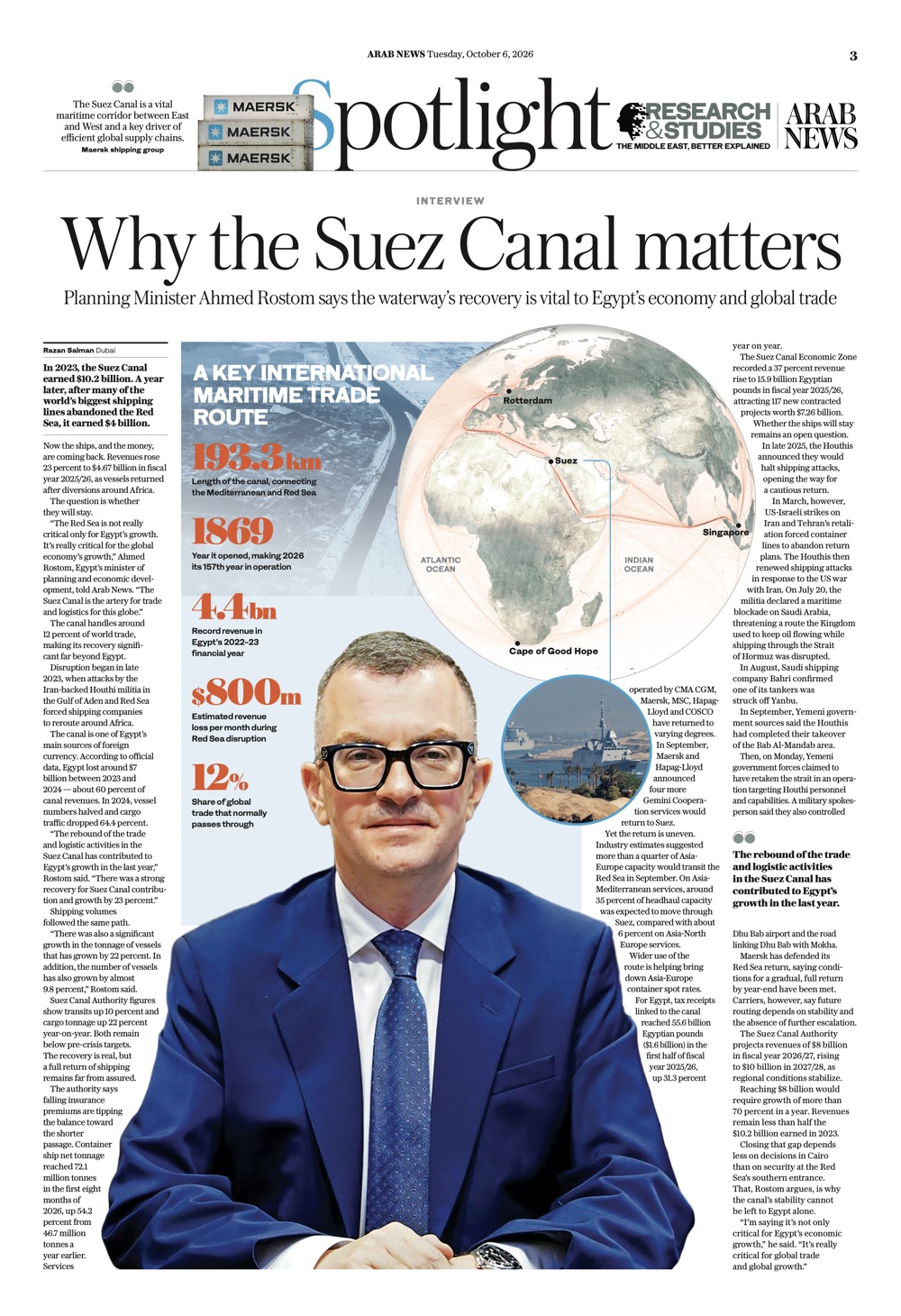
- Ahmed Rostom says the return of shipping is boosting Egypt’s economy after two years of disruption
- But the planning minister warns the canal’s full recovery depends on lasting stability across the Red Sea
CAIRO: In 2023, the Suez Canal earned $10.2 billion. A year later, after many of the world’s biggest shipping lines abandoned the Red Sea, it earned $4 billion.
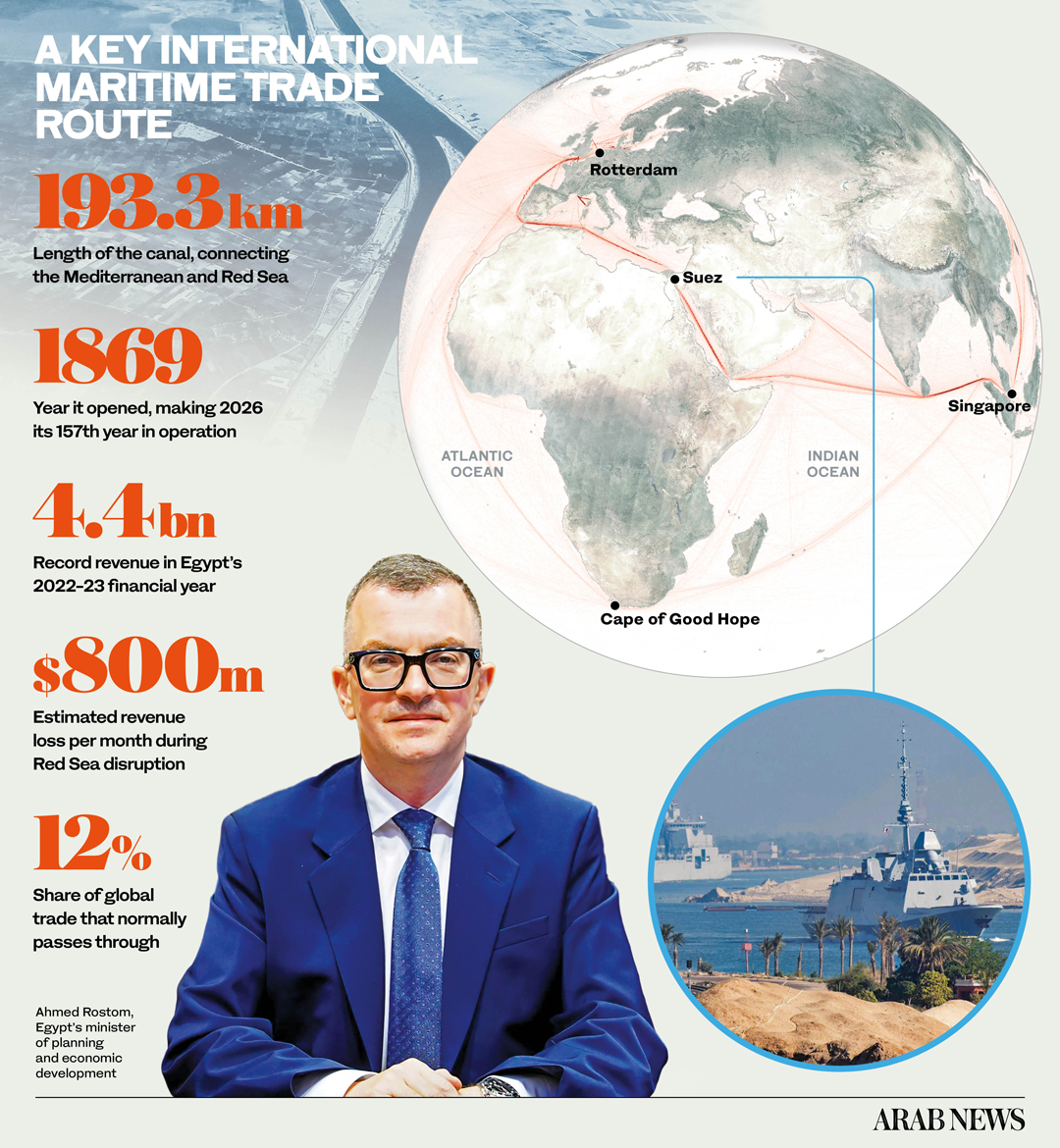
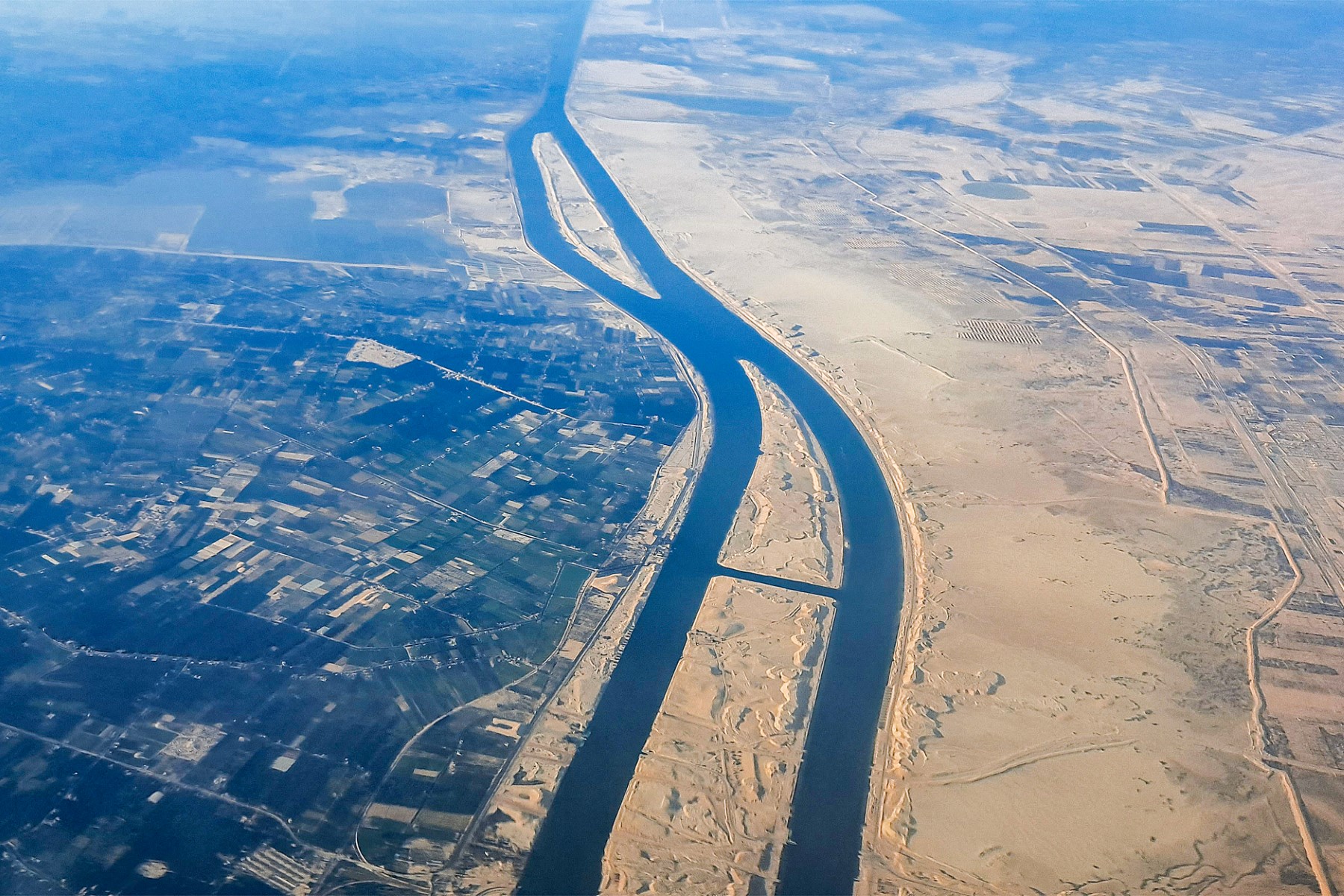
Now the ships, and the money, are coming back. Suez Canal revenues rose 23 percent to $4.67 billion in fiscal year 2025/26, as vessels returned after months of diversions around Africa.
The question is whether they will stay.
“The Red Sea is not really critical only for Egypt’s growth. It’s really critical for the global economy’s growth,” Ahmed Rostom, Egypt’s minister of planning and economic development, told Arab News. “The Suez Canal is the artery for trade and logistics for this globe.”
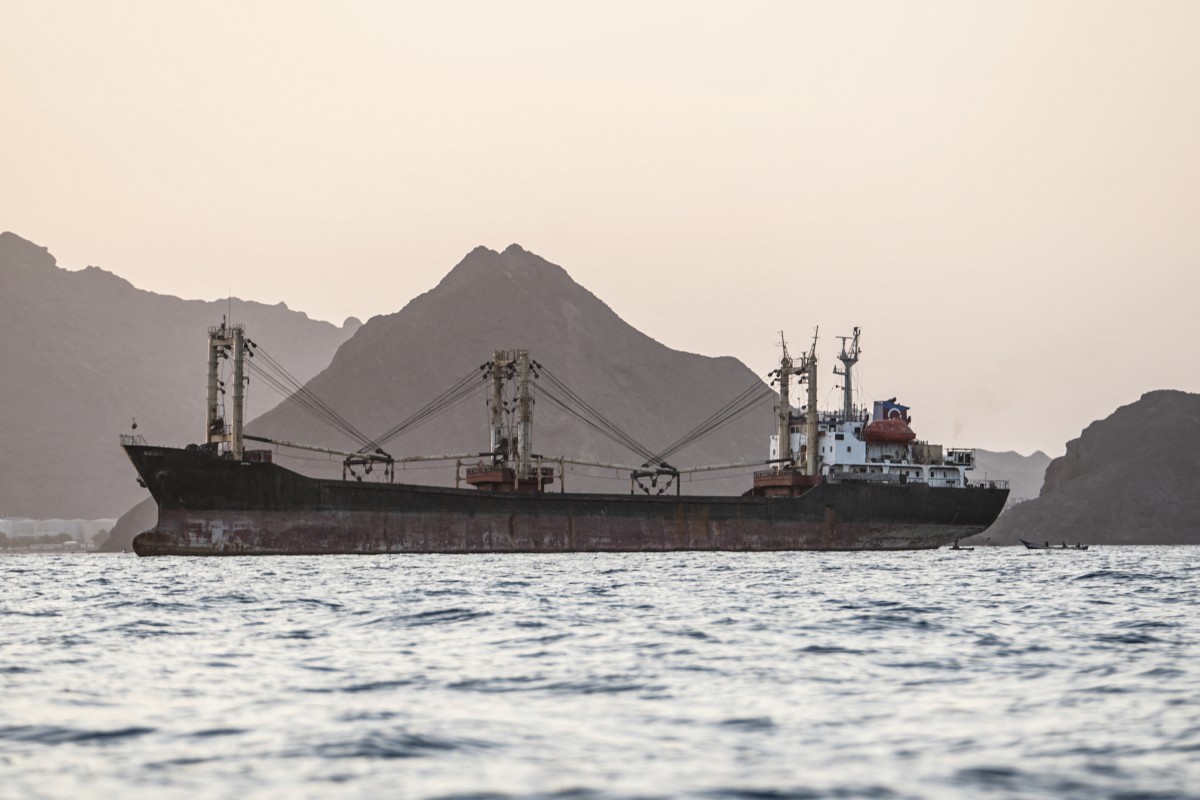
The canal handles around 12 percent of world trade, which is why its disruption was felt so widely, and why its recovery matters just as broadly.
That disruption began in late 2023, when attacks by the Iran-backed Houthi militia in the Gulf of Aden and the Red Sea forced many major shipping companies to reroute around the southern tip of Africa. The militia claimed it was acting in solidarity with Palestinians during the Gaza war.
The cost to Egypt was immediate. The canal is one of the country’s main sources of foreign currency, alongside tourism and remittances.
According to official data, Egypt lost around $7 billion between 2023 and 2024 — about 60 percent of the canal’s revenues. In 2024, vessel numbers halved, and cargo traffic dropped 64.4 percent.
The return of shipping over the past year has begun to reverse that damage. Rostom said the effect was felt across the economy.
“The rebound of the trade and logistic activities in the Suez Canal has contributed to Egypt’s growth in the last year,” he said. “There was a strong recovery for Suez Canal contribution and growth by 23 percent.”
The recovery gathered pace as the year went on. Revenues rose 18.5 percent in the first half of fiscal year 2025/26, and the final quarter of 2025 recorded a further 24.5 percent increase.
Shipping volumes followed the same path.
“There was also a significant growth in the tonnage of vessels that has grown by 22 percent. In addition, the number of vessels has also grown by almost 9.8 percent,” Rostom said.
Suez Canal Authority figures point the same way, showing transits up 10 percent and cargo tonnage up 22 percent year-on-year. Both remain below the canal’s pre-crisis targets — a reminder that the recovery is real but incomplete.
According to the canal authority, falling insurance premiums are now tipping the balance back toward the shorter passage.
Container shipping, which carries much of the trade between Asia and Europe, shows the shift most clearly. Container ship net tonnage through the canal reached 72.1 million tons in the first eight months of 2026, up 54.2 percent from 46.7 million tons a year earlier.
Services operated by CMA CGM, Maersk, MSC, Hapag-Lloyd and COSCO have all returned to varying degrees. In September, Maersk and Hapag-Lloyd announced that four more of their Gemini Cooperation services would move from the Cape of Good Hope back to Suez.
On Sept. 16, the container ship OOCL Portugal sailed through the canal, completing COSCO Shipping Lines’ first southbound passage since the Red Sea crisis began.
Yet the return is uneven. Industry estimates suggested that more than a quarter of Asia-Europe capacity would transit the Red Sea in September.
On Asia-Mediterranean services, around 35 percent of headhaul capacity was expected to move through Suez, compared with about 6 percent on Asia-North Europe services.
Even this partial return is being felt well beyond Egypt. Wider use of the Red Sea route is helping bring down Asia-Europe container spot rates, which is exactly the global dimension Rostom describes.
For Egypt, the gains are already reaching the treasury. Tax receipts linked to the canal reached 55.6 billion Egyptian pounds in the first half of fiscal year 2025/26, up 31.3 percent year-on-year.
The economic zone around the waterway is growing too. The Suez Canal Economic Zone recorded a 37 percent rise in revenues to 15.9 billion Egyptian pounds in fiscal year 2025/26, and attracted 117 new contracted projects worth $7.26 billion.
But whether the ships will stay remains an open question, and the past year has shown how quickly the answer can change.
In late 2025, the Houthis announced they would halt their attacks on shipping, opening the way for a cautious return.
In March, however, US-Israeli strikes on Iran and Tehran’s retaliation forced container lines to abandon plans to return to the Suez route. One leading industry analyst warned at the time that hopes of a large-scale return in 2026 had been shattered.
The Houthis then renewed attacks on Red Sea shipping in response to the US war with Iran.
On July 20, the militia declared a maritime blockade on Saudi Arabia, threatening a route the Kingdom had been using to keep oil flowing while shipping through the Strait of Hormuz was disrupted.
Saudi-linked vessels have since come under attack. In August, Saudi national shipping company Bahri confirmed that one of its tankers was struck off the Red Sea port of Yanbu.
In September, the Houthis tightened their grip on the Red Sea’s southern gateway. Yemeni government sources said the militia had completed its takeover of the Bab Al-Mandab area.
Then, on Monday, Yemeni government forces claimed to have retaken the Bab Al-Mandab strait in an operation targeting Houthi personnel and capabilities.
A military spokesperson also said Yemeni government forces had taken control of Dhubab airport and secured control over the road linking Dhubab with Mokha.
Shipping lines are watching closely. Maersk has defended its return to the Red Sea, saying conditions for a gradual, full return by the end of the year have already been met.
Carriers, however, have made their commitment conditional. Future routing, they say, depends on stability in the Red Sea and the absence of further escalation.
That condition hangs over Egypt’s ambitions for the canal. The Suez Canal Authority projects revenues of $8 billion in fiscal year 2026/27, rising to $10 billion in 2027/28, and expects a fuller recovery as regional conditions stabilize.
Reaching $8 billion would require revenues to grow by more than 70 percent in a single year. Even after this year’s rebound, they remain less than half the $10.2 billion earned in 2023.
Closing that gap will depend less on decisions taken in Cairo than on security at the southern entrance to the Red Sea. That, Rostom argues, is why the canal’s stability cannot be left to Egypt alone.
“I’m saying it’s not only critical for Egypt’s economic growth,” he said. “It’s really critical for global trade and global growth.”