- Salih urged global nations to focus on ending conflicts so that over 117 million displaced people can return home
- He highlighted major ongoing displacement crises, including Sudan (12 million people displaced)
UNITED NATIONS: The UN refugee chief urged the world’s divided nations Friday to focus on ending conflicts and crises so the more than 117 million people forced to flee their homes can return, and not spend generations displaced in a foreign country.
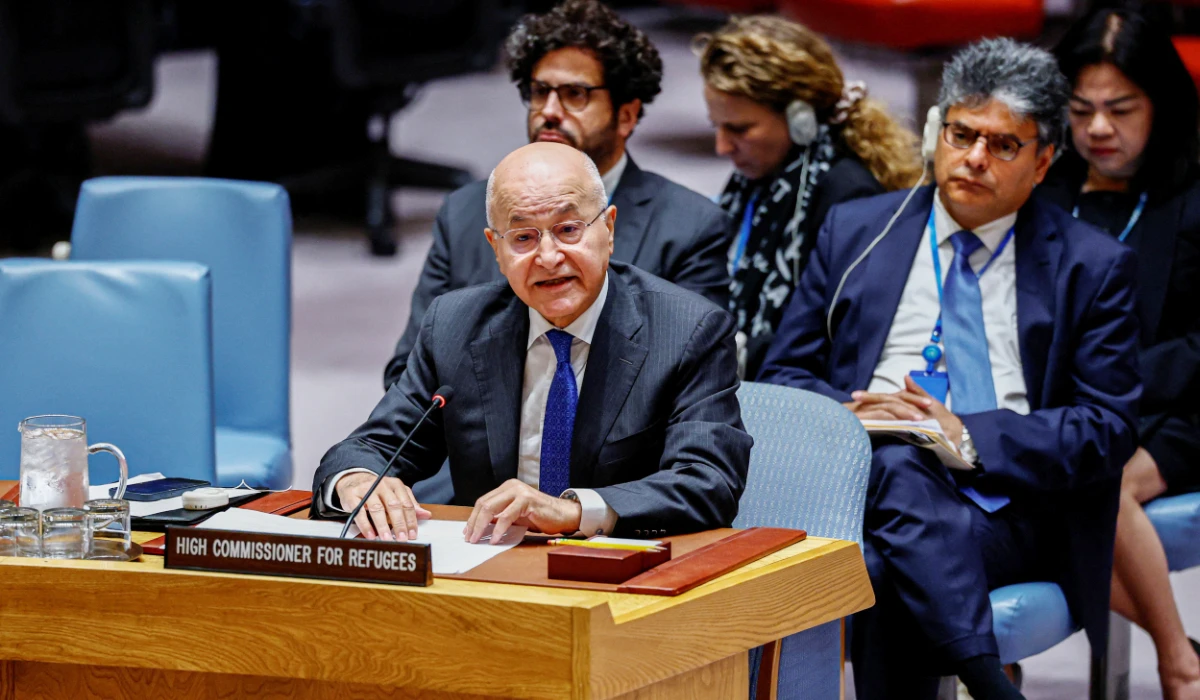
In his first speech to the UN Security Council since his election as high commissioner for refugees last December, Barham Salih told its 15 members that they have “a unique responsibility to help make peace possible.”
“For the millions of people forced from their homes – and the millions more who should never have to flee – I urge you to use that responsibility,” the former refugee, who was president of Iraq from 2018 to 2022, told the meeting on the sidelines of the annual UN gathering of world leaders.
Salih stressed that humanitarians, like those working for the refugee agency known as UNHCR, deal every day with the consequences of conflict, but they can’t create peace. That responsibility under the UN Charter is entrusted to the Security Council which is charged with maintaining international peace and security.
The refugee chief ticked off conflicts that have forced people to flee.
The war in Sudan remains the world’s largest displacement crisis, with 12 million people inside and outside the country, he said. “As long as this war continues, people will continue to flee,” he said.
In Congo, Salih said, “generations have now lived through cycles of conflict and violence,” now compounded by an escalating Ebola crisis. In Ukraine, he said, war has displaced millions inside the country and sent millions more fleeing to other countries.
Generations of refugees from disputed Western Sahara, which Morocco claims, have grown up in camps near Tindouf in neighboring Algeria “facing uncertainty and limited prospects while awaiting a political solution,” he said.
In the latest Mideast escalation, Salih said, UNHCR has mobilized resources and staff to help more than 130,000 Yemenis who have fled recent hostilities and remain in the country, and over 3,700 who have sought safety in Djibouti.
The refugee chief acknowledged that a goal he launched earlier this year to reduce the number of refugees in long-term displacement who rely on humanitarian aid by half by 2035 “is ambitious.” But he stressed that “it must be, because keeping people alive year after year while they remain unable to rebuild their lives cannot be our end goal.”
Success can’t mean becoming better at keeping people caught in war alive for another year, or establishing a new camp in response to a 50-year emergency, he said, and it can’t mean having children inherit displacement from their parents.
“Success must ultimately mean creating the conditions in which people no longer need us,” Salih said. UNHCR’s ambition must be “to prevent displacement where we can, resolve it where it has occurred, and create the conditions in which people can rebuild their lives in safety and dignity.”