- Overseas storage offers the twin advantage of protecting market access during crises and generating commercial value through trading, logistics and distribution
Economic diversification is hardly a new ambition for Gulf economies. It has featured in national development strategies since the late 1960s and early 1970s to reduce dependence on oil and gas revenues, initially through investments in industrialisation, infrastructure and non-oil productive sectors. More than five decades later, however, the concept of economic security is expanding beyond diversifying sources of economic growth and government revenues to diversifying where essential resources are sourced, stored, and accessed, reducing exposure to disruptions in trade corridors and supply chains.
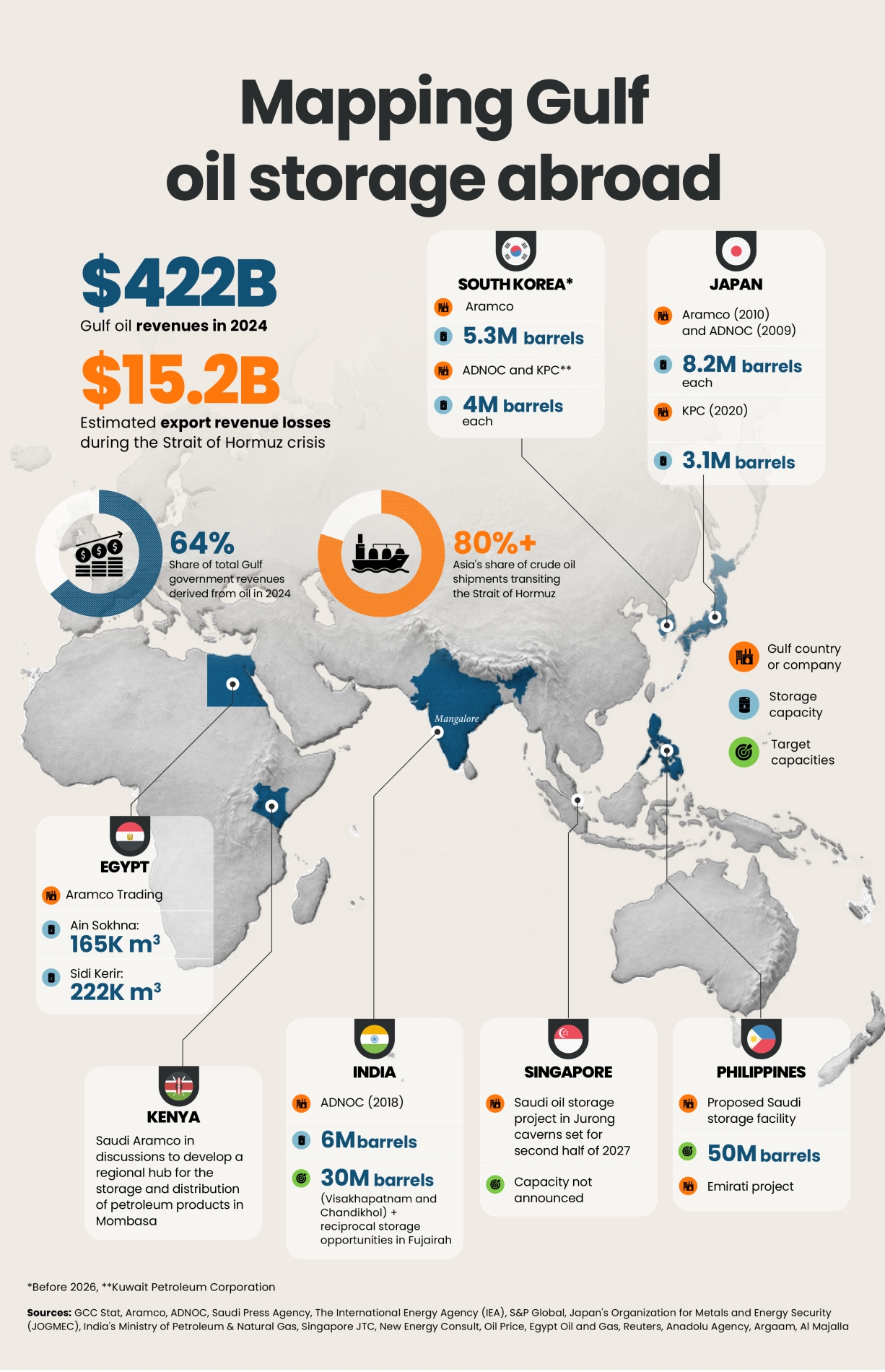
Gulf economies remain heavily dependent on hydrocarbons. In 2024, oil accounted for approximately 64% of total GCC government revenues, generating $422bn compared to $237bn from non-oil sources. As a result, any disruption to hydrocarbon production or export routes extends well beyond energy-sector earnings, pressuring government finances, public investment, and broader economic stability.
This makes the geography of resilience as important as its scale. Energy and economic security increasingly depend on the geographic distribution of reserves, access to foreign markets, and alternative transportation corridors, especially when primary routes fail. Strategic reserves, once treated mainly as emergency insurance, are becoming a core instrument of national and global economic security. GCC states are now acting on this, building reserves and access routes both at home and in strategic destinations abroad.
Lessons learned
The 2026 disruption to the Strait of Hormuz showed that maintaining production capacity is not enough. Securing reliable access to export markets matters just as much. Nearly 30% of global oil and 20% of liquefied natural gas (LNG) exports were disrupted, Brent crude exceeded $100 per barrel, and European gas prices surged by approximately 60%. The IMF downgraded its 2026 global growth forecast by 0.2 percentage points to 3.1%. The crisis demonstrated that disruptions to Gulf energy exports extend far beyond regional supply shortages, generating global economic repercussions through higher inflation, disrupted trade, weaker industrial production and increased financial market volatility.
Exposure and vulnerabilities differed among Gulf exporters. Saudi Arabia and the UAE are the only Gulf producers with existing pipelines that can substantially bypass Hormuz. Saudi Arabia’s East-West line to Yanbu on the Red Sea, rated at up to 7 million b/d, and the UAE’s Habshan–Fujairah line to the Gulf of Oman, at around 1.5-1.8 million b/d. Kuwait, Qatar and Bahrain had no alternatives. Gulf producers reliant on the strait saw shipments fall by more than a third in the first month, with export revenues down an estimated $15.2bn. The crisis led to four lessons.
1. Pipelines are not sufficient. Bypass routes cover only part of Gulf exports, much of the rated capacity is already in use, and the terminals and alternative pipelines remain vulnerable and sit within range of regional threats.
2. Financial buffers are also not sufficient. Fiscal and sovereign reserves can absorb a revenue shock, but they cannot sustainably safeguard revenues or protect market access.
3. Customer relationships are at stake. Asian buyers that lose Gulf supply for weeks will diversify, reducing Gulf producers’ market share.
4. Vulnerability runs in both directions. Hormuz is also a passage for much of the Gulf’s imported food and industrial inputs, also threatening food security and manufacturing.
The scale of the shock is therefore now prompting a strategic rethink across the region.
Asia focus
Asia is emerging as the centre of Gulf overseas strategic reserves. Asia is the Gulf's largest energy export market, accounting for more than 80% of crude oil shipments passing through the Strait of Hormuz. The region's heavy dependence on Gulf supplies, coupled with longer shipping distances from alternative producers, makes it particularly vulnerable to disruptions. For Gulf exporters, positioning strategic reserves closer to Asian customers helps safeguard market access, reduce delivery times, and strengthen long-term commercial relationships.
Japan and South Korea provide the clearest operational precedents. Japan has hosted joint crude stockpiling arrangements with Saudi Arabia and the UAE since 2010 and 2009, respectively, and with Kuwait since 2020. Under these agreements, Saudi Aramco and ADNOC each have approximately 8.2 million barrels of contractual storage capacity, while Kuwait Petroleum Corporation (KPC) has 3.1 million barrels. The producers use these inventories commercially during normal conditions, while Japan retains preferential purchasing rights during emergencies.
South Korea operates a comparable model through Korea National Oil Corporation. Existing arrangements, predating 2026, provide approximately 5.3 million barrels of storage for Saudi Aramco and 4 million barrels each for ADNOC and KPC. In July 2026, ADNOC further expanded its energy security cooperation with South Korea, covering long-term crude supply, emergency coordination and additional strategic stockpiling opportunities.
India represents another strategic destination. ADNOC has stored crude at Mangalore since 2018, with capacity of approximately 6 million barrels. In May 2026, ADNOC and Indian Strategic Petroleum Reserves Limited agreed to explore expanding ADNOC's total storage capacity to 30 million barrels, including potential facilities at Visakhapatnam and Chandikhol. The agreement also envisages reciprocal storage opportunities in Fujairah, potentially allowing India to maintain strategic reserves in the UAE.
New partnerships could extend this network across Southeast Asia. In October 2026, Saudi Arabia and Singapore announced plans to store Saudi crude in the Jurong Rock Caverns, a facility with approximately 9 million barrels of total capacity. Operations are expected to begin in the second half of 2027, although the Saudi allocation remains undisclosed.
The Philippines is also exploring arrangements with Saudi Arabia and the UAE. Discussions include a proposed 50 million-barrel Saudi-backed facility in Bataan and a UAE proposal involving producer-owned storage with emergency access for the Philippines. Both projects remain at a preliminary stage.
These arrangements are transforming overseas reserves into instruments of mutual economic security: importing countries gain access to emergency supplies without necessarily financing the full inventory, while Gulf producers strengthen their market presence and retain commercial flexibility. However, the protection they offer remains time-limited and depends on available inventories, contractual access rights and the ability to replenish stocks during prolonged disruptions.
Not all overseas storage is a strategic reserve. Commercial hubs are built to move products among multiple customers, support blending and trading, and earn revenue from throughput. Their inventories carry no automatic emergency access rights. A facility can serve both purposes, but only where its contracts and operating design allow it.
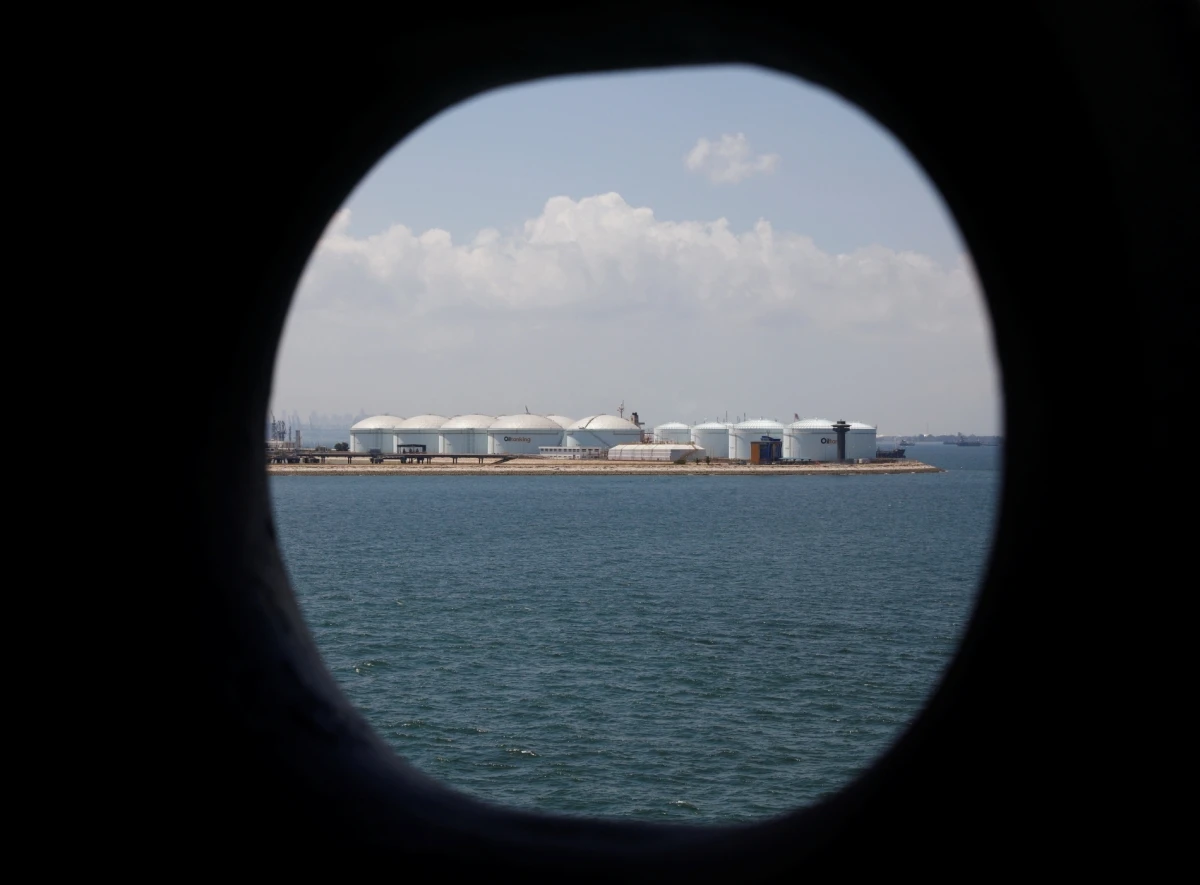
Singapore illustrates the distinction. In January 2026, ADNOC Global Trading reportedly leased around 160,000 cubic metres of fuel oil storage at Jurong Port Universal Terminal, a trading position rather than a reserve. In April 2025, the UAE, India and Sri Lanka signed an MoU to develop Trincomalee as an energy hub, covering tank farm rehabilitation, bunkering, a pipeline to India and a possible refinery. In August 2026, Pakistan approved revised bonded storage rules allowing foreign suppliers to hold fuel in the country, with Saudi Aramco and Kuwait Petroleum Corporation among the reported interested companies. Interest exists, but these projects have yet to move into committed projects.
The economic calculation is shifting from the cost of storing reserves to the value of maintaining market access. Traditionally, importing countries have maintained petroleum inventories to cushion supply disruptions, with limited financial returns. For Gulf exporters, however, overseas storage offers a dual advantage: 1) protecting market access during crises, and 2) generating commercial value through trading, logistics and distribution.
Four investment models
Four investment models are emerging. Each distributes costs, ownership, commercial returns and emergency access rights differently.
1. Commercial capacity leasing. ADNOC Global Trading’s Singapore lease is the lightest model: no capex, flexible tenure, inventory managed as a trading book. It buys speed and optionality, not sovereignty.
2. Producer-held stocks in host-country strategic facilities. Saudi Aramco, the Singapore Energy Market Authority, and JTC Corporation’s agreement allows the producer, Aramco, to store its crude in the host’s strategic caverns, trade it commercially on regular terms, and give the host access during supply emergencies. The host saves on filling costs; the producer gains a forward position in its biggest market.
3. Producer-owned, producer-funded facilities. The Saudi and UAE proposals to the Philippines go further. The Gulf party finances construction and, in the UAE case, retains ownership, while Manila gets guaranteed emergency access. A capital outlay that buys a durable claim on a market and a strategic relationship.
4. Co-developed hubs. Pakistan’s bonded storage combines Gulf capital with host-country land, ports and pipelines, often alongside traders. These are logistics bets as much as security plays, and their returns depend on volumes.
Gulf producers are also using domestic infrastructure monetisation to release capital. Kuwait Petroleum Corporation’s July 2026 Project Peregrine lease-and-leaseback of crude pipelines was reported as a $16bn transaction with $7.85bn in upfront proceeds to support capital expenditure plans. It does not itself finance overseas reserves, but illustrates how long-dated infrastructure cash flows can attract institutional investors and free corporate liquidity for other priorities.
African ports
Africa offers Gulf producers a further route to diversify, particularly through ports serving several importing countries. Aramco Trading already operates storage at Ain Sukhna and Sidi Kerir in Egypt, but East Africa remains largely untapped.
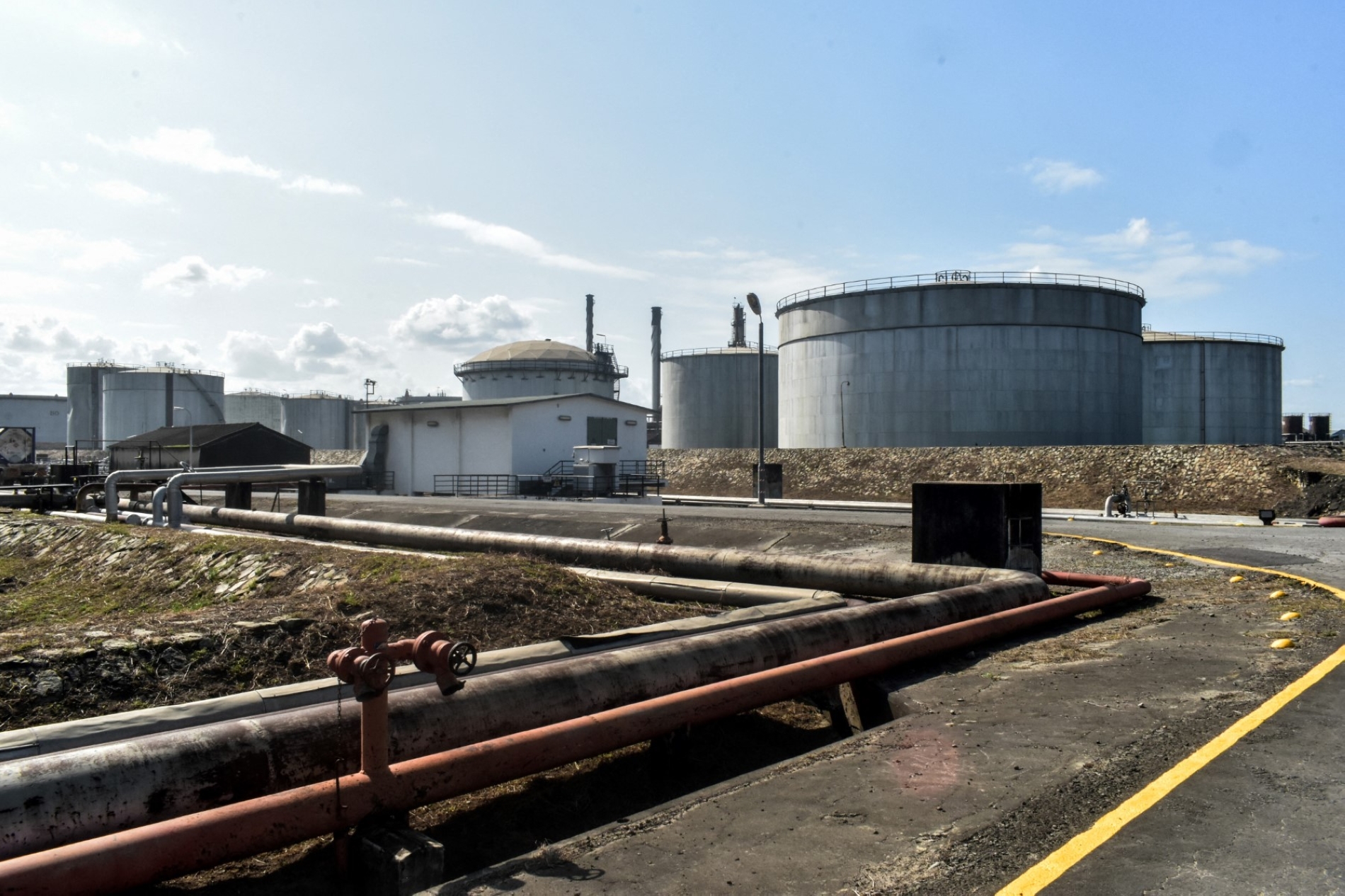
Kenya’s Mombasa port is one potential destination. It fits the “co-developed hubs” model discussed earlier. In 2025, Kenyan media reported that Aramco Trading Fujairah was in talks with the government about investing in storage and developing Mombasa into a hub supplying East Africa through transshipments. The talks build on a 2023 government-to-government deal under which Aramco and ADNOC supply Kenya with fuel on 180-day credit. Kenya Pipeline Company, which acquired the former Kenya Petroleum Refineries site in 2023, plans to use its 45 tanks, with a combined capacity of 484 million litres, for a trading hub and strategic reserves.
For Gulf producers, Mombasa offers growing markets beyond Asia. For Kenya, it promises more reliable supply. However, the Aramco investment remains unconfirmed, and it would hold mainly refined products rather than crude stockpiles. It also does not address the current key exposure, as cargoes bound for Mombasa still transit Hormuz or Bab al-Mandab.
From what to where
Diversification is no longer only about what Gulf economies produce, but where they hold essential resources and how reliably they can reach markets in a crisis. Strategic reserves sit at the centre of this shift. Overseas storage in Asia, emerging hubs in Africa and bypass routes are turning reserves into an investment in market access, commercial relationships, and growing influence. Yet none of these instruments works alone. Stocks abroad are finite, bypass capacity is limited, and the supply chain is only as strong as its most exposed link.
Resilience will depend less on the size of any single reserve than on how well the region's pipelines, hubs and partnerships work together when the next disruption comes.