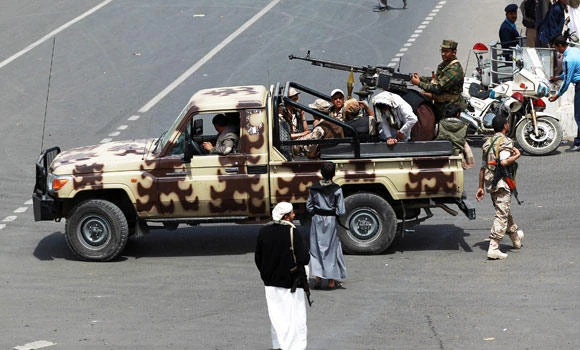
SANAA: Shiite rebels who recently overran Yemen’s capital on Tuesday seized control of a key port city on the Red Sea and a province south of Sanaa in a stunning new blitz that is certain to deepen the country’s turmoil, security and military officials said.
The land grab indicates the rebels, also known as the Houthis, may be determined to carve out a mini-state within Yemen, taking advantage of the weakness of the central government and the disarray in the army and security forces.
Yemen analysts say the Houthis, who are widely suspected of being supported by Iran, may be building on the momentum gained from their recent battlefield successes — only months ago no one had thought they would seize the capital, Sanaa — to snatch more territory. Apart from Sanaa, they also have taken control of the provinces of Saada and Omran to the north.
On Tuesday, the rebels pushed into the Red Sea port city of Hodeida, located west of Sanaa and the capital of a province with the same name, which they had besieged for days, said Yemeni officials.
The rebels set up checkpoints and deployed forces at all entry points to the city, its airport and seaport, and were also in control of several military bases inside Hodeida, 200 km from Sanaa. They also deployed armed supporters outside key state installations in the city, whose population is estimated at about 1 million.
The officials said the Houthis also raided a seaside residence belonging to their long-time adversary, Gen. Ali Mohsen Al-Ahmar, who commanded Yemen’s elite 1st Armored Division and took part in fighting against the rebels between 2004 and 2010.
Al-Ahmar, linked to the rebels’ foes in the Sunni Islah Party, has been on the run since the fall of Sanaa on Sept. 21.
South of Sanaa, the Houthis took Damar province and its provincial capital, also called Damar. The officials said soldiers and police vanished from Damar city streets and have now been replaced by armed Houthis.
The capture of Damar appeared to have been made possible with help from the local Al-Maqadshah tribe, known to be loyal to Ali Abdullah Saleh, Yemen’s president of 33 years who stepped down in 2011 but retains vast influence among tribes and the military.
Meanwhile, tens of thousands of people demonstrated in the southern port city of Aden on Tuesday, calling for secession from the north of the country. On Tuesday, the protesters in Aden burned images of Abdul-Malik Al-Houthi, the movement’s current leader, and of Saleh, the former president. Meanwhile, hundreds of protesters demonstrated on the streets of Sanaa to call on the armed Houthis to leave the capital.
Yemen rebels grab port city